What a Visitor Does When Their State Issues No Plate
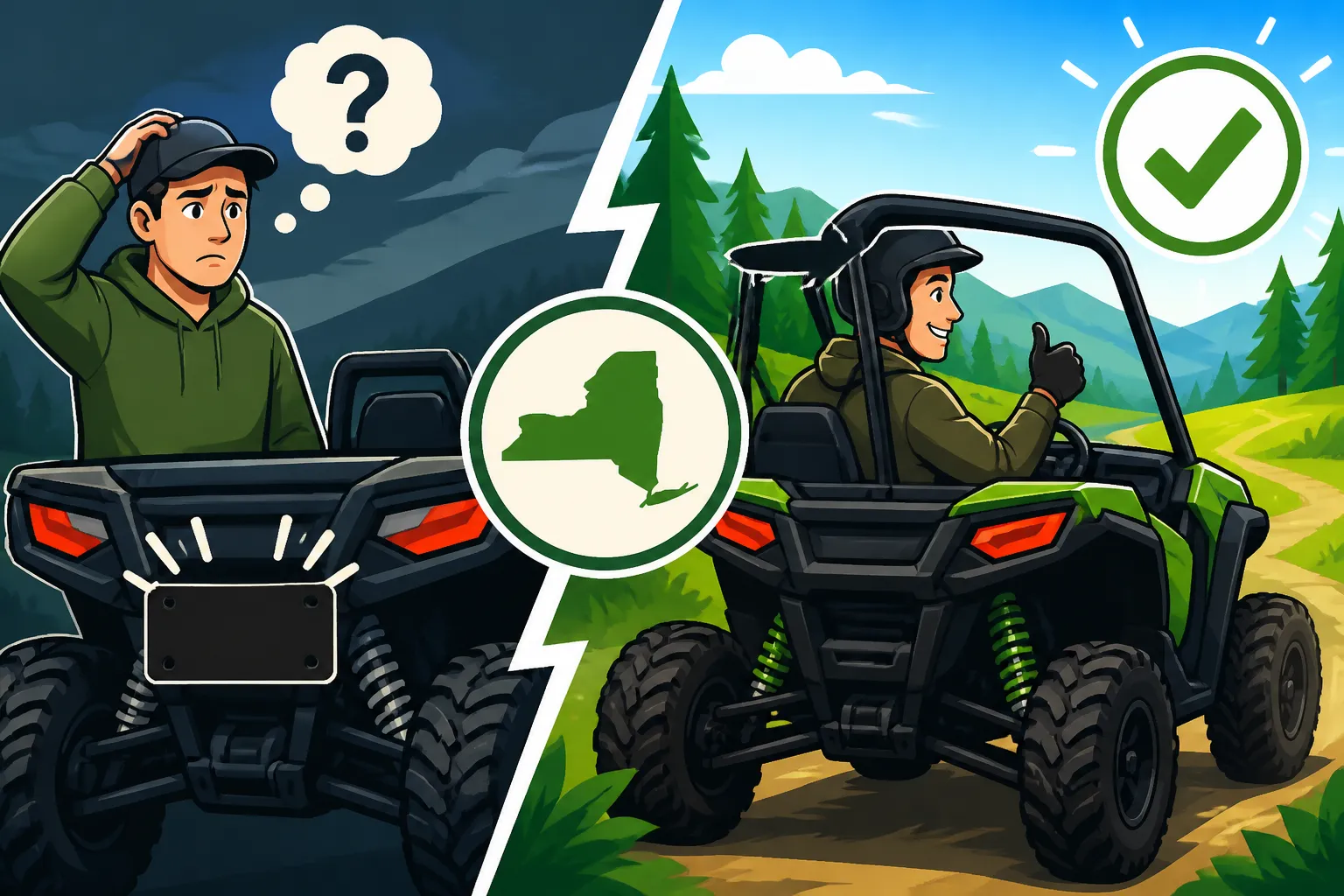
A visitor whose home state does not register ATVs cannot rely on New York’s out-of-state registration rule: there is no valid home-state registration to recognize. Before riding, the visitor must obtain a New York ATV registration, then meet New York’s insurance and riding-location rules. The practical challenge is arranging registration before the trip instead of arriving with an unregistered machine.
Why a home-state plate is not enough
New York honors valid out-of-state ATV registrations. But that recognition depends on having a valid registration in the first place. If your state does not require ATV registration and does not issue a plate or registration document for your machine, you do not have a home-state registration that New York can honor.
According to the New York State Department of Motor Vehicles (DMV), an operator whose home state does not require ATV registration must obtain a New York State ATV registration before operating in New York. In other words, the absence of a plate at home is not an exemption from New York’s registration requirement.
That distinction matters for visitors planning to ride a machine they brought from home. A sales receipt, a home-state document saying registration is not required, or a plate from another vehicle does not substitute for a New York ATV registration. If you are unsure whether your state’s paperwork counts as a valid ATV registration, check with the DMV before travelling. See New York Reciprocity for Out-of-State Registrations and Does New York Honor an Out-of-State Registration? for related questions.
| Your situation | What it means in New York |
|---|---|
| Your home state issued a valid ATV registration | New York honors valid out-of-state ATV registrations, according to the DMV. |
| Your home state does not require ATV registration | You must obtain New York ATV registration before operating the ATV in the state, according to the DMV. |
| Your home state has paperwork but no plate | Confirm with the DMV whether the document is a valid ATV registration; do not assume it qualifies. |
| Your machine may not meet New York’s ATV definition | Confirm its classification before applying or planning to ride. |
Registration is only one part of making a trip lawful. It does not automatically give you permission to ride on a trail, public land, private property, or a road. The place where you plan to ride has its own access rules, and the machine must meet the applicable New York requirements.
Check that the machine fits New York’s ATV definition
According to the New York State Department of Motor Vehicles, an ATV is a self-propelled vehicle manufactured for off-highway use that is no wider than 70 inches and weighs no more than 1,000 pounds. If your vehicle is wider or heavier, do not assume it can be registered as an ATV under New York’s rules. Check its classification with the DMV before you invest time in a registration application or make travel plans.
This is especially important for visitors travelling with a larger side-by-side or another machine that their home state treats as an ATV. A vehicle’s label or home-state registration category does not, by itself, confirm that New York will treat it the same way. For more detail on the measurements, see New York ATV Width Limit for Registration and New York ATV Weight Limit for Registration.
How to arrange New York registration before riding
The most useful step is to resolve registration before loading the machine or setting out. Start by confirming that the vehicle fits New York’s ATV definition and that your home-state documents do not amount to a valid ATV registration. Then ask the DMV which registration process and paperwork apply to a visitor in your situation.
The DMV says a valid New York State ATV registration is required unless a specific exemption applies. The rule for a visitor from a state with no registration program is clear: obtain New York registration before operating in New York. Do not treat a call, an application in progress, or a receipt for paperwork as permission to ride unless the DMV confirms that it is sufficient.
Use this sequence to avoid arriving with an unresolved registration problem:
- Identify the vehicle accurately. Confirm its width, weight, and off-highway purpose against New York’s ATV definition. If its status is uncertain, ask the DMV before applying.
- Check what your home state issued. If you have a registration document, determine whether it is an actual valid ATV registration. If your state has no ATV registration requirement, plan on applying in New York.
- Ask the DMV what documents to submit. The paperwork can depend on the machine and how you acquired it. Use the current instructions for your particular situation rather than relying on an unrelated form or another visitor’s experience. The checklist in New York ATV Registration Paperwork may help you identify what to ask about.
- Complete the New York registration process before riding. If you are not sure how to submit the application as a visitor, confirm the available options with the DMV. Where to Register an ATV in New York covers the registration location question.
- Carry the registration document when you ride. According to the DMV, ATV operators must carry the registration document while operating the machine. The DMV also says the license plate must be attached to the rear of the ATV and the registration sticker placed on the right side of the plate.
- Arrange insurance and access separately. Registration does not replace liability insurance or permission to use a trail or property.
If you are travelling with more than one machine, check each one individually. A registration for one ATV should not be treated as covering another machine. Similarly, do not assume that a companion’s registration or plate can be moved to your ATV.
New York registrations have their own renewal cycle. According to the DMV, new and used ATV registrations first registered in New York expire each year on August 31. ATVs originally registered before April 1, 2005, continue to expire annually on April 30. A visitor should confirm the registration’s expiration date and plan accordingly, especially if a trip spans a renewal period. More information is available in New York’s Annual ATV Registration and When a New York ATV Registration Expires.
A registration document is one of the papers you may need to show while riding. Keep it protected from rain, mud, and damage; a waterproof document sleeve from a retailer such as Amazon can help keep papers together, but it does not replace the official registration document.
Insurance, access, and other rules still apply
Getting a New York registration does not make every riding location legal. According to the DMV, liability insurance is required to operate an ATV anywhere in New York State except on your own property. The DMV also says proof of insurance must be shown to a judge, police officer, or person making a claim of injury or property damage. Do not assume that your home policy meets New York’s requirement; confirm coverage with your insurer before the trip. See New York ATV Insurance Requirement and Does an Out-of-State Policy Satisfy New York’s ATV Rule?.
Access depends on where you intend to ride:
- Public highways: According to the DMV, ATVs may not be operated on public highways unless the highway has been designated and posted for ATV use. A registration does not make an ordinary road open to ATV riding.
- Public lands: The DMV says ATVs may be operated on public lands where signs indicate that ATV use is allowed. Check the rules and signs for the specific area rather than assuming that public ownership means motorized access is permitted.
- Private property: The DMV says you may operate an ATV on private property only with the property owner’s permission. A campsite booking, trail map, or invitation to visit does not necessarily establish permission to ride across every part of the property.
- State Forest land: The New York State Department of Environmental Conservation says ATV use on State Forest Lands is unlawful unless the route is specifically designated by posting or permit. Do not treat an existing snowmobile trail, an abandoned road, or an unmarked route as open to ATVs without confirmation.
These access limits can affect a visitor’s plans as much as registration does. Before travelling, identify the actual riding area and check its current rules, trail status, and permission requirements. A machine can be properly registered and insured yet still be prohibited from the route you intended to use. [New York Rules for a Visiting Rider] and [New York Rules for Riding Public Land] provide more context.
The DMV also says a driver license is not required to operate an ATV in New York State, but restrictions apply to younger operators. All operators and passengers must wear a USDOT-approved helmet, according to the DMV. These are separate requirements from registration, so a visitor should not assume that being old enough to ride at home or having a home-state safety card resolves every New York rule.
Before departure, use this final check:
- Confirm the vehicle meets New York’s ATV definition.
- Obtain New York registration if your home state does not require ATV registration.
- Carry the New York registration document while operating the ATV.
- Attach the required plate and place the registration sticker as directed.
- Confirm that liability insurance covers operation in New York.
- Verify that the specific route or property allows ATV use.
- Check the rules for the riders and passengers travelling with you.
The key point is simple: New York recognizes a valid registration from another state, but a visitor whose state issues no ATV registration must obtain New York registration before riding. Handle that requirement before the trip, and check insurance and access as separate questions rather than treating a plate as permission to ride anywhere.
Sources
- New York State Department of Motor Vehicles — Register an ATV | NY DMV (checked November 3, 2026)
- Department of Motor Vehicles — ATVs: Information for Owners and Operators | NY DMV (checked November 3, 2026)
Disclaimer
This article is for general informational purposes only and does not constitute professional advice. Laws, prices and regulations vary by location and change over time. Consult a qualified professional for guidance on your specific situation.