New York Rules for a Rider Under 14
A child under 14 cannot simply join an adult on a New York ATV trail. The rules depend on age, where the machine is being ridden and who owns the land. Here’s how to understand the limits for riders ages 10–13, what adult supervision means in practice, and which safety and equipment requirements still apply.
Where a rider under 14 may operate an ATV
In New York, a child younger than 10 may not operate an ATV. A rider who is 10, 11, 12 or 13 is generally limited to operating on private property owned or leased by the child’s parent or guardian. The child must also be under adult supervision.
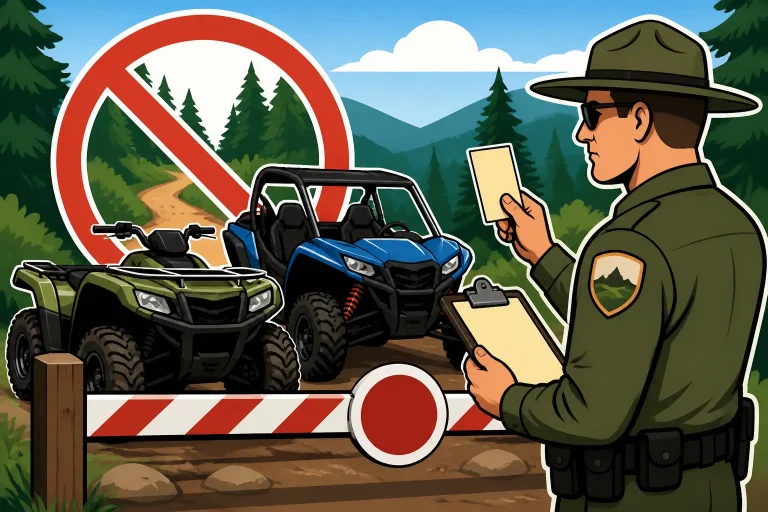
That restriction matters when planning a ride. Having a landowner’s permission does not necessarily make a property eligible for a rider under 14. For this age group, permission to use someone else’s private land is not a substitute for the parent-or-guardian land requirement. Public ATV trails, public land and roads are not places for a rider under 14 to operate a machine.
| Rider’s age | General rule for operating an ATV in New York |
|---|---|
| Under 10 | May not operate an ATV |
| 10–13 | Limited to qualifying private property owned or leased by a parent or guardian, with adult supervision |
| 14–15 | Different rules apply; a safety certificate may be required for some riding situations |
| 16 and older | Age-specific rules for younger riders no longer apply, but other riding laws still do |
The table is a starting point, not permission to ride anywhere on eligible land. Local restrictions, property rules and other ATV requirements can still affect what is allowed. For the broader age framework, see New York Minimum Age to Ride an ATV and New York Rules for Riders Under 16.
Private property is not the same as public riding access
A private field or trail can be suitable for a young rider only if it fits the age-specific rule and the property owner allows the activity. A road, public trail or state-managed recreation area does not become an allowed riding place simply because an adult is present.
The distinction can be easy to miss at a large property. A route might start on qualifying private land and continue onto a public trail, a town road or land owned by someone else. The rider’s age does not change when the route crosses a boundary, so plan a route that stays within the permitted area. If the property has shared access roads or adjoining trail connections, confirm exactly where they go before riding.
Permission matters even on private property. A parent or guardian should establish who owns or leases the land, what areas the child may use and whether any gates, roads or neighboring parcels are off limits. New York’s general rules for land access are covered in New York Rules for Riding Private Land.
An adult’s presence does not expand the permitted area
Adult supervision is part of the rule for a rider ages 10–13, but it does not turn a prohibited location into a permitted one. An adult riding alongside a child on a public trail does not create an exception to the age limit. Nor does an adult following in a truck, waiting at the trailhead or being reachable by phone make the ride appropriate.
Treat supervision as active. The supervising adult should be close enough to monitor the child, respond if something goes wrong and help prevent the rider from leaving the approved area. A child should not be sent ahead around a blind corner or allowed to continue out of sight where the adult cannot intervene.
Adult supervision and choosing a suitable machine
The supervising adult should be capable of focusing on the young rider rather than managing several machines, navigating an unfamiliar route or riding far ahead. Before the engine starts, agree on a simple route, where the child must stop and what to do if the adult or child becomes separated.
A young rider also needs a machine that fits their ability and physical size. New York’s age rules do not replace sensible equipment selection. A machine that is difficult for a child to reach, control or stop can be dangerous even when the ride takes place on permitted land.
Fit the machine to the rider, not just the rider’s age
Check that the child can sit comfortably, reach the controls and operate the brakes without shifting into an unstable position. They should be able to steer and stop smoothly, understand the throttle and keep both feet properly positioned. If they cannot do those things reliably while stationary and at low speed, they are not ready for a moving ride on that machine.
Do not rely on engine size alone when deciding whether an ATV is appropriate. Handling, weight, throttle response, braking and the child’s experience all matter. Follow the manufacturer’s age and use guidance, and do not assume that a larger machine is safe just because the child has ridden a smaller one.
For a first ride or a change to a different machine, use a controlled area with clear visibility and no traffic, steep drop-offs or hidden obstacles. Keep the pace slow enough for the child to stop on request. Avoid carrying cargo that interferes with the rider’s position or controls.
Set ground rules before riding
A short pre-ride discussion can prevent a child from interpreting the adult’s silence as permission to go faster or farther. Set expectations in plain language:
- Stay within the agreed boundaries and keep the supervising adult in view.
- Stop when asked, and stop if the machine feels difficult to control.
- Do not carry a passenger or let anyone else take the controls.
- Do not ride near people, animals, buildings, water or obstacles without adult direction.
- Stop and wait if separated rather than trying to find another route.
Keep the group small enough that the adult can supervise effectively. If the adult is also operating an ATV, the pace and route should allow them to watch the child rather than simply follow from behind.
Safety and equipment rules still apply
The private-property age exception is not a general exemption from New York ATV rules. It does not waive applicable helmet requirements, safe operation requirements or other rules that apply to the machine and ride. Check the rules that fit your situation, including New York Helmet Law for ATV Riders, New York Equipment Requirements for ATVs and New York ATV Insurance Requirement.
Wear a properly fitted helmet
A child should wear a helmet that fits securely and is appropriate for ATV use. A helmet that shifts, sits too high or blocks the rider’s view is not a good fit. Goggles or other suitable eye protection can help protect against dust and debris, but they do not replace a helmet.
When comparing helmets, including options on Amazon, check that the product is intended for the activity, fits the child and meets applicable safety standards. A low price or a familiar appearance is not a substitute for fit and proper use. Recheck fit as a child grows; a helmet that fit last season may no longer fit properly.
Use clothing and footwear suited to the conditions. Long sleeves, long pants, gloves and sturdy over-the-ankle footwear provide more protection than everyday clothes and open shoes. Keep loose clothing, straps and hair away from moving parts.
A private-property ride still needs responsible use
Stay away from public roads unless the law and the specific road conditions allow the activity. A child under 14 should not use a road as a shortcut between two private areas. Avoid operating near other people, livestock, pets or active farm equipment, and leave enough space to stop without swerving.
Never let a child ride after consuming alcohol or drugs, and do not allow an adult who is impaired to supervise. Check the machine before each ride: controls and brakes should work, tires should be in suitable condition, and there should be no leaking fuel or other obvious mechanical problem. Follow the manufacturer’s instructions for the machine.
Registration and insurance questions are separate from a child’s age. The fact that a rider is on private land does not automatically settle whether a particular ATV must be registered or insured. Requirements can depend on the machine and how it is used. Check Do You Need to Register an ATV in New York? and the applicable insurance rules rather than assuming that private property removes every obligation.
Planning ahead for the rider’s 14th birthday
Turning 14 changes the age category, but it is not automatic permission to ride any ATV, on any trail or without preparation. A safety certificate and supervision requirements may apply depending on the rider’s age and where the ATV will be operated. A certificate also does not override trail closures, land-access restrictions, equipment rules or local requirements.
The New York ATV safety certificate has its own age and training rules. Check New York ATV Safety Certificate Requirements before signing a child up or planning a public-land ride. Do not assume that completing a course before the minimum age for certification makes a rider eligible to operate in a location that was previously off limits.
Before the first ride after a birthday or certificate, confirm the rider’s permitted locations and whether adult supervision is still required. Then check the specific route: a trail system’s access rules are not the same as the rules for a private property, and a certificate does not grant permission to ride land without authorization.
A practical checklist for a rider under 14:
- Confirm the child is at least 10 years old.
- Confirm the property is owned or leased by the child’s parent or guardian.
- Make sure the adult supervising the ride can actively monitor the child.
- Choose a machine the child can control and operate safely.
- Provide a properly fitted helmet and suitable protective clothing.
- Keep the ride within the approved property and away from public trails and roads.
- Check applicable registration, insurance, equipment and property rules.
If any part of the plan is unclear, postpone the ride until the location and requirements are confirmed. A child’s age, the property boundary and the route all matter; an adult’s presence alone does not resolve those questions.
Disclaimer
This article is for general informational purposes only and does not constitute professional advice. Laws, prices and regulations vary by location and change over time. Consult a qualified professional for guidance on your specific situation.