New York Rules on County Forest Land
New York does not have one statewide rule that opens every county forest to ATV or UTV riding. Access depends on who manages the land, which routes are marked for machines and whether a county or club permit is required. Before loading up, check the rules for the specific property and trail system—not just the county name on the map.
County forest land does not mean automatic ATV access
“County forest land” is a broad description, not a statewide access category. A county may own or manage forest, recreation, watershed or conservation property, but ownership alone does not mean that ATVs and UTVs may ride there. A property might allow hiking but prohibit motor vehicles, or permit machines only on a signed trail during an approved season.
The rules can also differ between properties in the same county. One parcel may be part of an authorized trail network, while another has no ATV route at all. Even when a route crosses county-owned land, it may rely on a separate agreement with a club or another landowner. That agreement can set limits on where and when riders may go.
This is why “It’s county land” is not enough to establish permission. Look for an official trail map or property notice that specifically identifies the route as open to ATVs. If the route is not shown, or signs are unclear, ask the land manager before riding.
Identify who manages the property
The word “county” can appear in a property name, trail name or map without telling you who controls access. A route might be managed by a county department, a town, a club, a state agency or a combination of organizations. Each may have different responsibilities: one could maintain the trail, another issue permits, and a third control the land.
Start with the county’s official recreation, parks, forestry or public works information. Look for the property name, the responsible department and a current map or notice. If a club operates the trail, check whether the county’s information directs riders to that club for access details. A club’s trail map can be helpful, but it should be clear that the route is open to your type of machine and to nonmembers, if that matters.
Do not assume that a forest road is an ATV trail. A road may be used for forestry, maintenance or emergency access without being open for recreational riding. A gate being open, tire tracks in the dirt or a route appearing on a general-purpose map does not prove that ATVs are permitted.
The distinction between county property and New York State land also matters. Rules for state land are a separate subject; see New York Rules for Riding State Land. County ownership does not automatically make the property part of the Forest Preserve, and state-land restrictions should not be casually applied to every county forest.
Look for the specific access arrangement
County forest access may be organized in several ways. The table below shows common arrangements, but it is not a substitute for the rule posted for the property you plan to visit.
| Access arrangement | What it generally means for riders | What to confirm |
|---|---|---|
| No ATV route shown | The property may be closed to recreational ATV use | Whether any written permission or designated route exists |
| Marked route on county land | Riding may be limited to the signed route and stated season | Vehicle types, hours, closures and any permit |
| County trail system with a permit | A county-issued or authorized permit may be needed for that system | Where the permit is valid, how it must be displayed and who may ride |
| Club-managed route | Access may depend on a club agreement or membership rules | Whether the trail is open to the public, members only or temporarily closed |
| Road open to ATVs by designation | The route is subject to road-specific rules and signs | Whether ATVs may travel the entire road or only a marked section |
If a property has a written access policy, follow that policy even when a route looks physically rideable. If the information is missing or conflicts with signage, treat the route as uncertain and verify it rather than using another rider’s tracks as permission.
Statewide requirements still apply on county land
A county permit, where required, does not replace New York’s general ATV requirements. Riders need to distinguish between permission to use a particular trail and the legal requirements for operating the machine. Both can apply at once.
Registration is one important part of that picture. In general, New York requires ATVs operated in the state to be registered, subject to defined exceptions. Check the details for your machine and situation in Do You Need to Register an ATV in New York?. If you are visiting from elsewhere, a valid out-of-state registration may be relevant, but it does not give you access to a county trail that is closed or permit-restricted. See New York ATV Reciprocity With Other States for the separate registration question.
Insurance requirements are also separate from trail access. A county permit is not an insurance policy, and a registration card does not by itself prove insurance. Review New York ATV Insurance Requirement and carry the required proof when riding. A county or trail operator may ask riders to show documentation even when the underlying state rule and the property’s access conditions are different issues.
Other state rules may apply as well, including rules on helmets, equipment, passengers and young riders. Do not assume that a quiet forest route or a private trail is exempt from rules that apply to the machine and rider. Requirements can depend on the rider’s age, the place of operation and other details. Check the relevant state rules before taking a young person or passenger onto a route.
A machine’s size can also matter. New York’s ATV definition has limits, and a large side-by-side may not qualify to register as an ATV under the state rules. A county trail’s width or surface may impose further practical limits even when a machine is otherwise eligible. Confirm both the legal classification of your vehicle and the route’s stated vehicle restrictions; do not treat the words “UTV trail” or “forest road” on an informal map as proof that your machine is allowed.
A public road is a different question
Some riders reach a forest by traveling along roads or crossing them. Permission to ride a county forest route does not automatically authorize riding on the road that leads to it. Road use depends on the road’s status, applicable state rules and any local designation or signs.
Check the route one segment at a time. If the trail map ends at a public road, do not assume you may continue down it to the next trailhead. The requirements for roads designated for ATV use are addressed in New York Roads Designated for ATVs. A route that is not open for ATV travel should not be treated as an informal connector just because it would make the ride more convenient.
County permits and trail permits are not interchangeable
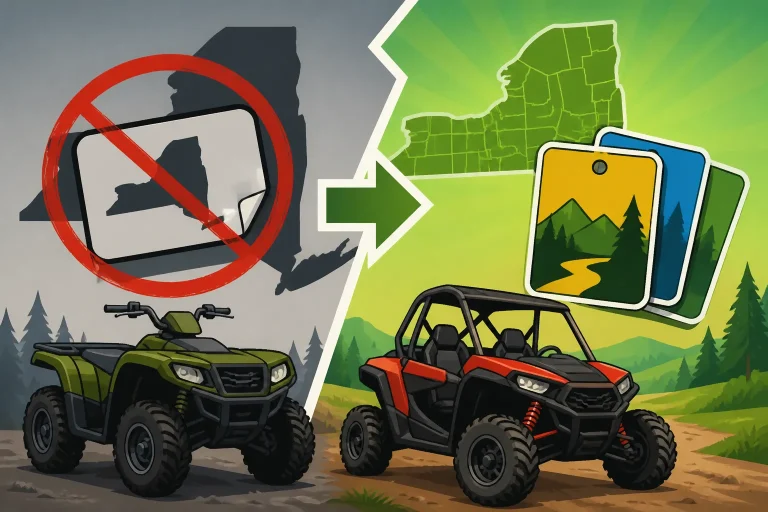
New York does not have one general county-forest permit that automatically grants access to all county land. Some organized trail systems use permits, while other properties may have different access rules or no ATV access. A permit is usually tied to a specific system, route or set of conditions. It is not a statewide pass.
Before buying one, establish exactly what it covers. Check whether the permit applies to a named trail system, whether it is required for every rider or every machine, how it must be displayed and whether access is open to nonmembers. Confirm whether the permit is valid for the dates you plan to ride and whether any route sections are managed separately. Do You Need a Trail Permit in New York? explains why a county or trail-system requirement should not be confused with state registration.
Club membership may be connected to access, but do not assume that joining a club opens every nearby route. Some trails are open to the public with a permit; others may have membership conditions or limited access. Membership can also support trail maintenance and landowner agreements without giving a rider blanket permission on every property the club works with. Check the rules of the particular system, as described in New York Club Trail Rules in New York.
A permit is not permission to leave the trail. If the authorized route runs through a forest, riding off it to explore a side road, field or wooded area can still violate property rules. The same applies to shortcuts around a closed section. Follow the map, signs and any temporary notices, even if an alternate route looks well used.
Confirm what the permit covers before you pay
A useful pre-purchase check is to match the permit details against your actual ride plan:
- Property: Is the forest or trail system named in the permit information?
- Route: Are the trails you intend to ride shown as open?
- Vehicle: Are ATVs and your specific type of machine permitted?
- Rider: Are there age, supervision, membership or documentation conditions?
- Timing: Is the route open on your planned day and during that season?
- Display and proof: Does the permit need to be displayed, and what else must you carry?
- Connections: Are the roads or trails between sections also authorized?
A permit may be inexpensive or costly depending on the system, but the key issue is not the price—it is whether it is valid for the place and ride you have in mind. For current permit availability and terms, use the county or trail operator’s official information. Do not rely on an old screenshot, a secondhand listing or a permit issued for another county.
How to check access before you ride
A few minutes of checking can prevent a wasted trip or an avoidable violation. Use current information from the land manager and treat the trail map as a route plan, not a general invitation to roam.
- Name the exact property. Identify the forest, trail system, trailhead or parcel—not just the county. If you are unsure which property a route crosses, ask the county or trail operator.
- Find the manager’s current rules. Look for an official page, map, notice or contact for the agency or organization responsible for that property. A general county tourism page may not contain detailed operating rules.
- Confirm machine access. Check that the posted route allows ATVs and, if relevant, the type and dimensions of your machine. A route open to one category of vehicle may not accept another.
- Check the permit and membership conditions. Find out whether a permit is required, where it is valid and whether a club membership is an additional condition.
- Check season and closures. A trail can close because of weather, maintenance, logging, landowner concerns or another temporary issue. Use the latest official notice rather than assuming that the route remains open because it was open last season.
- Trace every connection. Make sure the road, trail or corridor between your parking spot and the forest route is also open to your machine. Do not ride an unapproved connector to reach an approved trail.
- Carry the required documents. Bring registration, insurance proof and any permit or certificate required for your situation. Keep them accessible if an officer or trail representative asks.
- Recheck before unloading. Conditions can change after you plan the trip. Check notices at the trailhead and respect a gate, closure sign or staff instruction, even if an online map appears to show the route as open.
County maps can be useful starting points, but the map’s age and purpose matter. A countywide recreation map may show public facilities without showing which routes allow motorized use. For a focused approach to finding a county-issued map, see New York Trail Maps From a County. Then verify its information with the current manager or trail operator.
If you cannot confirm a route is open, do not try to settle the question by riding it and seeing what happens. Contact the responsible office or use a clearly authorized route instead. That is especially important where trails cross several parcels: permission from one owner or manager does not automatically cover the next section.
Closures, signs and responsible use
County forests are managed for more than recreation. Forestry work, habitat protection, erosion control, fire response and other operations can affect where machines may travel. An open route can be temporarily closed, and access can change if a landowner agreement ends. A map is helpful, but it cannot guarantee that every section is open on the day you arrive.
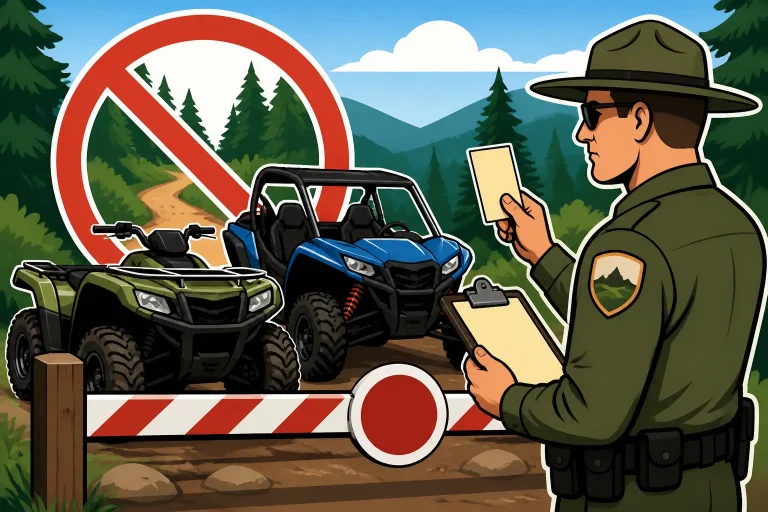
Pay attention to gates, signs and temporary barriers. A gate may be closed for a reason that is not obvious from the trail. Do not ride around it, remove a barrier or follow an unmarked bypass. If a sign appears to conflict with a map, the sign at the site may reflect a newer closure; pause and contact the managing authority before continuing.
Stay on the marked route and avoid widening it. Cutting a corner, riding around mud or creating a new path through the trees can damage the land and make a trail harder to keep open. If a section is wet or rutted, turn around where permitted rather than forcing a pass or making a detour. These choices matter on shared trails and on routes that cross working land, where good relationships with landowners help preserve access.
Ride at a speed that lets you stop safely, yield to other users and avoid disturbing nearby homes or operations. Forest routes can have limited sightlines, uneven surfaces, drainage features and work vehicles. Keep noise and debris down, carry out trash and never assume that people on foot or at work will hear you coming.
If you encounter an unclear boundary, stop before crossing it. Check the map, look for signs and contact the manager when possible. Do not assume that a trail continuing beyond a marker is still covered by your permit. The safer rule is simple: stay where access is clearly authorized, and get confirmation before using a route whose status is uncertain.
Frequently Asked Questions
Can I ride any ATV trail on county forest land in New York?
No. County ownership does not create blanket ATV access. Ride only on routes that the responsible manager identifies as open to your machine, and follow any permit, season and route conditions.
Does a county trail permit cover every forest in that county?
Not necessarily. A permit may apply only to a named trail system or route. Check the permit terms and current map before riding, especially if your route connects more than one property.
Can I ride a forest road if there are tire tracks on it?
Tracks are not proof of public permission. The road may be for forestry or maintenance, or it may be closed to recreational machines. Confirm its status with the land manager and follow posted signs.
If I have an out-of-state registration, can I ride county trails?
An out-of-state registration may address the registration question, but it does not replace a county permit or grant access to a closed trail. Check New York’s reciprocity rules and the specific trail system’s access requirements separately.
Disclaimer
This article is for general informational purposes only and does not constitute professional advice. Laws, prices and regulations vary by location and change over time. Consult a qualified professional for guidance on your specific situation.