What a New York Officer Checks Roadside
There's a distinct pit-in-your-stomach feeling when you're out on the trails, enjoying the roar of your engine and the freedom of the New York backcountry, and suddenly you spot the flashing lights of a state trooper, sheriff, or forest ranger. Your mind races: "Is everything in order? Did I miss something?" It's a natural reaction, especially given New York's specific—and sometimes complex—regulations for ATVs. This guide is here to cut through that anxiety, clearly outlining exactly what a New York officer is looking for when they pull you over or stop you for a routine check, ensuring you can ride with confidence.
The Initial Stop: Why Officers Pay Attention
Nobody wants to be pulled over, especially when you're just trying to enjoy a ride. But understanding why an officer might initiate a stop can help you avoid potential issues. Sometimes it's a simple, random check, but often, there’s something specific that catches their eye.
Visible Violations That Catch an Eye
Many stops begin because an officer observes something that immediately signals a potential violation. Think of it like a car without a valid inspection sticker, or a tail light out—it's an obvious flag. For ATVs, this could be something as straightforward as a missing registration plate, or a plate so caked in mud it’s unreadable. Maybe your validation decal isn't where it should be, or it's simply absent.
Beyond the registration, an officer might notice how you're riding. Are you tearing through a posted speed zone on a designated trail? Are you operating your machine in an area clearly marked as closed to ATVs, perhaps an environmentally sensitive zone or private property without permission? Riding on a public highway not designated for ATV use, or crossing one improperly, are huge red flags. Even something as seemingly minor as excessive noise could draw attention if your muffler isn't up to snuff. These are all things that don't require an officer to guess; they're plain as day and give them probable cause to initiate a stop and investigate further.
Random Checks and Designated Checkpoints
While observed violations are common, it's also entirely possible to be stopped as part of a routine check. Just like seatbelt checks or DWI checkpoints for cars, law enforcement agencies conduct similar operations for ATV riders, particularly in popular riding areas like the Tug Hill Plateau or other county trail systems. These checkpoints are often set up at trailheads, key intersections, or entry points to riding zones.
The purpose of these checks isn't necessarily to catch someone in the act of breaking a law, but rather to ensure general compliance with safety and registration regulations. Officers might be performing these checks to address community concerns, ensure rider safety on busy weekends, or simply maintain a presence in areas with high ATV activity. During such a stop, they'll typically go through a standard checklist of items, which we'll cover in detail below. It’s not personal; it’s part of ensuring everyone is riding legally and safely, helping to keep our trails open and accessible.
Registration and Plates: Your ATV's Official Identity
When an officer approaches your machine, one of the very first things they’re going to look for and ask about is your ATV’s registration and its corresponding plate. Think of it as your machine's driver's license and license plate – it proves it's allowed to be out there.
The Plate and Validation Decal
New York requires all registered ATVs to display a valid registration plate. This isn't just a suggestion; it's a legal mandate. The plate isn't just for decoration; it's how your machine is identified, much like a car's plate. Officers will be checking for its presence, and critically, its visibility. If your plate is missing, obscured by mud, bent beyond recognition from a gnarly trail ride, or mounted in an unconventional spot where it’s hard to see, that's an immediate issue. It needs to be securely fastened to the rear of your machine, clearly visible, and legible. For details on placement, you can check out [New York ATV Plates and Where They Mount].
Accompanying your plate is the small, but mighty, validation decal. This sticker signifies that your registration is current for the specific year. It typically gets affixed directly onto the plate itself in a designated area. Just like the plate, this decal needs to be clearly visible and the current one. An officer will be looking for the correct year and ensuring it hasn't been tampered with. If it's missing, expired, or improperly placed, it raises a red flag that your registration might not be active. Learn more about its placement in [Where to Stick a New York ATV Validation Decal]. Some riders opt for aftermarket plate relocation kits or sturdy plate holders to protect their plate from trail damage; SuperATV offers a range of durable accessory options that can help keep your plate secured and visible, even on the roughest terrain.
Current Registration Paperwork
Beyond the physical plate and decal, you need to carry proof that your ATV is officially registered. This means having the actual registration document with you while you ride. It’s similar to carrying your car’s registration. This paper document contains vital information: your name, your address, your machine's VIN, and most importantly, the registration's expiration date. An officer will ask to see this document to cross-reference it with the plate and decal, verifying that everything matches up and is current.
Forgetting your paperwork at home, even if your machine is properly registered, can lead to a delay and potentially a citation, as you can’t immediately prove compliance. It’s always best practice to keep a copy on your person, perhaps laminated and stored in a waterproof bag or compartment on your machine. Be mindful of the expiration date, which in New York, is typically August 31st for most machines. It’s easy to let it slip if you’re not regularly checking. Missing that date means your registration is expired, and that’s a clear violation. You can learn more about renewal periods and [New York's Annual ATV Registration] or [When a New York ATV Registration Expires].
Here’s a quick glance at what an officer will likely check for regarding your ATV’s identity:
| Item | Officer Check | Why It Matters |
|---|---|---|
| Registration Plate | Presence, secure mounting, legibility, visibility | Legal identification of your ATV |
| Validation Decal | Presence, current year, proper placement | Proof of active, current registration |
| Registration Card | Current document, matches VIN/rider info | Official proof of ownership and legal operation |
| Expiration Date | Valid for the current riding season | Ensures you're not riding on an expired registration |
Proof of Ownership and Insurance: Protecting Yourself and Others
Having your ATV registered is one thing, but proving you lawfully own it and have the necessary insurance coverage is another critical layer of compliance. An officer will often ask for these documents to ensure responsibility and protection are in place.
Demonstrating Ownership
New York is one of those states where ATVs typically aren't issued traditional titles, which can sometimes make proving ownership a bit confusing for new riders or those from out of state. However, when an officer stops you, they still need to verify that you are the rightful owner or have permission to operate the machine. Without a title, your registration document serves as your primary proof of ownership. This document lists you as the registered owner and, combined with your driver's license or identification, usually suffices.
However, if you've recently purchased a used ATV and haven't yet registered it in your name, you'll need additional documentation. A properly filled-out bill of sale from the previous owner is crucial here. It acts as the paper trail demonstrating the transfer of ownership. Without either a current registration in your name or a valid bill of sale, an officer might question your right to operate the machine, potentially leading to further investigation or impoundment until ownership can be verified. It's always best to have these documents readily accessible. For a deeper dive into proving ownership without a traditional title, check out [Proving Ownership Without a Title in New York] and [New York ATV Proof of Ownership Requirements].
Mandatory Insurance Coverage
This is non-negotiable in New York: if you're riding an ATV anywhere off your own private property, you must have insurance. An officer will absolutely ask for proof of insurance. This usually comes in the form of an insurance card, much like the one you carry for your car. This card should clearly show the policy holder's name, the ATV's year, make, and VIN, the policy number, and the effective dates of coverage.
New York law mandates specific minimum liability coverage amounts: twenty-five thousand dollars for bodily injury to one person, fifty thousand for bodily injury to two or more people, and ten thousand for property damage. If your insurance card doesn't show these minimums, or if you simply can't produce proof of insurance, you're looking at significant penalties, including fines and potential suspension of your ATV registration. It's a critical safety net, not just for you but for anyone you might accidentally involve in an incident. Riding without it is a serious offense. Make sure you understand [New York's Mandatory ATV Insurance] and the [New York ATV Insurance Minimum Coverage]. Always carry your insurance card with you, perhaps with your registration, to easily demonstrate [New York ATV Registration and Insurance Proof] at a moment's notice.
Rider and Passenger Requirements: Safety on the Trail
Beyond the machine itself, officers are highly concerned with the safety of those operating and riding on the ATV. This means checking that everyone is properly equipped and meets the legal requirements for age and supervision.
Helmet Laws for All Ages
Let's make this crystal clear: in New York, everyone riding an ATV, regardless of age or experience level, must wear an approved helmet. There are no exceptions for adults, seasoned riders, or even if you're just puttering around a field. An officer will be looking for riders to be wearing a helmet that is securely fastened. This isn't just a suggestion; it's a critical safety measure designed to protect against head injuries, which are often the most severe in ATV accidents.
The helmet should be DOT (Department of Transportation) approved, meaning it meets specific safety standards. While an officer isn't likely to scrutinize the interior labels unless there's a doubt, they'll certainly check for obvious signs of non-compliance, like a bicycle helmet being worn instead of a proper ATV helmet, or a helmet that's clearly too big and ill-fitting. Forgetting your helmet or choosing not to wear one is an easy ticket to a citation, and it puts you at immense risk. You can find more detailed information on [New York Helmet Law for ATV Riders] and specifically, [Does a Sixty-Year-Old Rider Still Need a Helmet?]. The answer is always yes.
Age, Supervision, and Safety Certificates
New York has strict rules about who can operate an ATV and under what conditions, especially for younger riders. An officer will certainly be checking the age of the operator.
- Under 10 years old: Absolutely no one under the age of 10 is permitted to operate an ATV, regardless of supervision.
- Ages 10-15: Riders in this age group must possess an ATV safety certificate and be under the general supervision of someone 18 years or older. General supervision means the adult must be present and capable of guiding the younger rider, even if not riding directly alongside them. This safety certificate proves they've learned the basics of safe ATV operation.
- Ages 16 and older: While a safety certificate isn't legally required for riders 16 and over, it is highly recommended. However, anyone under 18 still generally falls under parental liability rules.
If an officer stops a young rider, they will ask for that safety certificate and verify the presence of a supervising adult. Failure to meet these requirements can lead to citations for both the minor and the supervising adult or parent. These rules are in place to ensure that young riders have the necessary knowledge and guidance to operate powerful machines safely. For more information, explore [New York Minimum Age to Ride an ATV], [New York ATV Safety Certificate Requirements], and [New York Rules for a Rider Aged 14].
Passenger Rules
Can you carry a passenger on your ATV? It depends on your machine and the circumstances. New York law specifies that an ATV can only carry a passenger if it was specifically designed by the manufacturer for two riders. This means it must have a factory-fitted seat and footrests for a passenger. You cannot simply add a makeshift seat or have someone sit on the rear rack of a single-rider quad. An officer will visually inspect your machine for these design features.
Furthermore, there are age considerations for passengers. While specific age cutoffs can be nuanced, the general rule is that a passenger must be able to securely hold onto the handholds and place their feet on the footrests. If an officer observes an ATV with a passenger on a single-rider machine, or a passenger who appears too small or insecurely seated, they will likely stop you. These rules are in place to prevent falls and injuries, as riding with an improperly seated passenger significantly increases the risk of an accident. Dive deeper into [New York Passenger Rules on an ATV] and the specifics of [Why a Passenger Needs a Factory-Fitted Seat in New York] or [New York Rules for a Child Passenger].
Machine Equipment: Is Your ATV Trail-Ready?
Beyond the paperwork and rider qualifications, an officer will also physically inspect your ATV to ensure it meets New York's equipment standards. This is about ensuring your machine is safe to operate and doesn't pose a hazard to yourself or others.
Essential Safety Equipment
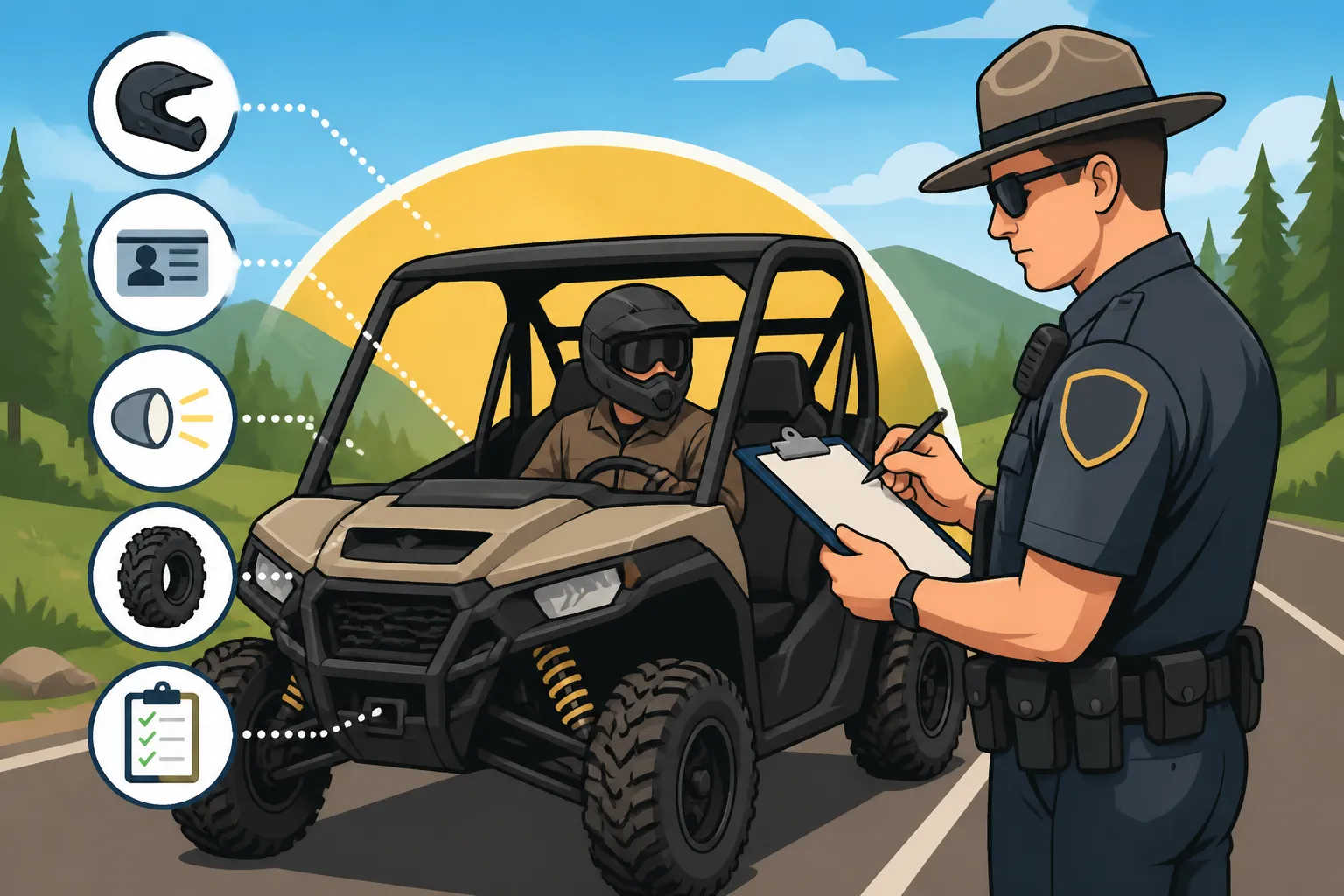
New York law outlines several equipment requirements for ATVs to be considered trail-worthy and safe. An officer will be checking for the following:
- Headlights and Taillights: If you're riding after sunset or before sunrise, or in conditions of reduced visibility, your ATV must have working headlights and taillights. Officers might conduct checks at dawn or dusk, or in wooded, shadowed areas, to ensure these are functional.
- Brakes: Your ATV must have at least one brake system, operated by hand or foot, capable of stopping the vehicle effectively. This is a crucial safety component, and an officer might perform a quick function test if there's any doubt about their effectiveness.
- Muffler and Spark Arrester: All ATVs must be equipped with an adequate muffler that limits engine noise to specific federal standards. Additionally, a spark arrester, approved by the U.S. Forest Service, is mandatory. This device prevents hot carbon particles from escaping the exhaust and potentially starting wildfires. Officers in state or county lands are particularly keen on ensuring spark arresters are present and functional.
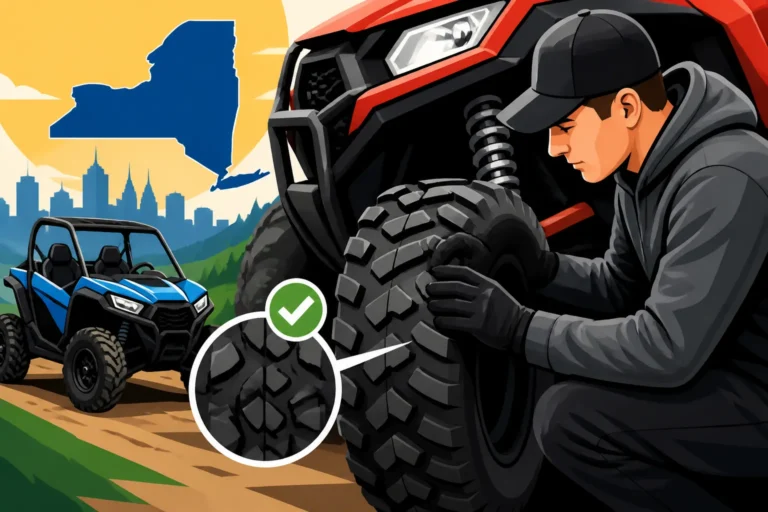
- Tires: Your tires must have at least two thirty-seconds of an inch of tread depth. Worn-out tires compromise traction and safety, especially on varied terrain. An officer might carry a simple gauge to check this.
These aren't optional upgrades; they are fundamental safety features. Running without them not only makes you unsafe but also puts you in violation of New York law. For comprehensive details, see [New York Equipment Requirements for ATVs], [New York Spark Arrester Requirement], and [New York ATV Tread Depth Requirement]. Aftermarket parts can sometimes enhance these features; for example, SuperATV offers a variety of robust lighting solutions that exceed factory brightness, ensuring maximum visibility and compliance during night rides.
Width and Weight Limitations
This is a big one, especially for side-by-sides (SxS) or UTVs, and often a point of confusion for riders. New York law defines an ATV with very specific dimensions: it must be no more than 70 inches wide and weigh no more than 1,000 pounds (dry weight, not including fuel or fluids). An officer, especially those patrolling designated ATV trails, will be keenly aware of these limits.
Many modern side-by-sides, particularly popular models, easily exceed both the 70-inch width and the 1,000-pound weight limit. If your machine is stopped, an officer might have a measuring tape or knowledge of common machine specifications to quickly assess if your vehicle falls outside the legal definition of an ATV for registration purposes in New York. If it does, even if you’ve somehow managed to get it registered (which is unlikely if inspected by the DMV correctly), you could be cited for operating an unregistered vehicle or a vehicle that doesn't meet the legal definition. This is a primary reason [Why a Modern Side-by-Side Fails the Test] in New York. These limitations are in place to preserve trail integrity and manage the type of vehicles allowed on ATV trails. Be sure to measure your machine and understand [New York ATV Width Limit for Registration] and [New York ATV Weight Limit for Registration] before you ride. If your machine is too wide, it will simply not qualify for registration as an ATV in New York.
Where and How You're Riding: The Legality of Your Location
Finally, an officer's concern extends beyond your machine and your person to where and how you're operating your ATV. New York has clear rules about permissible riding areas and conduct, and violating these can quickly lead to a stop.
Designated Trails vs. Unauthorized Areas
One of the most frequent reasons for an ATV stop is riding in an unauthorized area. New York's ATV laws are very specific: you can only ride an ATV on designated and posted ATV trails, on your own private property, or on private property where you have explicit written permission from the landowner. If you're caught riding on state land that isn't designated for ATVs (like the Adirondack Forest Preserve or most State Parks), on private land without permission, or on a public road not specifically designated and posted for ATV use, you are in violation of the law.
Officers, particularly park rangers or environmental conservation officers, are highly vigilant about protecting natural resources and respecting private property. They know their patrol areas well and will quickly identify machines in places they shouldn't be. This isn't just about getting a ticket; it's about preserving access. Landowners grant permission for trails based on trust, and trespassing or riding where prohibited jeopardizes the future of ATV riding for everyone. Always know where you're riding and ensure it's a legal, designated spot. Learn more about [New York Rules for Riding State Land], [New York Rules for Riding Private Land], and the severe consequences of [New York Fines for Riding a Closed Trail].
Road Crossings and Public Roads
While ATVs are generally not "street legal" in New York, there are specific circumstances where you can interact with public roads, primarily for crossing purposes or on specifically designated and posted roads. An officer will be observing how you navigate these situations.
- Crossing a Highway: If you need to cross a public highway, you must do so at approximately a ninety-degree angle to the road. You must come to a complete stop before entering the roadway, yield to all traffic, and proceed only when safe. You cannot ride along the shoulder or within the ditch line to get to a crossing point; the crossing must be as direct as possible.
- Designated Roads: Some towns and counties have local ordinances that designate specific roads or sections of roads for ATV use. These roads must be clearly marked with signs indicating they are open to ATVs. If you're riding on a public road that isn't explicitly posted for ATV use, you're likely in violation.
Any deviation from these rules—such as riding casually down a town road, not stopping before a crossing, or riding on a non-designated paved surface—will certainly draw an officer's attention. Understanding and adhering to these rules is vital for safe and legal operation. Familiarize yourself with [New York Rules for Crossing a Public Road] and how to identify [New York Roads Designated for ATVs]. Even if you're just crossing an ice-covered lake, there are rules to follow, such as [New York Rules for Riding on Frozen Water], which includes a 100-foot rule near ice shanties.
Signs of Impairment
Finally, and perhaps most critically, officers are always on the lookout for signs of impaired operation. Just like driving a car, operating an ATV under the influence of alcohol or drugs is strictly illegal and carries severe penalties in New York. This applies whether you're on a public trail, a private trail, or even your own property. New York's DWI laws extend to ATVs.
An officer might observe erratic riding, unusual behavior, slurred speech, or the smell of alcohol, all of which would prompt an investigation for impairment. They have the authority to administer field sobriety tests, and refusal can lead to immediate consequences. Riding impaired not only risks your life and the lives of others but also undermines the responsible image of the ATV community. Always ride sober. For more information, please see [Riding Impaired on Private Land in New York] and [New York DWI Rules for ATV Riders].
Disclaimer
This article is for general informational purposes only and does not constitute professional advice. Laws, prices and regulations vary by location and change over time. Consult a qualified professional for guidance on your specific situation.