New York’s Form MV-51B Explained
One of the biggest head-scratchers for new and even experienced ATV owners in New York is figuring out how to prove you actually own your machine when the state doesn't issue traditional titles for them. It's a common source of frustration, leaving many to wonder what official document serves as that crucial link between you and your quad. This comprehensive guide is here to unravel the mystery of New York's Form MV-51B, explaining exactly what it is, why it's so important, and how to use it correctly to ensure your ATV registration goes smoothly.
Understanding New York's Unique ATV Ownership System
Navigating the world of ATV ownership in New York can feel a bit like trying to solve a puzzle with half the pieces missing, especially when it comes to official paperwork. Unlike cars, trucks, or even snowmobiles in some states, ATVs in New York don't come with a traditional certificate of title. This lack of a formal title document often leaves new owners scratching their heads, wondering how they're supposed to prove they legitimately own their prized quad, especially when it comes time to register it or, down the road, sell it. It's a system that, while seemingly straightforward once understood, often causes confusion because it deviates from what most people expect based on their experience with other vehicles.
The Lack of a Traditional Title for ATVs in New York
Let's be clear: when you buy an ATV in New York, whether it's brand new from a dealer or a used machine from a private seller, you won't ever receive a document explicitly called a "certificate of title" from the Department of Motor Vehicles. This is a fundamental difference compared to automobiles, which are always accompanied by a title that establishes legal ownership. For ATVs, the state operates under a different set of rules, classifying them as recreational vehicles that don't require the same strict titling process. This distinction is crucial because it means your proof of ownership will rely on other documents, primarily sales receipts and a specific DMV form we'll dive into shortly. Understanding [Why New York Issues No ATV Title] is the first step in making sense of the entire process.
This absence of a title can lead to a lot of anxiety, particularly for those unfamiliar with the process. People often worry about what might happen if they need to prove ownership for insurance purposes, in the event of theft, or during a sale. Without that single, definitive piece of paper, it can feel like your ownership is on shaky ground. However, New York has established alternative methods for verifying and transferring ownership that, while different, are perfectly legitimate and recognized by the DMV, provided you follow the correct procedures.
Why Form MV-51B Becomes Your Proof of Ownership
Given that a traditional title isn't issued, New York's Form MV-51B, officially known as the "Vehicle Bill of Sale," steps up as one of the most critical documents in establishing and transferring ATV ownership. While its name suggests a simple bill of sale, for non-titled vehicles like ATVs, it serves a much more elevated purpose. This form acts as the official bridge between the seller and the buyer, meticulously recording the transaction details and, most importantly, providing verifiable proof that the machine has legally changed hands. It's what the DMV relies on when you come in to register your ATV.
Think of the MV-51B as the closest thing you'll get to a "mini-title" for your ATV. It contains all the pertinent information about the vehicle, the seller, and the buyer, creating a clear paper trail. Without a properly completed MV-51B, you might find yourself in a bind when trying to register your ATV, as the DMV will require robust documentation to confirm your ownership before they issue those crucial registration plates and decals. This form is often the cornerstone of [New York ATV Proof of Ownership Requirements], and getting it right is paramount.
The Frustration of Non-Titled Vehicles
The entire concept of non-titled vehicles can be a source of significant frustration for many New Yorkers. You've just invested your hard-earned money in an ATV, and you want to ensure all your ducks are in a row, only to discover the standard ownership document you'd expect simply doesn't exist. This often leads to confusion, unnecessary trips to the DMV, and sometimes even delays in getting out on the trails. It's easy to feel like you're navigating a bureaucratic maze, especially when conflicting information or old forms might lead you astray.
This frustration is particularly acute for private sales, where both buyer and seller might be unsure of the exact documentation needed. Without a clear title, the onus falls heavily on ensuring the MV-51B is filled out perfectly and accurately, alongside any other supporting documents like a separate bill of sale. For those who are used to simply signing over a title, this alternative process can feel overly complicated and prone to error. Understanding the specific purpose of the MV-51B is key to alleviating this common headache.
What Exactly is New York's Form MV-51B?
At its core, New York's Form MV-51B is the official Department of Motor Vehicles document designed to facilitate the sale and transfer of certain non-titled vehicles, including ATVs. It's not just a generic piece of paper you scribble on; it's a specific, multi-part form that the DMV uses to track ownership changes for vehicles that don't get a traditional certificate of title. Its significance can't be overstated when you're buying or selling an ATV in the Empire State. Without it, you might find yourself unable to register a machine you just bought, or your buyer might face similar hurdles.
This form provides a standardized method for documenting the transfer of ownership, ensuring that all necessary information is captured consistently. It helps prevent disputes and clarifies who is the legal owner at any given time, which is critical in a system where a single, universally recognized title document doesn't exist. When you're ready to register your ATV, the MV-51B, correctly completed and signed, will be one of the first things the DMV representative asks to see.
More Than Just a "Bill of Sale"
While the MV-51B is indeed titled "Vehicle Bill of Sale," it's important to understand that for ATVs, it functions as much more than just a simple receipt. A generic bill of sale, which you might create yourself or find online, certainly records the transaction and price. However, the MV-51B is a DMV-specific form, meaning it's designed to meet their precise requirements for proof of ownership for non-titled vehicles. It includes specific fields that the DMV needs to process your registration, ensuring consistency and legitimacy.
Some people mistakenly believe they can use any handwritten bill of sale. While a detailed, self-generated bill of sale is always a good idea to protect both buyer and seller in a private transaction, the DMV prefers and often requires their official MV-51B for non-titled vehicle registration. Think of it this way: a generic bill of sale proves you paid money for something, but the MV-51B proves that the state recognizes this transfer of ownership for registration purposes. You might even use a service like LawDepot to generate a comprehensive bill of sale for your records, but always make sure to also complete the official MV-51B for DMV purposes.
The Different Sections of the Form Explained
The MV-51B is structured to capture all the essential details of an ATV transaction. It typically includes:
- Seller Information: This section requires the full legal name and address of the person or entity selling the ATV. Accuracy here is critical, as it confirms who is releasing ownership of the machine.
- Buyer Information: Similarly, this section demands the full legal name and address of the person purchasing the ATV. This is you, if you're the one acquiring the quad, and it's how the DMV will identify the new owner.
- Vehicle Information: This is arguably the most crucial section. It requires the year, make, model, and—most importantly—the Vehicle Identification Number (VIN) of the ATV. Getting the VIN absolutely correct is non-negotiable, as this is how the DMV identifies the specific machine being transferred. You might even need a [New York ATV VIN Tracing Requirement] for the registration itself, but it needs to be recorded accurately on the MV-51B.
- Sale Information: Details regarding the sale date and purchase price are included here. This information is vital for calculating sales tax and documenting the transaction timeline.
- Signatures: Both the seller and buyer must sign and date the form. These signatures attest to the accuracy of the information and the mutual agreement of the transaction. Without both signatures, the form is incomplete and won't be accepted by the DMV.
Each section plays a vital role in establishing a clear and undeniable record of ownership transfer. Any missing or incorrect information can lead to significant delays and headaches when you attempt to register your ATV.
When the MV-51B is Absolutely Essential
The MV-51B isn't just a suggestion; it's a requirement in several key scenarios for ATV owners in New York. The most common situation where you'll absolutely need this form is when you're registering an ATV that you've purchased from a private party, whether it's an individual seller or a farm owner. Since there's no title to transfer, the MV-51B serves as the official documentation of the sale. When you visit the DMV, this form, along with your proof of identity and residency, will be scrutinized carefully.
Another critical time for the MV-51B is when you're trying to [Registering an Inherited Machine in New York]. If you've received an ATV as part of an estate, and there's no previous registration or other official documentation from the deceased, the MV-51B can be used by the executor of the estate to transfer ownership to you. It helps bridge the gap where traditional sales documents might not exist. Furthermore, if you're trying to prove ownership for a machine where the original paperwork has been lost over time, a properly executed MV-51B from the last known owner can be a lifesaver. Essentially, anytime a non-titled ATV changes hands and you need to interact with the DMV for registration or official record-keeping, the MV-51B is your go-to document.
Filling Out Your MV-51B Correctly: A Step-by-Step Guide
Filling out official government forms can often feel like walking through a minefield, with every blank space holding the potential for a mistake that sends you back to square one. The MV-51B is no exception. While it might seem straightforward, accuracy and completeness are absolutely crucial. A small error, a forgotten signature, or an incorrect number can lead to your registration being denied, forcing you to go back to the seller, which can be difficult or even impossible if they've moved on. Taking your time and double-checking every detail will save you immense frustration down the line, especially when dealing with [New York ATV Registration Without a Title].
Remember, this document is effectively your legal proof of ownership for a non-titled vehicle, so treating it with the utmost care and attention to detail is paramount. You wouldn't want to jeopardize your ability to hit the trails just because a minor detail was overlooked on a piece of paper.
Seller Information: What You Need to Know
The seller information section is where the previous owner of the ATV clearly identifies themselves. This typically includes their full legal name and their complete street address. It's not enough to just use a nickname or an incomplete address; the DMV needs official, verifiable details. If the seller is a business or a dealership, the business name and address will be required.
It's also essential to ensure that the name provided matches any previous registration documents the seller might have, or at least aligns with their identification. This helps create a clear chain of ownership. As the buyer, it's in your best interest to verify this information, perhaps by asking to see a form of ID or previous registration papers, just to be sure you're dealing with the legitimate owner. A good practice, especially in a private sale, is to have the seller fill out their section themselves, ensuring accuracy on their part.
Buyer Information: Ensuring Accuracy
As the buyer, this section is all about you. You'll need to provide your full legal name exactly as it appears on your driver's license or other official identification, along with your current complete street address. P.O. boxes are generally not accepted for physical address verification for registration purposes, so be sure to use your residential address.
This information is what the DMV will use to link you to the ATV in their system and issue your registration. Any discrepancies here could cause problems. For example, if you list your name differently than it appears on your ID, or if your address doesn't match other official records, it could raise red flags. Take a moment to write legibly and confirm every letter and number before proceeding. This is your chance to establish your legal ownership, so make it count.
Vehicle Details: Getting the VIN Right
This section is arguably the most critical part of the MV-51B. You must accurately record the year, make, and model of the ATV. For instance, "2018 Yamaha Grizzly 700." While these details are important, the most absolutely vital piece of information here is the Vehicle Identification Number (VIN). The VIN is a unique 17-character code that specifically identifies your ATV and no other. It's like the machine's fingerprint.
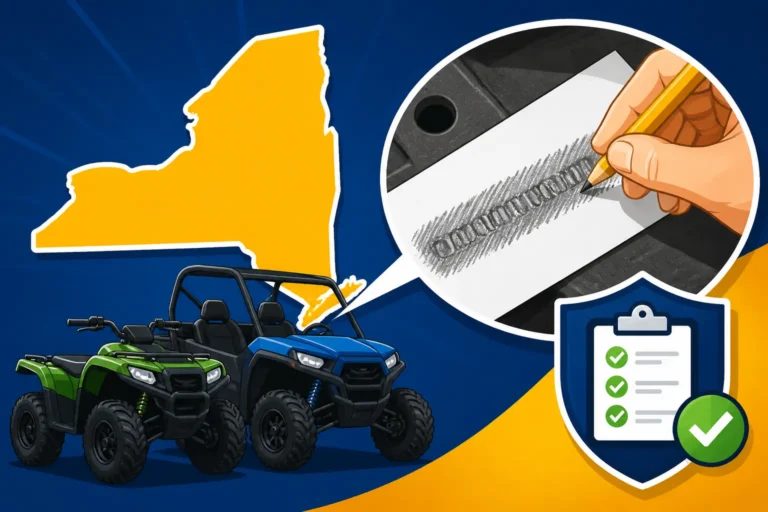
You must locate the VIN directly on the ATV itself, usually stamped into the frame. Do not rely solely on previous paperwork, as errors can occur. Carefully transcribe each character, double-checking for any easily confused letters or numbers (like an "O" for a "0," or an "I" for a "1"). If the VIN is obscured or difficult to read, take extra steps to clean the area or even take a [Tracing a Frame Number With a Pencil] to ensure you get it right. An incorrect VIN on the MV-51B will almost certainly lead to your registration being rejected, as the DMV needs to link the specific physical machine to your ownership.
The Importance of Signatures and Dates
Once all the information has been filled in, the MV-51B requires the signatures of both the seller and the buyer, along with the date of the transaction. This isn't just a formality; it's the legal validation of the entire transfer. By signing, both parties attest that the information provided is true and accurate to the best of their knowledge, and that the ownership of the specified ATV has officially transferred on that date.
Crucially, both signatures must be present. If the seller signs and you forget to, or vice-versa, the form is incomplete. If you are buying an ATV, ensure the seller signs it in front of you, if possible, to verify their identity. Make sure the date of sale is also clearly written and matches any other related documents, such as a separate bill of sale or payment receipts. Without complete and accurate signatures and dates, the MV-51B holds no legal weight for the DMV, and you'll likely face issues when trying to complete your registration. This signed document is the cornerstone of [Proving Ownership Without a Title in New York].
Beyond the Basics: Common Scenarios for Using MV-51B
The MV-51B might seem like a straightforward form for a simple transaction, but its utility extends to various common, and sometimes complicated, scenarios that ATV owners in New York might encounter. It's not just for the typical "buy from a friend" situation; it plays a critical role when navigating private sales, dealing with inherited property, or even recovering from lost ownership documents. Understanding these broader applications ensures you're prepared for whatever unique situation arises with your non-titled ATV.
The form's versatility makes it an indispensable tool for establishing a clear paper trail, which is especially important in a state that doesn't issue traditional titles for ATVs. Each scenario underscores the MV-51B's central role as a primary document for ownership verification.
Buying a Used ATV from a Private Seller
This is by far the most common scenario where the MV-51B comes into play. When you find that perfect used quad advertised online or through a local contact, and you're purchasing it from an individual rather than a licensed dealer, the MV-51B is your absolute best friend. Since the seller won't have a title to hand over, this form, properly completed and signed by both of you, becomes the primary document for demonstrating that you legally acquired the machine.
When engaging in a private sale, it's wise to complete the MV-51B at the time of the transaction. Verify all information with the seller, especially the VIN. You might also want to draft a separate, more detailed bill of sale for your own records, potentially using a template from a service like LawDepot, that covers additional terms like "as-is" condition or specific accessories included. However, for the DMV's purposes, the MV-51B is paramount. This process is fully detailed in our guide on [Buying a Used ATV in New York], highlighting the MV-51B's importance.
Registering an Inherited Machine
Receiving an ATV as part of an inheritance can be a wonderful, albeit sometimes complicated, gift. If the original owner has passed away and the ATV is part of their estate, you'll need a way to legally transfer ownership into your name for registration. This is another situation where the MV-51B shines. In this case, the executor of the estate would act as the "seller" on the form, transferring the ATV to you as the "buyer."
Along with the MV-51B, you would typically need to provide supporting documentation such as a copy of the death certificate and letters of administration or testamentary from the surrogate's court, proving the executor's authority. The MV-51B, filled out by the executor and you, then serves as the official record of the transfer from the estate to you, allowing you to proceed with registering the machine in your own name. Our guide on [Registering an Inherited Machine in New York] elaborates on these steps.
Dealing with Lost or Missing Ownership Documents
Imagine you've owned your ATV for years, perhaps even decades, and somewhere along the line, the original bill of sale or previous registration documents have gone missing. Now you need to sell it, or perhaps you're moving to a new county and need to update your records, and suddenly you realize you have no concrete proof of ownership. This is a common predicament for older machines that may have changed hands multiple times before current documentation standards were firmly in place.
In such cases, tracing back the ownership chain is crucial. If you can locate the person from whom you purchased the ATV, even if it was years ago, they can fill out an MV-51B with you. This creates a fresh, official record of the transfer into your name. If that's not possible, sometimes a sworn affidavit of ownership, combined with any other supporting evidence (old registration cards, insurance policies, maintenance records with your name on them), can be used in conjunction with or as an alternative to the MV-51B, though this can be a more challenging path. The goal is always to provide the DMV with undeniable evidence that you are the rightful owner, and the MV-51B is the preferred tool for doing so when available. It's all about fulfilling the [New York ATV Proof of Ownership Requirements].
Potential Pitfalls and How to Avoid Them
While New York's Form MV-51B is a vital tool for establishing ATV ownership, it's not foolproof. There are several common mistakes and oversights that riders and sellers frequently make, leading to frustrating delays and rejected registration applications at the DMV. Understanding these potential pitfalls ahead of time can save you immense hassle, time, and even money. The key is meticulous attention to detail and a clear understanding of what the DMV expects.
Navigating paperwork can be daunting, but with the MV-51B, being prepared means being proactive about accuracy and completeness. Don't let a simple oversight keep you from enjoying your quad on the trails.
Incomplete or Incorrect Information
This is perhaps the most common reason for MV-51B rejection. Every single field on the form needs to be filled out accurately and completely. Leaving a blank space, abbreviating a name, or incorrectly stating an address can cause problems. For example, if the year of the ATV is listed incorrectly, or if the make and model don't precisely match what's visible on the machine, the DMV might question the legitimacy of the transfer.
The VIN, as mentioned before, is especially critical. A single transposed digit or character can render the form useless. Double-check everything, ideally by having both the buyer and seller review the completed form before signatures are added. It’s also wise to ensure the information on the MV-51B aligns with any other supporting documents you might have, such as a separate, more detailed bill of sale. If you're creating a comprehensive bill of sale through a platform like LawDepot, ensure all details flow consistently to your MV-51B.
Missing Seller Signatures
Another frequent issue is the absence of the seller's signature, or sometimes even both signatures. Without the signature of the person or entity transferring ownership, the MV-51B is simply a blank form. The DMV cannot process a transfer of ownership without clear authorization from the previous owner. This is particularly problematic in private sales where the buyer might fill out the form themselves and forget to obtain the seller's endorsement.
Always ensure that both the seller and the buyer sign the form in the designated areas. If possible, have the seller sign it in your presence, and ideally, ask for a copy of their driver's license for your records to prove who signed it. This provides an extra layer of security and ensures that you won't be caught in a situation where you have a form but no valid signature, which would make it impossible to register your new-to-you ATV. This is a core part of [Selling an ATV in New York] correctly.
The Importance of a Clear Bill of Sale Even with MV-51B
While the MV-51B is the official DMV form for non-titled vehicles, it's not always the most comprehensive document for recording the full details of a private sale. Many buyers and sellers find it beneficial to create a separate, more detailed bill of sale in addition to the MV-51B. This supplementary document can include specifics like:
- A more detailed description of the ATV's condition (e.g., "as-is, no warranty").
- A list of included accessories (e.g., "includes winch, plow mount, and spare tire").
- Payment terms and method.
- Contact information for both parties, beyond what's on the MV-51B.
- Witness signatures, if applicable.
This additional bill of sale, which you can easily generate using templates from services like LawDepot, provides a more robust legal record for both parties. While the DMV primarily cares about the MV-51B for registration, a comprehensive bill of sale offers protection and clarity in case of future disputes between the buyer and seller. It complements, rather than replaces, the MV-51B. For more details on what should be included, refer to our guide on [New York ATV Bill of Sale Requirements].
A Checklist for Completing New York's Form MV-51B
To help you avoid common pitfalls, here's a quick checklist to review when completing your MV-51B:
| Item | Detail to Verify | Buyer Action |
|---|---|---|
| Seller's Full Name | Matches ID, clearly legible | Confirm with seller's ID |
| Seller's Full Address | Complete street address, no P.O. Box (if applicable) | Confirm accuracy |
| Buyer's Full Name | Matches your ID, clearly legible | Write carefully, verify against your ID |
| Buyer's Full Address | Complete residential address, no P.O. Box | Write carefully, verify against your ID |
| ATV Year, Make, Model | Accurate and consistent with the machine | Visually confirm on ATV, check any existing paperwork |
| ATV VIN | EXACTLY 17 characters, no errors or transpositions | Locate on ATV frame, write carefully, double-check each character |
| Date of Sale | Correct date of transaction | Record accurately |
| Purchase Price | Agreed-upon sale price | Record accurately for sales tax purposes |
| Seller's Signature | Present and legible | Ensure seller signs, ideally in your presence |
| Buyer's Signature | Present and legible | Sign clearly |
| Copies Made | At least one copy for buyer, one for seller | Make copies IMMEDIATELY after signing |
By following this checklist, you significantly reduce the chances of encountering issues when you present your MV-51B to the DMV.
The Role of MV-51B in New York ATV Registration
Understanding the MV-51B is one thing, but knowing how it fits into the broader process of registering your ATV in New York is another. This form isn't a standalone document that magically registers your machine; rather, it's a critical piece of the puzzle that, when combined with other necessary paperwork and fees, allows you to legally operate your ATV on designated trails and property. The DMV is essentially looking for a complete package of information, and the MV-51B fulfills the essential ownership proof component for non-titled vehicles.
Without a properly executed MV-51B, your journey to obtaining that coveted New York ATV registration sticker and plate will hit a dead end before it even begins. It truly is the lynchpin in the registration process for machines without a formal title.
Connecting MV-51B to Your DMV Application
When you visit your local DMV office to register your ATV, you'll be completing a primary application form, typically Form MV-82, which is the "Vehicle Registration/Title Application." Although the MV-82 is a general form for all vehicle types, for an ATV, you'll specifically check the box for "ATV" and omit the title information since it doesn't apply. This is where the MV-51B comes into play.
While the MV-82 captures your personal details and the ATV's basic information, it doesn't serve as proof of ownership for a non-titled machine. That's the MV-51B's job. You'll present the MV-51B alongside your completed MV-82, proof of identity, proof of residency, and proof of [New York's Mandatory ATV Insurance]. The MV-51B will be reviewed to ensure the ownership transfer is legitimate and that all vehicle details, especially the VIN, match your MV-82 application. The DMV needs to see a clear connection between the previous owner (on the MV-51B) and you, the new applicant (on the MV-82).
Why Other Forms Might Cause Confusion (e.g., MV-82ATV)
It's completely understandable if you've done some research and found references to forms that seem specific to ATVs, like an "MV-82ATV." This can lead to significant confusion, making you wonder if you're using the correct paperwork. However, it's important to clarify that New York does not have a specific Form MV-82ATV as a separate document for ATV registration. The standard MV-82 is used for this purpose, with specific sections related to ATVs.
This misinformation often stems from older, unofficial guides or confusion with other states' specific forms. It’s a common pitfall that sends people on wild goose chases for forms that don't exist. When you go to the DMV, stick with the general MV-82 for the application itself, and bring your completed MV-51B as your proof of ownership. Understanding [Why New York Has No Form MV-82ATV] can save you a lot of wasted time and effort. The DMV staff are familiar with the MV-51B for ATVs, so don't let references to non-existent forms throw you off. This makes the question of [Which DMV Form Registers a Non-Titled ATV in New York] fairly clear: it's MV-82 with MV-51B as proof of sale.
Keeping Your MV-51B Safe and Accessible
Once you've successfully navigated the purchase of your ATV and diligently filled out your Form MV-51B, the journey isn't over. This document, remember, serves as your primary proof of ownership for a non-titled vehicle. Losing it, or not being able to access it when needed, can create just as many problems as an incorrectly filled-out form. Therefore, it's absolutely crucial to treat your MV-51B with the same care and importance you would a traditional title. Proper storage and accessibility are not just good practice; they are essential for long-term peace of mind and hassle-free ownership.
Think about all the situations where you might need this document: selling your ATV, proving ownership for insurance claims, or even just reminding yourself of the VIN. Having it readily available will prevent future headaches.
Physical Storage Best Practices
First and foremost, make multiple copies of your signed MV-51B immediately after the transaction. A physical paper copy should be stored in a safe, secure place, away from extreme temperatures and moisture. Consider a fireproof safe, a secure filing cabinet, or a lockbox. Avoid keeping the original in your ATV's glovebox or tool bag, as it's susceptible to damage, theft, or loss while riding. While you'll need to present the original to the DMV for registration, once registered, a copy (or photo) might suffice for casual roadside checks, though the original is always best for official transfers.
It’s also a good idea to keep a copy with other important vehicle documents, such as your registration certificate, insurance card, and any maintenance records. This creates a central hub for all your ATV-related paperwork. If you ever need to transfer the machine again, having the original MV-51B will make the process much smoother for the next buyer.
Digital Backups for Peace of Mind
In today's digital age, relying solely on physical copies is a risky strategy. Once you have your physical copies secured, take the extra step to create digital backups of your MV-51B. A clear, well-lit scan or high-resolution photograph of the completed and signed form can be stored in several places:
- Cloud Storage: Upload the file to a secure cloud service like Google Drive, Dropbox, or OneDrive. This ensures you can access it from anywhere with an internet connection.
- External Hard Drive/USB: Keep a copy on a portable storage device, separate from your main computer.
- Email: Send a copy to yourself in an email, creating an easy-to-search record.
Ensure these digital copies are also secured, perhaps with password protection. This redundancy means that even if a physical copy is lost or destroyed, you still have verifiable proof of your ATV's ownership. Imagine losing all your paperwork in a house fire or flood; a digital backup could be your saving grace in proving ownership and potentially making an insurance claim. Having a digital copy is also incredibly handy if you need to quickly reference the VIN or other details, without having to dig through physical files.
What to Do if Your MV-51B is Lost
Despite your best efforts, sometimes documents go missing. If you lose your MV-51B after the sale but before registration, you're in a tough spot. Your first step should be to contact the seller immediately and explain the situation. If they are willing, you might be able to fill out a new MV-51B together. This is why maintaining a good relationship with the seller and having their contact information is always a smart move, especially for private sales.
If you cannot reach the seller or they are unwilling to complete another form, the situation becomes more complex. You might need to rely on other forms of proof, such as a detailed, signed bill of sale (if you have one), old registration documents (if the ATV was previously registered), or even an affidavit of ownership. In some extreme cases, the DMV might accept an affidavit explaining the loss and providing all other available evidence. However, this is often a lengthier and more challenging process. The best defense against this scenario is proactive backup and storage, emphasizing why the MV-51B should be treated with utmost care from day one.
Form MV-51B and Other Important New York ATV Considerations
The MV-51B doesn't just exist in a vacuum; its completion often triggers or is intertwined with other important aspects of ATV ownership in New York. While its primary role is to establish ownership for registration, the information contained within it—especially the purchase price—has implications for sales tax. Moreover, if you're financing your ATV, the MV-51B interacts with the lender's requirements. Understanding these connections provides a more holistic view of the ATV ownership process and helps you anticipate other necessary steps and obligations.
It's all part of the larger picture of being a responsible ATV owner in New York, ensuring all legal and financial requirements are met before you hit the trails.
Sales Tax Implications
When you purchase an ATV in New York, whether from a dealer or a private seller, you are generally subject to state and local sales tax on the purchase price. The purchase price recorded on your MV-51B (or a supplementary bill of sale) is what the DMV will use to calculate the sales tax you owe when you go to register the machine. This is an unavoidable part of the transaction for most buyers.
It's important not to try and artificially lower the sale price on the MV-51B to avoid sales tax, as this can lead to legal issues. The DMV has ways of estimating fair market value and can question unusually low sale prices. Be honest and transparent about the actual transaction amount. The sales tax calculation will occur at the DMV counter, and you'll typically pay it at that time. For a deeper dive into these financial responsibilities, our guide on [New York ATV Registration and Sales Tax] is a valuable resource. You might even find that a detailed bill of sale generated by a platform like LawDepot can clearly outline the sales tax component for both parties.
Registering a Financed Machine
If you're financing your ATV purchase, the MV-51B still plays a crucial role, particularly in establishing ownership before the lien is recorded. Even though ATVs don't get titles, if you take out a loan, the lending institution will typically want their lien recorded with the DMV to protect their interest in the machine.
When you register a financed ATV, you'll still present the completed MV-51B as proof of your purchase and ownership. However, the DMV will also process paperwork from your lender (often a UCC-1 financing statement for non-titled collateral) to record their lien. This means that while you are the owner, the lender has a legal claim on the ATV until the loan is paid off. The MV-51B serves as the foundational document that proves the ATV was transferred to you, allowing the lien to then be appropriately attached to your registration record. Our guide on [Registering a Financed Machine in New York] covers this process in more detail. It's a key distinction that separates a fully owned machine from one with an outstanding loan.
Disclaimer
This article is for general informational purposes only and does not constitute professional advice. Laws, prices and regulations vary by location and change over time. Consult a qualified professional for guidance on your specific situation.