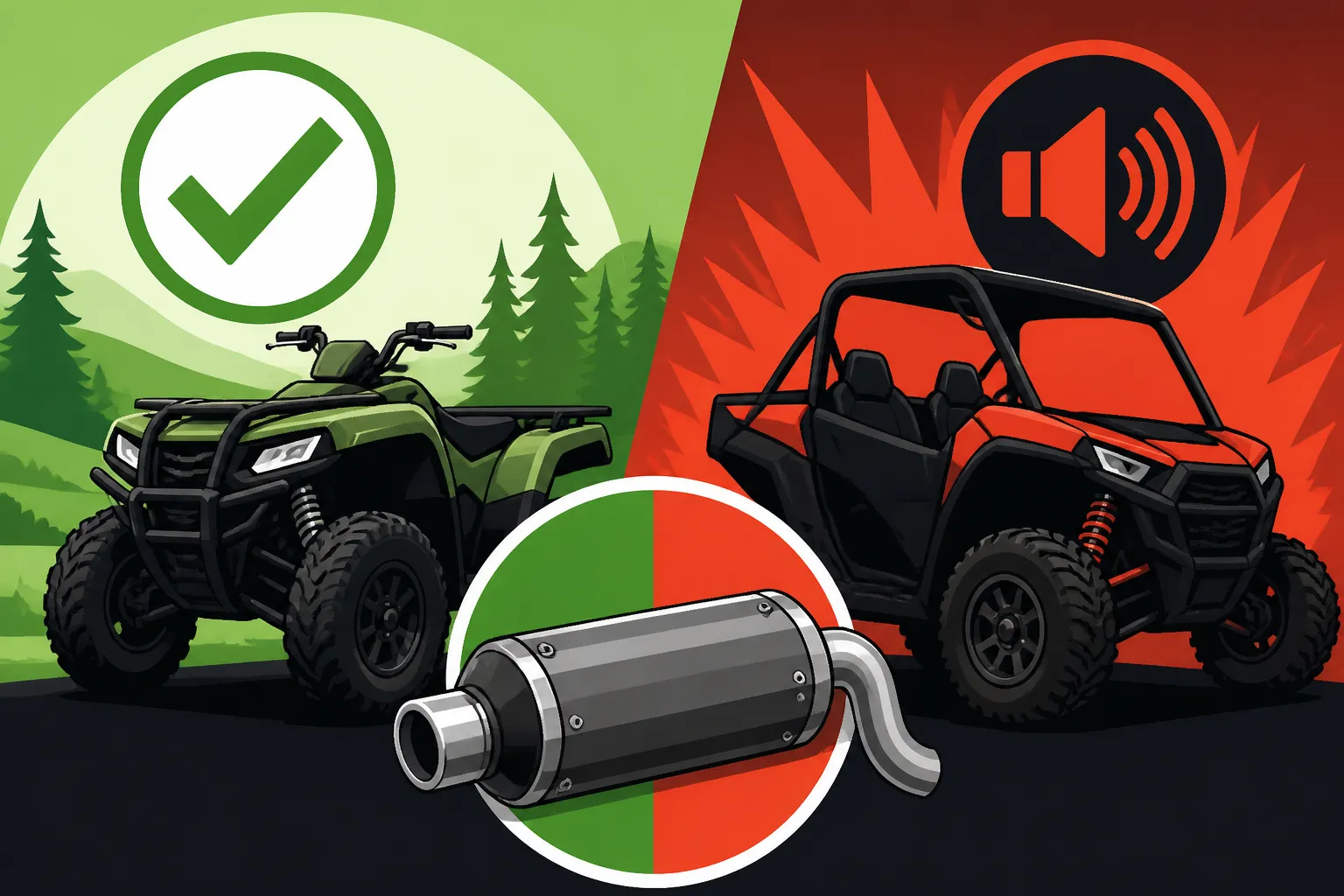
Mufflers Under the Federal Noise Standard
There's nothing quite like the roar of an ATV engine, especially when you're out on the trails, but that exhilarating sound can quickly become a headache – for you, for other riders, and especially for the folks living near our riding areas. One of the most common points of friction between ATV enthusiasts and communities, or even between riders and law enforcement, often comes down to noise. An excessively loud machine isn't just annoying; it can actually be illegal and lead to serious consequences, jeopardizing our access to trails. This guide is all about helping you understand the rules around ATV mufflers, specifically how federal noise standards impact your riding in New York, and how you can ensure your machine stays compliant, keeping the trails open for everyone.
Why ATV Noise Matters More Than You Think
It’s easy to think that a little extra rumble from your quad isn't a big deal, especially when you’re out having fun. But the truth is, the sound your ATV makes has far-reaching consequences that go beyond just your personal preference. From maintaining access to our beloved trails to respecting the natural environment, managing noise is a critical aspect of responsible ATV ownership in New York. Ignoring these realities can lead to frustrating closures and fines for all of us.
Community Friction and Trail Access
The perception of ATVs can really suffer because of noise pollution. For residents living near trails, especially in quieter rural areas, the sound of loud machines can carry for miles, disrupting their peace and quiet. Imagine a family enjoying their serene backyard on a beautiful Saturday afternoon, and suddenly a group of ATVs with straight pipes rumbles by, rattling windows and drowning out conversation. That kind of experience doesn't foster good neighborly relations; it builds resentment and can lead to complaints, petitions, and ultimately, stricter regulations or even outright trail closures. This is a battle many riders across New York are fighting constantly.
It’s a classic "tragedy of the commons" situation where a few loud riders can unintentionally spoil the experience for everyone else. This negative perception paints all ATV riders with the same broad brush, making it incredibly difficult for responsible clubs and advocates to lobby for new trails, secure landowner permissions, or maintain access to existing ones. Every time a machine is excessively loud, it undermines the hard work put in by those who strive to keep our riding areas open.
Furthermore, it's not just about residential areas either. Other trail users – hikers, cyclists, even horseback riders – often seek out the peace and quiet of nature. When our machines are overly loud, we disrupt their experience, creating conflict and contributing to the narrative that ATVs don't belong on multi-use trails. Being mindful of our sound output is a crucial part of being a good trail steward, ensuring that everyone can enjoy New York's beautiful outdoors without unnecessary friction.
Environmental Impact and Wildlife Disturbance
Beyond human discomfort, excessive noise can have a tangible impact on local wildlife and the delicate ecosystems we ride through. Studies have shown that sudden, loud noises can startle animals, disrupt breeding patterns, and even cause them to abandon vital habitats. While a single ATV might not make a huge difference, the cumulative effect of many loud machines over time can be significant, particularly in sensitive environmental areas. This isn't just an abstract concern; it's something environmental agencies and conservation groups actively monitor, and it often feeds into their arguments against ATV access in certain natural areas.
Think about nesting birds or deer fawns. Constant, jarring noise can force them to expend more energy to avoid perceived threats, stress them out, or push them into less ideal foraging or breeding grounds. This can have long-term effects on local populations. Maintaining a quieter machine isn't just about legality; it's about respecting the very environment we choose to enjoy with our ATVs. We want to be able to continue enjoying these wild spaces, and that means being good neighbors to the creatures that call them home.
Additionally, a damaged or poorly maintained muffler can also lead to increased emissions, even if it's just a small amount. While the primary focus of noise regulations isn't emissions, a system that's failing in one area often isn't performing optimally in others. Keeping your exhaust system in good repair ensures both noise and emissions are within acceptable limits, protecting both the air quality and the soundscape of New York's natural areas. It's another layer of environmental stewardship that comes with responsible ATV ownership.
The Basic Legal Imperative
At its core, having a compliant muffler is a fundamental legal requirement in New York, just like [New York Equipment Rules for ATVs]. These laws aren't just arbitrary rules; they are put in place to address legitimate concerns about noise pollution and to maintain peace and order in shared public and private spaces. Ignoring these rules isn't just risky; it demonstrates a disregard for the law and the communities we ride near, which can have ripple effects for all ATV enthusiasts.
Law enforcement, whether it's the New York State Police, a county sheriff, or local conservation officers, takes these regulations seriously. An officer pulling you over for an unregistered machine might also notice an illegally loud exhaust. It's an easy "add-on" ticket that can quickly make a bad day worse. Officers are often on the lookout for obvious violations, and a roaring ATV that can be heard from a distance is undeniably hard to miss. These visible and audible infractions are low-hanging fruit for enforcement.
The fines and potential for impoundment or other penalties are very real, and they can be quite costly. It is always far cheaper and infinitely less stressful to ensure your machine is compliant before you hit the trail than it is to deal with the financial and logistical aftermath of a citation. We'll delve deeper into these federal standards and New York's specific requirements shortly, but the underlying message is crystal clear: compliance with noise regulations is not merely a suggestion; it is a mandatory part of safe and legal ATV operation.
Deciphering the Federal Noise Standard for ATVs
When people talk about noise standards for off-highway vehicles, it can feel like navigating a maze of acronyms and technical jargon. What exactly does "federal noise standard" mean for your ATV, and how does it actually apply to a day of riding out on the trails? It's not always a straightforward federal law with an officer standing by with a decibel meter, but rather a standard that influences how your ATV is manufactured and, consequently, how it should sound.
The Role of SAE J1287
When we talk about "federal noise standards" for ATVs, we're largely referring to the Society of Automotive Engineers (SAE) J1287 standard. This isn't a federal law itself, but rather an industry-developed test procedure that manufacturers use to measure and certify the noise levels of their off-highway motorcycles and ATVs. The Environmental Protection Agency (EPA) then references this standard in its regulations, making it the de facto benchmark for acceptable ATV noise.
SAE J1287 specifies a very particular test to ensure consistency across different manufacturers and models. The ATV is warmed up to operating temperature, and then a sound meter is positioned 20 inches from the exhaust outlet, at a precise 45-degree angle. The engine is then revved to a specific percentage of its maximum RPM – typically half of its rated maximum – and a reading is taken. The magic number for ATVs under this standard is generally 96 dB(A) at that half-throttle measurement, which is the maximum allowable noise level. It's a very specific, repeatable test designed to give a consistent measurement across different machines and conditions, providing a fair standard for all.
Why half-throttle? It's considered a representative operating condition that generates a significant amount of noise without redlining the engine, which would give an artificially high and less relevant reading for general riding. This standard ensures that when you purchase a new ATV from a reputable dealer, it meets a baseline level of quiet operation right off the showroom floor. Any modification that makes a machine significantly louder than that 96 dB(A) threshold is generally considered non-compliant under the federal reference and can quickly get you into trouble.
How the EPA Got Involved in ATV Noise
The Environmental Protection Agency (EPA) has a broad mandate to protect human health and the environment, and this mandate specifically includes regulating noise pollution. While the EPA doesn't directly test every single ATV that rolls off an assembly line, it sets comprehensive regulations that require manufacturers to certify that their products, including ATVs, meet certain noise emission limits. These limits are almost always based on or directly reference the aforementioned SAE J1287 standard, establishing a uniform level of acceptable noise across the industry.
This EPA involvement means that manufacturers are legally obligated to design their stock exhaust systems to comply with these stringent standards. That's precisely why your brand-new quad comes equipped with a muffler that often appears and feels quite restrictive compared to some of the aftermarket options you might see. It's not just about optimizing performance; it's fundamentally about meeting federal noise regulations that impact their ability to sell machines across state lines and throughout the country. Any modifications that increase noise above the certified level can render the machine non-compliant, putting both the rider and potentially the retailer at risk.
It's crucially important to understand that while individual states like New York don't always have their own specific decibel limits for ATVs written directly into their vehicle and traffic laws, they frequently defer to or incorporate these federal standards by reference. So, even if the New York state code doesn't explicitly state "96 dB(A)", an officer can still enforce violations based on a "modified exhaust system" that clearly exceeds the federally accepted standard or simply for making "unnecessary noise." This is a key point linking back to [Mufflers Under the Federal Noise Standard] and how it translates to practical, local enforcement on New York trails and roads.
The OEM Standard Versus Aftermarket Reality
Original Equipment Manufacturer (OEM) mufflers are far more than just noise-reduction devices; they are meticulously engineered components that play a vital role in the entire powertrain system of your ATV. They are designed not only for sound compliance but also for specific engine back pressure, optimal emissions control, and overall performance characteristics precisely as intended by the manufacturer. They represent a carefully balanced part of the whole system, designed for a broad range of operating conditions.
The aftermarket, in contrast, offers a vast and sometimes bewildering array of exhaust systems. Some aftermarket options are meticulously designed for maximum performance, some for a unique "sound signature" that appeals to certain riders, and unfortunately, a significant number are designed with little to no regard for existing noise regulations. It’s a very common scenario for riders to replace their stock muffler with a louder, more aggressive-sounding one, often without fully realizing the serious legal implications or the wider impact on the communities and ecosystems where they ride.
When you're considering an aftermarket exhaust, it’s absolutely crucial to look for systems that explicitly state they are "SAE J1287 compliant" or "USFS (U.S. Forest Service) approved" for sound. These certifications indicate that the product has undergone testing and meets recognized noise standards. Companies like SuperATV, for instance, often offer exhaust components that aim to strike a balance between performance gains and compliance, understanding that responsible riders want both power and legal peace of mind. Simply installing a "performance" exhaust without first checking its sound rating is a risky move and a recipe for potential trouble.
New York's Approach to ATV Noise Enforcement
New York State has its own unique way of addressing ATV noise, which often leaves riders scratching their heads. Unlike some other states that might have explicit decibel limits written directly into their laws, New York's approach is a bit more nuanced. It relies on broader statutes and the discretion of law enforcement, making it even more important for riders to understand the spirit of the law, not just the letter.
New York's Reference to General Noise Statutes
New York State law doesn't typically state an exact decibel limit for ATVs, unlike some other states that have directly adopted the SAE J1287 standard into their vehicle code. Instead, New York generally approaches ATV noise through broader statutes concerning "unnecessary noise," "modified exhaust systems," and general public nuisances. This gives law enforcement officers the discretion to determine what constitutes excessive noise without necessarily needing a decibel meter on hand for every roadside stop. It’s a judgment call based on what is generally considered acceptable.
The Vehicle and Traffic Law (VTL) in New York, which governs many aspects of vehicle operation, often requires mufflers to be "in good working order to prevent excessive or unusual noise." This phrasing is critically important. It means that if your muffler is rusted out, has a gaping hole in it, or has been illegally modified to be significantly louder than its original design, you're likely in direct violation of the law. It’s a more subjective standard than a precise decibel reading, but it is certainly no less enforceable. An officer's assessment, based on common sense and experience, holds significant weight.
Furthermore, New York often effectively adopts federal standards by reference. This means that if an ATV manufacturer is required to meet the 96 dB(A) at half-throttle standard, then a modified machine that clearly exceeds that level would very likely be considered in violation of the "good working order" or "unnecessary noise" clauses. This places the onus squarely on the rider to ensure their machine isn't significantly louder than its stock configuration, especially if they've made any alterations to the exhaust system. This is an important distinction to grasp when you're looking at [New York Equipment Requirements for ATVs].
The Impact of Local Ordinances and Posted Land
While state law provides a foundational baseline for ATV operation, it’s vital to remember that many towns, villages, and counties across New York have the authority to enact their own local ordinances. These local laws can, and often do, impose stricter rules regarding noise levels. These local statutes are frequently a direct response to resident complaints about ATV noise, highlighting the very real impact our machines can have on local communities. A town might, for example, have a specific decibel limit, or it might simply have a zero-tolerance policy for "loud vehicles" on designated ATV routes or when operating near residential areas.
For instance, a county that actively operates its own ATV trail system, such as Lewis County, might have very specific rules for noise levels as a prerequisite for its trail use permits. If you're caught riding on [The Lewis County ATV Trail System in New York] with an excessively loud machine, you could face significant fines, have your permit revoked, or even be permanently banned from using the trails. It's absolutely crucial to check and understand all local regulations and specific trail rules before you even load your machine, as the reality of [Why a New York Town May Be Stricter] becomes very apparent once you hit those local trails.
Beyond official government regulations, private landowners who graciously grant access for ATV trails – often facilitated by local clubs – frequently include specific noise stipulations in their access agreements. If you're riding on a club trail that traverses private property, and your machine is making an unholy racket, you're not just risking a ticket; you're risking that landowner pulling their permission. This single act could result in the closure of an entire section of trail for everyone, impacting hundreds of riders. Respecting noise limits is therefore vital for maintaining positive relationships with landowners and ensuring the continued viability of our trail systems.
What a New York Officer Checks Roadside
So, what exactly happens if a New York law enforcement officer suspects your ATV is too loud during a roadside stop? It's highly unlikely they will pull out a calibrated decibel meter to conduct a formal SAE J1287 test. That level of technical measurement is simply not practical or feasible for a routine roadside interaction. Instead, officers will primarily rely on their trained ears, their professional experience, and a thorough visual inspection of your exhaust system to make their determination.
An officer will be looking for clear and obvious signs of modification or damage that contribute to excessive noise. Is there a straight pipe where a muffler should be? Has the baffling inside the muffler been removed or altered? Are there noticeable holes, cracks, or loose components in the exhaust system? Does it look like an aftermarket exhaust that is clearly not designed for noise compliance, appearing much more aggressive than a standard stock setup? They might then ask you to rev your engine gently to get a clearer sense of the sound level your machine produces. If your ATV is significantly louder than a typical stock ATV, that's often sufficient grounds for them to issue a citation for a "modified exhaust system" or for creating "unnecessary noise." This falls under common roadside checks, just like ensuring you have [New York ATV Registration and Insurance Proof].
They might also conduct a quick check for a spark arrestor, which is a required safety feature often integrated directly into the muffler system. While its primary purpose is fire prevention, a missing or obviously modified spark arrestor can also indicate a non-compliant exhaust system and further strengthen an officer's assessment of excessive noise. A quick visual inspection, a listen to your engine under light throttle, and perhaps a question or two about your exhaust setup are usually all it takes for an officer to make a judgment call on noise compliance. It’s a good reminder that [What a New York Officer Checks Roadside] extends far beyond just checking registration and insurance documents.
Understanding Your ATV's Muffler System
Your ATV's muffler is often taken for granted, but it's a finely tuned component that does a lot more than just quiet your engine. It's a critical part of your machine's overall design, impacting everything from performance to emissions. Understanding how it works and what options are out there can help you make informed decisions about your machine, keeping it running well and, crucially, within legal noise limits.
Stock Mufflers and Their Design Intent
The muffler that originally came with your ATV from the factory is a truly impressive piece of engineering. It's designed to accomplish several critical tasks simultaneously: first, to effectively reduce engine noise to comply with strict federal and state regulations; second, to optimize exhaust flow, which is crucial for the engine's intended performance; and third, to ensure that the machine meets stringent emissions standards. Manufacturers pour significant research and development resources into perfecting these complex systems, balancing multiple, often conflicting, objectives.
A stock muffler is far from being just a hollow tube. Inside, it’s a meticulously designed labyrinth of chambers, baffles, and often sound-absorbing packing material. This intricate internal structure is precisely engineered to cancel out sound waves through a process called destructive interference, and to slow down the velocity of exhaust gases. This complex design is what makes it remarkably effective at quieting the engine without excessively choking performance – though many riders often perceive it as restrictive due to its quiet nature. It represents a careful compromise, engineered for broad consumer appeal and strict regulatory compliance.
It’s important to remember that these OEM systems are built for unparalleled reliability and long-term longevity under a wide range of normal operating conditions. While they may not offer the loudest roar or the absolute peak horsepower that some aftermarket systems promise, they provide a compliant, consistent, and generally trouble-free experience for the average rider. Modifying a stock muffler in any way, such as drilling holes in it, removing internal baffles, or cutting it open, instantly voids its compliance, damages its effectiveness, and can lead to significant legal issues.
Aftermarket Exhaust Systems: Power vs. Sound
The world of aftermarket ATV exhausts is incredibly vast and diverse, offering a bewildering array of choices. Many riders are naturally drawn to aftermarket options with the goal of unlocking more horsepower, reducing the overall weight of their machine, or simply achieving a more aggressive and distinctive exhaust note. There's a common and persistent misconception that "louder automatically equals faster," but this is frequently not the case. While some genuine performance gains can certainly be achieved, a poorly designed or chosen aftermarket system can actually hurt overall performance and will almost certainly increase noise levels far beyond legal limits.
Performance-oriented aftermarket exhausts primarily aim to create less back pressure in the exhaust system, which theoretically allows exhaust gases to exit the engine more quickly and efficiently. This reduction in restriction can potentially lead to a slight increase in horsepower and torque, particularly at higher RPMs. However, achieving this often involves a much simpler, less restrictive internal design compared to stock mufflers, which inevitably translates to significantly more noise. Some systems are specifically designed purely for racing on private tracks where noise limits might be different or even non-existent, and these are often entirely unsuitable and illegal for use on public trails or designated riding areas.
When you're shopping for an aftermarket system, it is absolutely crucial to differentiate between those designed purely for competition and those specifically intended for general trail use. Reputable brands like SuperATV understand these distinctions and often offer exhaust systems that provide noticeable performance benefits while still aiming for a sound profile that aligns with compliance requirements. They recognize that riders want both increased power and legal peace of mind. Always look for certifications (like USFS approval) or clear, published statements about sound levels if you intend to ride on public lands or managed trails. If an aftermarket exhaust doesn't explicitly mention compliance, it’s a strong indicator that it is likely too loud for general trail use and could lead to issues.
Identifying a Compliant Aftermarket Solution
Choosing an aftermarket muffler for your ATV can definitely feel like a daunting task, fraught with confusing claims and technical specifications. However, it’s certainly not impossible to find a system that delivers improved performance without breaking the sound barrier or, more importantly, the law. The absolute key here is to be an informed and discerning consumer, prioritizing legal compliance alongside any performance aspirations you might have. The first and most critical thing to look for is an exhaust system that features a USFS-approved spark arrestor, as this often indicates that the system has been designed with at least some level of environmental and noise consideration in mind.
Beyond the presence of a spark arrestor, you should actively look for explicit statements about sound levels from the manufacturer. Some transparent manufacturers will readily publish the decibel ratings for their exhausts, often measured and certified using the SAE J1287 standard. If a company prominently boasts about how incredibly loud their exhaust is, or uses terms like "unrestricted race sound," that should be a significant red flag if your intention is trail legality. Instead, gravitate towards systems marketed as "trail-friendly," "low-noise," or "sound-compliant." These products are designed with responsible riding and community harmony in mind, recognizing the importance of maintaining access.
Brands like SuperATV, for example, often develop specific exhaust components that are meticulously engineered to enhance your machine's performance while simultaneously maintaining a sound profile that respects established legal limits. They understand that responsible riders often seek the best of both worlds – improved power coupled with the peace of mind that comes from compliance. Don't ever hesitate to ask pointed questions before you commit to a purchase: "Is this system compliant with federal noise standards for trail riding in New York?" or "What is the published decibel rating for this specific exhaust?" A little bit of thorough research upfront can genuinely save you a substantial amount of grief (and money) further down the line.
Ensuring Compliance and Avoiding Consequences
The thought of getting pulled over, or worse, getting a ticket, can definitely put a damper on any ride. When it comes to ATV noise, ensuring your machine is compliant isn't just about avoiding a fine; it's about being a responsible rider and protecting our collective access to trails. Knowing how to check your machine and what to do if you find yourself on the wrong side of the law is crucial for stress-free riding.
Pre-Ride Checks for Sound Compliance
Before you even think about loading your ATV onto a trailer or hitting a single trail, it's absolutely essential to take a few moments to perform a quick, yet thorough, check of your exhaust system. This proactive inspection can save you a lot of grief. Begin by visually examining the entire muffler and exhaust pipe for any obvious signs of damage: look for cracks, holes, loose connections, or missing bolts or hangers. These seemingly minor issues can all lead to increased noise levels and are clear indicators that your system is not functioning as it was originally intended.
Next, fire up your ATV and simply listen to it run. Does it sound significantly louder than it used to? Does it emit an unusual rattle, a distinct "blown out" sound, or an excessive raspiness that wasn't there before? These are all major red flags that something in your exhaust system might be compromised. If you've recently installed an aftermarket exhaust, take it for a short, controlled test ride in a private, safe environment and pay extremely close attention to the sound. Does it seem excessively loud even to your own ears? If your gut feeling tells you it's too noisy, it probably is.
If you're particularly concerned or just want to be extra diligent, you can invest in an inexpensive decibel meter. These are readily available online or at most electronics stores. While it won't be as precise as a formal SAE J1287 test conducted in a lab, it can provide you with a very good, informal indication if your machine is wildly out of compliance. To get a reading, hold the meter at arm's length, positioned directly behind the exhaust outlet, and have a trusted friend or family member gently rev the engine to approximately half-throttle. If your meter is consistently reading well above the 96 dB(A) mark, you definitely have a noise problem that needs immediate attention.
Fines and Penalties for Excessive Noise in New York
Riding an ATV with an illegal or excessively loud exhaust system in New York can lead to consequences far more severe than just a stern talking-to from an officer. The fines for such violations can be substantial and hit your wallet hard. While specific amounts can fluctuate based on the particular county or town where the infraction occurs, and also at the discretion of the issuing officer, you could easily be looking at hundreds of dollars for a first offense. These penalties are often more severe if the officer perceives your exhaust modification as deliberate or your machine as egregiously loud and disruptive.
Beyond the immediate monetary penalty, repeated offenses or engaging in extremely disruptive behavior could escalate to your ATV being impounded. Imagine the immense hassle, stress, and additional cost of retrieving your machine from a tow yard, all on top of the original fine and any storage fees! There's also the potential for points on your driver's license, though this is generally less common for ATV-specific violations unless the noise infraction is tied to a broader vehicle and traffic law infraction. Always remember that [New York Fines for an Unregistered ATV] are just one piece of the puzzle; noise violations add another layer of potential trouble that you really want to avoid.
Perhaps even more impactful, especially for dedicated riders who enjoy New York's trails regularly, is the very real potential for losing trail access. Many public and private club trails have strict rules against overly loud machines as a condition of use. Getting a ticket, or even just receiving a warning from trail staff or a landowner, could result in your permit being revoked, or you being permanently banned from using that particular trail system. This doesn't just affect you personally; it negatively impacts the entire riding community as maintaining trail access is a privilege we collectively work very hard to preserve.
How to Get Back in Compliance
If you discover that your ATV is too loud, or if you've unfortunately been cited for an exhaust violation, there's no need to despair; the situation is usually quite fixable. The most straightforward and reliable solution is to replace the non-compliant aftermarket exhaust with an Original Equipment Manufacturer (OEM) stock muffler. These parts are specifically designed and guaranteed by the manufacturer to meet all relevant noise standards, offering you immediate peace of mind and legal compliance. While an OEM muffler might sometimes be more expensive upfront than some aftermarket options, it provides a guaranteed solution.
If you currently have an aftermarket system, it's worth checking if it's possible to install a "quiet core" insert or to simply repack the muffler. Many performance mufflers are designed with the expectation that they will be repacked periodically with specialized fiberglass or stainless steel wool packing material. This packing material naturally degrades and burns out over time, which significantly reduces its sound-dampening capabilities and makes the muffler much louder. Repacking is often a relatively inexpensive, do-it-yourself fix for many aftermarket systems, usually involving little more than removing an end cap and replacing the old packing. If you're looking for replacement packing or quieter inserts, sometimes companies like SuperATV offer components that can help bring your current system into compliance without requiring a full, costly replacement.
For older stock mufflers that have succumbed to rust or have developed significant holes, simply patching them is usually a temporary solution at best. Corrosion tends to be widespread once it sets in, and a new, intact muffler will ensure proper function and effective noise reduction for the long haul. Remember, achieving and maintaining compliance isn't solely about avoiding tickets and fines; it's fundamentally about being a responsible ATV rider and contributing positively to the overall reputation and sustainability of the ATV community in New York.
Maintaining Your Muffler System for Longevity and Compliance
Your ATV's exhaust system, especially the muffler, takes a lot of abuse out on the trails. From jarring impacts to constant exposure to mud, water, and extreme temperatures, it's a component that needs regular attention. Neglecting your muffler can quickly lead to increased noise, reduced performance, and eventually, expensive repairs or tickets. A little proactive care goes a long way in keeping your ride compliant and quiet.
Regular Inspection and Care
Proactive maintenance is truly your best friend when it comes to keeping your ATV's exhaust system compliant, effective, and free from issues. After every few rides, or certainly before you embark on any major trips or long trail excursions, dedicate five quick minutes to visually inspect the entire exhaust system. Start by looking for any loose bolts where the muffler connects to the header pipe, or where the exhaust hangers attach to the ATV's frame. The constant vibrations and stresses from riding can cause these critical fasteners to loosen over time, which can lead to exhaust leaks and a noticeable increase in noise.
Next, diligently check for any signs of cracks, paying particular attention to areas around welds and bends in the exhaust piping. Exhaust systems are routinely exposed to extreme temperature fluctuations, potential impacts from trail debris, and corrosive elements such as mud, water, and even road salt during transport or storage. All of these factors can contribute to metal fatigue and cracking. Be especially thorough when inspecting the muffler body itself, as well as the header pipe where it exits the engine cylinders. Even small, hairline cracks can allow exhaust gases to escape prematurely, significantly increasing the overall noise level.
Finally, make it a habit to thoroughly clean off any accumulated mud, dirt, and debris from your muffler, especially after navigating deep mud holes or water crossings. While a muffler is designed to withstand a certain amount of abuse, a thick, caked-on layer of mud can effectively trap moisture against the metal surface, dramatically accelerating the corrosion process. A simple rinse with a hose after a ride, once the system has completely cooled down, can go an incredibly long way in preventing premature rust and potential damage. This simple, consistent step can prevent unexpected costs and help ensure your machine remains compliant for many rides to come.
Addressing Common Muffler Issues
One of the most common issues, particularly prevalent with aftermarket performance mufflers, is the gradual degradation of the internal packing material. Over time, the fiberglass or stainless steel wool packing inside the muffler can burn out, become compressed, or simply disintegrate, which severely reduces its crucial sound-dampening capabilities. If you notice that your muffler suddenly sounds significantly louder than before, and perhaps has developed a distinctly raspier or hollow tone, it’s a very strong indicator that it’s likely time for a repack. This process is usually quite straightforward for many aftermarket systems, typically involving just the removal of an end cap and the careful replacement of the old packing with fresh material.
Rust and corrosion stand as another persistent enemy of exhaust systems, especially in New York's highly variable climate where machines might be inadvertently exposed to road salt during transport or stored in damp, unheated conditions. Small pinholes that initially appear innocuous can very quickly grow into larger, more significant holes, leading to excessive and illegal noise. While temporary fixes using high-temperature exhaust repair putty or tape do exist, they are rarely permanent or fully effective solutions. For any significant rust damage, the most reliable and long-term solution is almost always the replacement of the affected section or, if the damage is widespread, the entire muffler.
Gaskets and seals play an incredibly critical role in maintaining a quiet and efficient exhaust system. There are typically gaskets where the header pipe connects to the cylinder head of the engine, and often another where the muffler connects to the header pipe. If these vital gaskets fail or deteriorate, hot exhaust gases can escape, creating a loud "hissing" or "ticking" sound and often leading to reduced engine performance. These gaskets are generally relatively inexpensive parts to replace and should be thoroughly checked and replaced if you notice any persistent exhaust leaks or unusual noises that are not clearly coming directly from the muffler outlet itself.
Choosing Replacement Parts Wisely
When the inevitable time comes to replace components of your ATV’s exhaust system, whether it’s a brand-new muffler, a section of header pipe, or even just some gaskets, making wise choices is paramount. Opting for cheap, unbranded parts might seem like a way to save a few dollars upfront, but these components often don't last as long, may not fit correctly, and are highly unlikely to meet the stringent noise compliance standards required for legal riding. Always prioritize quality, durability, and, crucially, compliance over the lowest possible price.
If you're replacing a full muffler, consider sticking with Original Equipment Manufacturer (OEM) parts, which guarantee compliance and proper fitment. Alternatively, choose a highly reputable aftermarket brand that explicitly states its products are USFS-approved for sound or meet the SAE J1287 standards. This is precisely where researching trusted brands like SuperATV can pay significant dividends; these companies often provide clear specifications and certifications that genuinely help you make an informed and responsible choice for [New York Equipment Requirements for ATVs].
For smaller, but equally critical, components such as gaskets, springs, or exhaust hangers, always endeavor to use parts that precisely match the original equipment specifications. The correct fit and appropriate material are absolutely crucial for effectively sealing exhaust gases and preventing unwanted vibrations that can lead to excessive noise and premature wear. Don't ever underestimate the significant role these seemingly small parts play in the overall sound, integrity, and long-term compliance of your ATV's exhaust system. A well-maintained and compliant muffler system is, without a doubt, a key part of responsible and enjoyable ATV ownership in New York.
| Feature | Stock OEM Muffler | Performance Aftermarket Muffler | Trail-Friendly Aftermarket Muffler |
|---|---|---|---|
| Noise Level | Generally quiet, designed to meet 96 dB(A) | Often significantly louder, frequently above legal limits | Louder than stock, but aims for compliance (e.g., USFS) |
| Performance | Optimized for balanced power/emissions | Can offer peak power gains, but may affect low-end torque | Often provides modest, balanced gains over stock |
| Legality (NY) | Compliant | Often non-compliant on public trails/roads | May be compliant if USFS/SAE J1287 rated and maintained |
| Cost | Moderate to high | Moderate to high | Moderate to high |
| Maintenance | Low, generally sealed, durable packing | May require periodic repacking more frequently | May require periodic repacking |
| Spark Arrestor | Typically integrated and compliant | Varies widely; check for inclusion and compliance | Usually integrated and USFS approved |
| Community Impact | Low, reduces complaints, fosters good relations | High, increases complaints and potential for trail closure | Moderate, better than full race, but still audible |
| Weight | Often heavier due to complex internal baffling | Can be lighter due to simpler internal design | Varies, can be lighter than OEM |
Disclaimer
This article is for general informational purposes only and does not constitute professional advice. Laws, prices and regulations vary by location and change over time. Consult a qualified professional for guidance on your specific situation.