County Permits Instead of a State Sticker
A New York ATV rider can have a valid registration and still be turned away from a trail system for not having its access permit. That’s because New York does not issue one statewide trail sticker for every riding area. This guide explains how county and club permits work, how they differ from registration, and what to check before you travel or buy a pass.
A trail permit is not the same as ATV registration
New York’s registration system and its trail-access systems answer different questions. Registration concerns whether a machine is registered for use under state rules. A trail permit concerns whether the rider has permission to use a particular trail network.
That distinction matters even if both items look like stickers or documents you carry on a ride. A county or club permit does not replace a required New York registration, and registration does not automatically grant access to every county trail, private trail, park, or club route.
For a wider overview of the state requirement, see Do You Need to Register an ATV in New York?. If you are visiting from another state, New York Reciprocity for Out-of-State Registrations covers the separate question of whether New York recognizes an out-of-state registration.
| What you need to check | What it generally covers | Who sets the rule |
|---|---|---|
| ATV registration | Whether the machine is registered under the applicable state rules | New York State |
| Trail permit or pass | Access to a particular trail system, county network, or club trail | The county, club, land manager, or trail operator |
| Landowner permission | Permission to ride on private property | The landowner |
| Safety and riding rules | Requirements such as insurance, helmets, age limits, and equipment | State law and, in some cases, the trail operator |
A useful way to think about it: registration is about the machine’s legal status, while a trail permit is about access to a place. You may need both before riding. In some locations, access may instead depend on membership, direct permission, a day pass, or a temporary closure notice.
This is why the phrase “I have my New York sticker” is not enough to plan a ride. First identify the trail system you intend to use. Then check its current entry requirements. A trail map may show a route, but a line on a map does not necessarily mean the route is open to every ATV rider or covered by a particular permit.
What a permit does not do
A trail permit does not usually authorize you to ride anywhere in the county. It is tied to the system or access arrangement that issued it. It also does not override a closed gate, landowner restriction, posted notice, or state riding rule.
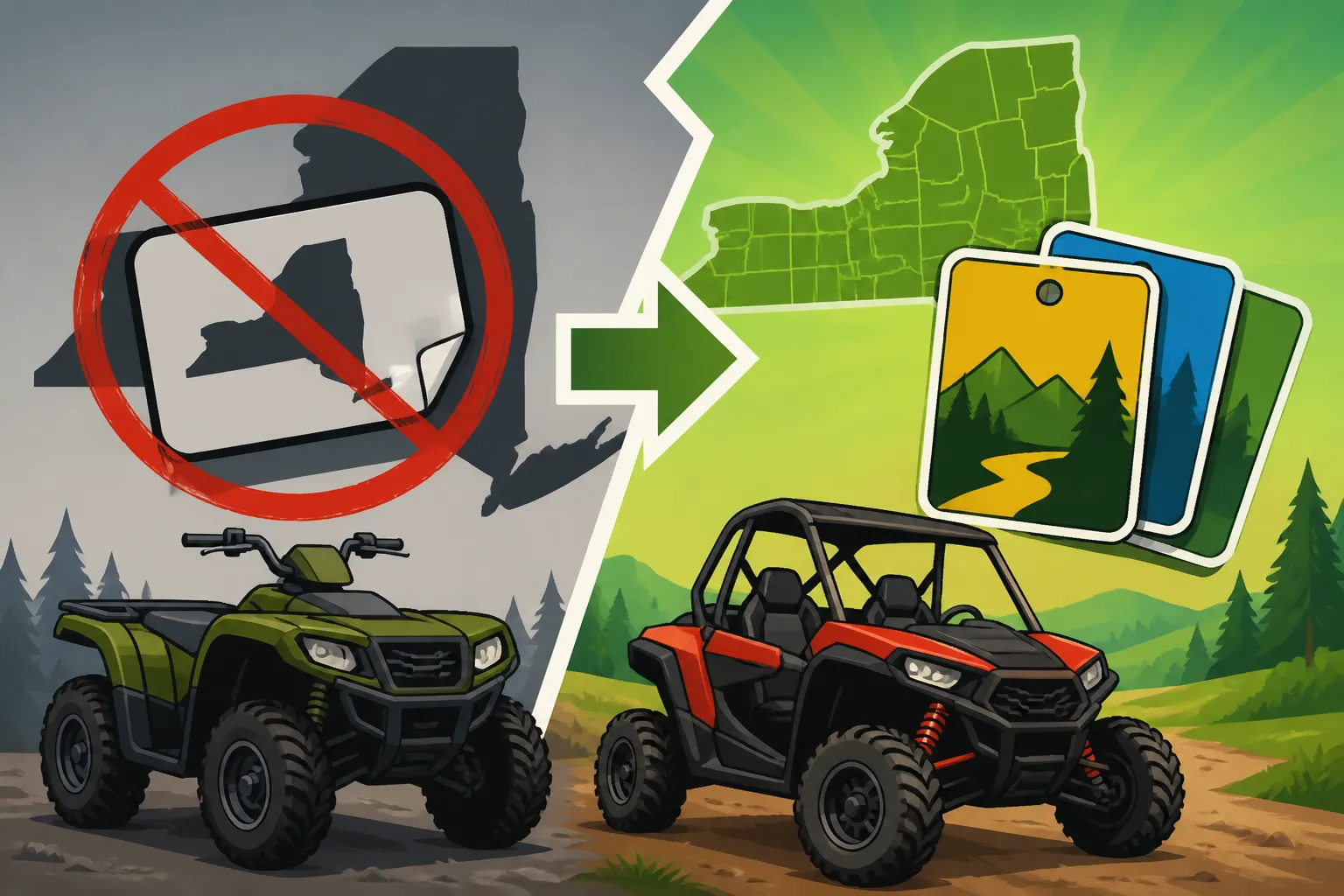
Nor does a pass for one county automatically work in a neighboring county. New York has no single statewide trail pass that gives you blanket access to all county and club trails. The state’s registration program and local trail-access programs are separate. For more background, see Why New York Has No Statewide Trail Pass and County Permits Instead of a State Sticker.
Before you assume a pass covers your whole trip, confirm the exact network named by the issuing organization. If a route crosses county lines, changes from county-managed to club-managed trails, or uses private land, the permit arrangements may change along the way.
Why New York uses county and local trail permits
Trail access in New York is often built around local agreements and local management rather than one statewide network. Counties, clubs, landowners, and other operators may coordinate access for a defined area. Their arrangements can differ because they do not necessarily manage the same land, trails, or services.
A county permit may support access to a network the county administers or coordinates. A club may maintain trails that rely on permission from private landowners. Another route may be open only to club members, or may require a separate pass. The details are local, so it is risky to treat one county’s rules as a template for another’s.
That local structure has practical benefits. A county or club can organize trail access around the agreements and conditions it actually manages. It can also close a route when maintenance, weather, logging, or a landowner issue makes riding unsuitable. The trade-off is that riders must do more checking before they head out.
Permit systems can differ from one place to another
A trail system may use one or more of these arrangements:
- A permit or pass purchased from a county or other designated seller
- A permit connected to membership in a local ATV club
- A day pass with limited availability or a specific purchase window
- A route open only to members or riders who meet local conditions
- No general access at all, unless the rider has direct landowner permission
These are examples of possible local arrangements, not a promise that a particular county offers each option. Do not rely on an old forum post or another rider’s pass as proof of current access. Check the trail operator’s latest instructions.
A county permit may also come with rules that go beyond displaying a sticker. The operator may set conditions for where you can ride, how you use the trail, or whether a permit is valid during a particular season. Read the instructions that come with the permit rather than assuming that purchase alone resolves every access question.
If your plans include Lewis County, for example, check the details specific to that system. Lewis County ATV Trail Permit Cost and Rules explains the local arrangement, while Which Trails a Lewis County Permit Covers focuses on the coverage question. Those details should not be carried over to another county without checking that county’s own rules.
Private land is still private land
A county or club permit does not automatically give you permission to leave the marked trail and ride across nearby property. Trail systems may depend on landowner agreements, and the route can be limited to the marked corridor. A pass is not a substitute for permission from a landowner whose property is not included in the trail agreement.
The same caution applies when a trail runs near a field, driveway, logging road, or farm lane. A route that looks like a convenient connection may not be open to public ATV use. Stay on the authorized trail and follow posted signs. For more on this issue, see New York Landowner Permission Rules and New York Rules for Riding Private Land.
How to check which permit you need
Start with the exact trail system, not a general search for “New York ATV permit.” That phrase can lead to state registration information, county trail permits, club memberships, or commercial riding parks. They are different things, and a purchase for one purpose may not cover another.
Use this process before loading your machine:
- Name the trail system. Identify the county, club, park, or operator responsible for the trails you want to ride. If your route crosses more than one network, list each one.
- Find the operator’s current access information. Use the county or club’s official information channels. Check whether the network is open and whether permits, membership, or a day pass are required.
- Confirm what the pass covers. Look for the precise trail system, eligible machine types, dates or season conditions, and any limits on where the permit may be used.
- Check the buying process. Confirm who is authorized to sell the pass, whether a permit must be purchased in advance, and whether it must be attached or carried in a particular way.
- Review rider and machine requirements. Make sure you have the required registration, insurance, and other documents, and that your machine is suitable and allowed on that trail.
- Check for closures immediately before leaving. A permit is not a guarantee that every route is open on your riding day.
- Carry proof of the access authorization. Keep any required pass or confirmation where you can show it, and follow the operator’s instructions for displaying it.
The details matter. A county may announce where to buy a permit, whether it is available online or through local sellers, and whether the permit is associated with a particular machine. Do not assume you can transfer a sticker from one quad to another, or that a digital receipt is an acceptable substitute for a physical permit, unless the operator says so.
You may see permit stickers or trail passes offered through informal sellers, social media, or online marketplaces. Use only the authorized sales channel identified by the trail operator. A listing on Amazon or another marketplace is not proof that a pass is valid for a county trail system. Amazon may be useful for unrelated ride supplies, such as a document pouch, but it is not a substitute for confirming the permit issuer and coverage.
If you want to protect a paper confirmation or permit from rain and mud, a document sleeve bought on Amazon might help with storage. But do not cover a sticker or alter its placement in a way that conflicts with the issuing organization’s directions. Follow the permit instructions first; accessories come second.
Keep separate records for separate requirements
A practical ride folder can prevent confusion. Keep the machine’s registration and insurance proof separate from county or club access documents, even if you carry them together. That way, if an officer or trail representative asks for one item, you can produce the right one without treating the documents as interchangeable.
For visitors, this separation is especially useful. An out-of-state registration may be recognized under New York’s reciprocity rules, but that does not mean the rider has a county trail permit. Likewise, buying a county permit does not resolve whether the machine’s registration or insurance meets state requirements. See Riding New York With an Out-of-State Plate for the registration issue and New York ATV Insurance Requirement for the insurance issue.
County permits, club memberships, and day passes
The word “permit” can describe different access arrangements, so read the operator’s wording carefully. A county permit may provide access to a county-associated network. A club membership may provide access to club trails or satisfy a local permit condition. A day pass may authorize a shorter visit, but only for the network and dates specified by its issuer.
These arrangements are not automatically interchangeable. A club membership does not necessarily function as a county permit everywhere. A county pass does not necessarily open a club trail. And a day pass for one system should not be assumed to cover a nearby system, even if the trails connect physically.
| Access arrangement | What to verify | Common mistake to avoid |
|---|---|---|
| County permit | The named network, machine coverage, validity period, and display or carry instructions | Assuming it covers every trail in the county |
| Club membership | Which trails the club maintains or has permission to use, and whether the membership is required for access | Treating membership as statewide access |
| Day pass | Where and when it is valid, how it is purchased, and whether availability is limited | Assuming a day pass can be bought at any time or trailhead |
| Landowner permission | The exact property and route covered by the permission | Treating permission for one parcel as access to nearby land |
| Commercial park pass | The facility, riding area, and rules included in the pass | Confusing a private park pass with a county trail permit |
A club can be important even where the county is involved. Clubs may help maintain trails, coordinate volunteers, and work with landowners. If club membership affects access or the permit process, confirm the details with the relevant club and county rather than relying on a general statement about “club trails.” See New York Club Memberships and Trail Access and What Club Dues Pay For.
Some systems may have specific sales windows or limits on day passes. If a pass is only available at certain times, buying it after you arrive may not be possible. Check the current availability before building a trip around a ride. For a county-specific example, Why a Day Pass Is Only Sold One Month a Year describes why riders should confirm the local process well in advance.
A route can cross more than one access system
A trail map can make a multi-county ride look seamless. The actual access rules may not be. One section may be maintained under a county permit, another may be a club trail, and a third may be closed or restricted. A route may also cross land where the public is allowed to ride only along a designated corridor.
Before attempting a long ride, trace the route and identify who controls each part. Ask whether one permit covers the full loop or whether you need separate authorization. If the trail operator cannot confirm that a connection is open, do not assume it is open because it appears on an older map or has tire tracks.
This is particularly important when a trail crosses private land. The landowner may have agreed to allow a marked trail but not open-ended riding, off-trail travel, or access outside the riding season. The trail’s continued availability depends on respecting those conditions. See Landowner Agreements That Keep Trails Open and What Happens When a Landowner Pulls Trail Permission.
Reciprocity for visitors does not create trail access
Riders visiting New York often ask whether an out-of-state plate is enough. Registration reciprocity and local trail access are separate questions. New York may recognize qualifying out-of-state registration under its rules, but that recognition does not act as a county trail permit or guarantee access to a private club network.
A visiting rider should check three things independently:
- Whether New York recognizes the machine’s registration
- Whether the rider has the insurance and other documents required for riding in New York
- Whether the destination trail system requires a county permit, club membership, day pass, or other access authorization
Do not infer that because your home state does not have a similar permit system, you are exempt from a local New York requirement. Trail access rules are tied to the network you plan to ride, not simply to the state where the machine is registered.
The reverse is also true: an out-of-state rider who buys a New York county permit still needs to satisfy applicable New York riding rules. A pass is not a waiver of state requirements. If you are bringing a machine from a nearby state, the relevant guide can help you separate the registration question from the trail-access question, such as Riding New York on a Pennsylvania Registration or Riding New York on a Vermont Registration.
Check rules for rented machines too
Renting an ATV does not necessarily mean trail access is included. A rental company may provide a machine and explain its registration or insurance arrangements, while the trail operator separately requires a permit or membership. Ask the rental company and the trail system directly what is included.
Before paying, clarify:
- Whether the rental machine is allowed on the intended trail
- Whether the rental fee includes the required trail permit
- Whether the renter must buy a pass separately
- Whether there are age or supervision conditions
- What documents the rider must carry
- Whether any route is closed or restricted on the rental date
Do not treat a rental confirmation as proof that the machine is authorized on every trail in the area. For more on the separate rental rules, see [New York Rules for Riding a Rented ATV].
Avoiding permit problems on ride day
Most permit problems come from assuming that one document covers more than it does, using outdated information, or failing to check a local closure. A few minutes of verification before you leave can save a long drive and a disappointing day at a trailhead.
Do not rely on old maps or old advice
Trail maps are useful planning tools, but they can become stale. A landowner may withdraw permission, a trail may be rerouted, or a section may close for maintenance or weather. A map that shows a connection does not necessarily prove that the route is open now or that your pass covers it.
Check the latest notice from the county, club, or operator. If you cannot find a clear answer, ask before riding. A trailhead sign may provide the final word on a closure, so pay attention when you arrive even if the route appeared open online.
Make sure the permit is valid for the machine and rider
Some permits or access programs may be associated with a particular machine, rider, membership, or season. Read the conditions before purchasing. If you own several machines, do not assume a single permit can be moved among them. If you are borrowing a quad, confirm who must hold the permit and whether the pass can be used by someone other than the purchaser.
For people who ride more than one machine, Do You Need a Separate Registration for a Second Quad? addresses registration, but trail-permit rules still need to be checked with the local operator. A registration arrangement and a trail-access arrangement can have different transfer rules.
Follow display instructions exactly
If the operator issues a sticker, follow its directions for attachment and visibility. If it issues a paper pass or confirmation, carry it in the form the operator accepts. A sticker in a glove box may not meet a display requirement, and a photo of a pass may not be accepted unless the operator says it is.
A protective holder or pouch can help keep paperwork dry, but it should not obscure required information or contradict the issuer’s instructions. Amazon and similar retailers may sell general-purpose holders, but buying one does not change the trail system’s display rules.
Keep access and safety documents together
Before loading, confirm that you have the documents relevant to both the machine and the trail. Depending on your situation, that may include registration, proof of insurance, a county or club permit, and any required rider documentation. Keep them accessible, not buried under gear.
An access permit also does not make a closed trail legal to ride. Stay on marked routes, respect gates, and do not use a pass as permission to cross private property outside the authorized corridor. If a local rule is unclear, stop and verify rather than guessing.
A simple checklist before you ride
Use this checklist whenever you plan to ride a New York trail network, especially if you are visiting from out of state or crossing between counties.
- Identify the exact county, club, or trail operator.
- Confirm that the trails are open for your planned date.
- Find out whether the system requires a permit, membership, day pass, or direct permission.
- Verify exactly which trails and machines the access document covers.
- Check whether the permit must be purchased in advance or through a specific seller.
- Confirm how the permit must be displayed or carried.
- Make sure your machine’s registration is valid for the ride.
- Carry the insurance and other documents required under New York rules.
- Review age, passenger, equipment, and trail-use rules that apply to your ride.
- Check for last-minute closures before departing and again at the trailhead.
- Stay on the authorized route and follow posted instructions.
The short answer is that New York has no single state trail sticker that substitutes for every local access rule. County permits, club access, and day passes are determined by the system you want to ride. Treat each as a separate permission, verify the current conditions with the operator, and keep that access paperwork distinct from registration and insurance.
Disclaimer
This article is for general informational purposes only and does not constitute professional advice. Laws, prices and regulations vary by location and change over time. Consult a qualified professional for guidance on your specific situation.