Machines New York Exempts From Registration
It's incredibly frustrating when you're just trying to enjoy your ATV or UTV in New York, but the rules around registration feel like a tangled mess of red tape and confusing exceptions. You've heard whispers about certain machines or uses being "exempt," but getting a clear, straight answer can feel impossible. This comprehensive guide is here to untangle that confusion, clearly outlining which machines and uses are truly exempt from ATV registration in New York, so you can ride with confidence and peace of mind.
Understanding New York's Core Registration Requirement
Before we dive into what doesn't need registration, it's really important to grasp the baseline. New York State, like many others, has a pretty clear stance: if you're operating an All-Terrain Vehicle (ATV) on public lands, public trails, or even on private land that isn't your own, you generally need to have it registered. This isn't just some arbitrary rule; it's a foundational piece of the state's efforts to manage trail systems, fund safety programs, and ensure accountability. Many riders assume that because it's "off-road," it's completely unregulated, and that simply isn't the case in the Empire State. Ignoring this core requirement can lead to some pretty hefty fines and a whole lot of headaches down the line. It's truly the starting point for understanding all the nuances that follow.
The Rationale Behind ATV Registration in New York
You might wonder, "Why does New York even care if my ATV is registered? It's not like I'm driving it on the road with cars." That's a fair question, and the answer comes down to several critical factors. First and foremost, registration fees play a vital role in funding the very trail systems many of us love to ride. Without these fees, the maintenance, signage, and development of designated ATV trails would suffer significantly. Think about the well-groomed paths and clear markers you see in places like Lewis County; much of that is supported by registration dollars.
Beyond funding, registration provides a mechanism for accountability and identification. In the unfortunate event of an accident, a dispute over land use, or even theft, a registered machine can be traced back to its owner. This helps law enforcement, property owners, and other riders. It also contributes to safety initiatives, as registration often ties into broader efforts to educate riders and enforce safety regulations. For instance, knowing how many ATVs are registered gives the state a better picture of the riding community, which can inform decisions about new trails or safety campaigns. It's all part of a larger ecosystem designed to keep the sport safe, accessible, and sustainable for everyone.
What "Operation" Truly Means in the Eyes of the Law
The term "operation" might seem straightforward, but in the context of ATV law, it's broader than just actively riding down a trail. In New York, "operating" an ATV generally means using it in any way on public land, designated trails, or even crossing a public road. This includes driving it from your camp to a trail access point, moving it between fields on someone else's property, or even letting it sit running while you chat with a friend by the trailhead. If the wheels are turning, or the engine is running and you're in control of it off your own private property, chances are it falls under the definition of "operation" and, therefore, potentially under the registration requirement.
This broad interpretation is crucial because many riders mistakenly believe that if they're just "staging" or briefly moving a machine, they're not technically "operating" it. But law enforcement often sees it differently. Even trailering your machine from out of state and then unloading it on a public access point could put you in a situation where proof of registration is expected if you plan to move it beyond that point. Understanding this wide scope of "operation" is the first step in determining if your particular use case truly qualifies for an exemption or if you need to go ahead and get that plate. You can read more about the general process in [Registering an ATV in New York].
The Agricultural Exemption: Farm Quads and Their Purpose
One of the most significant and commonly misunderstood exemptions for ATV registration in New York State revolves around agricultural use. If you're a farmer, or involved in farming operations, you might use an ATV daily for tasks around the property. New York acknowledges that these machines are tools of the trade, not recreational vehicles in this specific context, and has carved out an exemption for them. However, it's not a blanket exemption just because you live on a farm. There are specific criteria that must be met, and it's absolutely crucial to understand these details to avoid running afoul of the law. This exemption is designed to support the agricultural community, not to provide a loophole for recreational riding.
Defining "Agricultural Purposes" for ATV Use
So, what exactly constitutes "agricultural purposes" in the eyes of New York's Department of Motor Vehicles? Essentially, it means using the ATV directly in the production of crops, livestock, or other agricultural products. This could include tasks like herding cattle, inspecting fence lines, transporting feed or tools across fields, spraying small plots, or even moving irrigation equipment. The key word here is directly. If your ATV is primarily serving a function essential to the operation of a farm, it's likely to qualify.
What it doesn't mean, however, is simply riding your ATV for fun on farm property. Taking your kids for a joyride around the perimeter of the cornfield, or using it to explore the back woodlot for hunting (unless that hunting is directly related to managing game on a commercial farm), typically wouldn't fall under "agricultural purposes." The intent and primary use of the machine are paramount. If an officer were to question you, you'd need to be able to articulate how that ATV is directly contributing to the farm's productivity. It's a pragmatic exemption for working machines, not for recreational leisure. For more specific details, see [The Agricultural Exemption in New York].
Proof and Practicalities for Farm Quads
Even if your ATV is genuinely used solely for agricultural purposes, you can't just assume everyone will take your word for it. While you don't need a registration, you still need to be prepared to demonstrate that the exemption applies. This often means carrying proof of ownership and potentially documentation related to your farming operation, should you encounter law enforcement. A bill of sale or other ownership documents are critical here. You might also want to have a copy of the specific statute or a printed clarification from the DMV if you're particularly concerned, though generally, an officer familiar with rural areas will understand the context.
Furthermore, it's good practice to keep the machine clearly identifiable as a farm vehicle, if possible. While not legally required, sometimes having farm tags or simply carrying tools on the machine can visually reinforce its purpose. The biggest practical consideration, however, is ensuring that your agricultural use never spills over onto public roads or non-farm private land without proper registration. If you need to cross a town road to get from one section of your farm to another, for example, that momentary "public" use likely negates the exemption, and you'd then need to be registered. This is where many farmers can get caught out, believing the farm exemption covers all their use, even when a portion of that use is technically public.
Common Misconceptions About the Farm Exemption
There are a few persistent myths surrounding the agricultural exemption that can lead riders astray. One of the biggest is the belief that simply owning land zoned for agriculture automatically grants an exemption for any ATV used on it. Not true. The exemption isn't about the land's zoning; it's about the use of the ATV for direct agricultural production. If you have a hobby farm where you grow a few vegetables for personal consumption, using an ATV to tend that small garden might not be enough to justify the exemption if the machine is primarily used for recreation.
Another misconception is that the exemption extends to any vehicle on a farm. It specifically applies to ATVs used for agricultural purposes. A side-by-side that exceeds New York's strict definition of an ATV (which we'll discuss later) won't suddenly become exempt for farm use if it doesn't meet the initial ATV criteria. Similarly, allowing friends or family to ride your unregistered farm quad for fun on the property could blur the lines and potentially expose you to liability or fines if it's perceived as recreational use. The exemption is quite narrowly defined around the "working" aspect of the machine.
Snow Removal on Private Property: Clearing Your Driveway, Legally
Winter in New York brings a lot of snow, and for many homeowners, an ATV equipped with a plow is an absolute lifesaver. Dragging out a heavy walk-behind snowblower for a long driveway or a large parking area is nobody's idea of fun, and a quad can make quick work of it. Thankfully, New York State understands this practical necessity and offers a specific exemption for ATVs used exclusively for snow removal on private property. This is a common and highly valued exemption, but just like the agricultural exemption, it comes with important limitations that are essential to recognize. You can't just slap a plow on your quad and assume you're free to roam.
The Specifics of the Snow Removal Exemption
The exemption for snow removal is quite clear: an ATV does not need to be registered if it is "operated solely for snow removal on private property." The key words here are "solely" and "private property." This means that if the only purpose you use your ATV for is clearing snow from your own driveway, sidewalks, or other private areas you own or have explicit permission to clear, then you are exempt from registration.
This exemption is straightforward, but its strictness is often overlooked. If you use that same ATV for even one recreational ride on a public trail in July, or if you take it across a town road to plow your neighbor's driveway (even if you're doing it for free), you have technically violated the "solely for snow removal" and "on private property" clauses. At that point, the exemption no longer applies, and your machine would require proper registration. It's a great exemption for single-purpose machines, but flexibility in use is not part of its design. You can look at [Snow Removal on Private Property] for more information.
Differentiating Private Use from Commercial Plowing
This exemption often raises questions when it comes to helping out neighbors or engaging in commercial snow removal. Let's be very clear: the exemption is for snow removal on private property. If you are clearing your own driveway, fantastic, no registration needed. If you are clearing your neighbor's driveway, even if you are doing it as a kind gesture for free, you are now operating the ATV on someone else's private property. While the law might be interpreted leniently in some extremely localized, good-neighbor scenarios, technically, crossing a public road to get there or even using it on someone else's land could push you beyond the bounds of the "solely on private property" clause.
For commercial plowing, where you are getting paid to clear multiple properties, the situation is even more stringent. If you're a professional plower using an ATV, your machine absolutely needs to be registered. The exemption is not intended for business operations that involve moving between multiple private properties, especially if any public roads are involved in transit. The spirit of the law here is to exempt the homeowner clearing their own space, not a contractor providing a service across various locations.
When the Snow Plow Exemption Doesn't Apply
There are several common scenarios where people think the snow plow exemption applies, but it absolutely does not. As mentioned, using the ATV for any other purpose, even once, voids the exemption. So, if you plow snow in the winter and then pull the plow off to ride trails in the summer, you need to register it. It can't be a dual-purpose machine and still claim this exemption.
Another major pitfall is involving public roadways. If you need to drive your ATV down a public street, even for a very short distance, to get to another section of your property or a neighbor's, you are operating on a public thoroughfare and registration is required. The exemption is strictly confined to the bounds of private property, never crossing public access points. This means if your property is split by a road, and you use the ATV to plow both sides, you likely need registration. Always think about the entire path of operation, not just the plowing itself. The moment a wheel touches public land or pavement, the exemption often melts away faster than a snowbank in April.
Riding Exclusively on Your Own Private Land: The "Back Forty" Rule
Perhaps the most common and widely understood exemption in New York is for ATVs operated solely on private property owned by the operator, or by the operator's immediate family, or on land where the operator has explicit permission from the landowner. This is often referred to informally as the "back forty rule" or simply "private land use." For many quad owners, especially those with large tracts of land, this is the primary reason they might not need to register their machine. You bought that acreage specifically to enjoy your hobbies, and the state generally respects your right to do so without requiring registration for what amounts to a personal tool on your own turf.
What "Private Land" Entails for Exemption
When we talk about "private land" in the context of this exemption, we mean property that is privately owned and not open to the general public. This could be your own backyard, a vast family farm, a hunting camp parcel, or any other land that is clearly demarcated as private. The critical distinction is that this land is not a public park, a state forest, a municipal trail system, or any other area managed or maintained by a government entity for public access.
Furthermore, if you're riding on someone else's private land, you absolutely must have the landowner's express permission. Verbal permission might suffice in a casual setting, but for serious riding or to avoid misunderstandings, a written agreement, often a simple note or a LawDepot liability waiver, can provide an extra layer of protection for both you and the landowner. Without clear permission, you're not just outside the registration exemption; you could be trespassing, which is a whole different (and much more serious) problem. The essence is that the land is controlled by a private individual or entity, and your presence on it is by right or invitation, not by public access. You can find more details in [Riding Your Own Property Under New York Law].
The Limits of Riding Only on Your Property
While riding on your own land offers a fantastic exemption, it comes with strict boundaries. The moment your ATV's tires touch any public property, even momentarily, the exemption usually vanishes. This includes public roads, shoulders of roads, sidewalks, public easements, or any land not explicitly owned by you or where you have no private permission. Many a rider has been caught out by thinking a quick hop across a quiet county road from one field to another is harmless. It's not. That brief moment of public road use immediately triggers the registration requirement.
Even seemingly innocent actions like parking your trailer at a public access point to unload your ATV onto your adjacent private land can be tricky. You need to be exceedingly careful that your ATV is never operated on public ground without registration. This means being mindful of where you start and end your rides. If you solely ride on your 50-acre parcel and never leave it, you're good. If you ever venture beyond your property lines onto anything public, even for just a few feet, then you've left the exemption behind.
When You Cross the Line to Public Use
It's astonishingly easy to inadvertently cross the line from exempt private use to requiring registration. Imagine you own a beautiful piece of land with a great trail system. One day, you decide to ride a few miles down a dirt road that happens to be a town-maintained route to visit a friend who also lives on a large private parcel. The moment you enter that town road, your ATV needs to be registered. It doesn't matter that the road is unpaved, or that you're just going a short distance; it's public.
Another common scenario involves trails that appear private but actually cross public easements or old logging roads that have become de facto public access. It's vital to know your property boundaries and understand if any public rights-of-way traverse your land. If you plan to ride your ATV on land where there's any question about public access, the safest bet is to get it registered. The financial and legal headaches of getting a ticket for an unregistered ATV far outweigh the cost of a [New York ATV Registration Cost]. Always assume public means registered, unless you are 100% certain of an applicable exemption.
Exemptions for Dealers and Manufacturers: The Business Side
While most of this guide focuses on individual ATV owners, it's also worth noting that there are specific exemptions for businesses involved in the ATV industry. This isn't just about convenience; it's about practical necessity. Imagine if every single ATV on a dealer's lot, or every prototype being tested by a manufacturer, had to be individually registered. It would be an administrative nightmare and completely impractical for the flow of business. Therefore, New York law makes provisions for these entities, allowing them to operate machines under different guidelines.
Dealer Demos and Inventory Machines
For ATV dealerships in New York, the general rule is that inventory machines do not need individual customer-style registration while they are part of the dealer's stock and held for sale. This makes perfect sense; a dealer isn't "operating" these machines in the same way a private individual rides a personal ATV. However, there are typically provisions for dealer plates or special permits that allow these machines to be moved, test-driven by potential customers on the premises, or transported to events.
When a customer takes a demo ride, particularly if it's off the dealer's private lot and onto public roads or designated trails, the dealer typically uses a "dealer plate" or "in-transit plate" that covers the machine for this specific, temporary operational purpose. These plates are issued to the dealership, not the individual ATV, and signify that the machine is legitimately being operated as part of a commercial enterprise. The moment an ATV is sold to a private individual, the clock starts ticking for that new owner to obtain their own [New York ATV Registration Paperwork].
Manufacturer Testing and Research Vehicles
Manufacturers, too, have their own set of exemptions or specialized permits for vehicles undergoing testing, research, and development. When a new ATV model is being put through its paces, often on private test tracks or designated proving grounds, it's not expected to carry individual public registration. These machines are prototypes or pre-production units, and their "operation" is for internal assessment, not public recreational use.
Similar to dealers, manufacturers often operate under specific commercial or testing permits that allow them to move these machines between facilities or conduct field tests. These permits ensure that even though the machine isn't registered like a private ATV, its operation is still legally accounted for. The goal is to facilitate innovation and product development without bogging down companies with unnecessary administrative burdens. Once a machine goes into production and is sold to the public, of course, the standard registration rules then apply to the end consumer.
Youth Machines and Their Unique Status: Learning to Ride Responsibly
When it comes to youth ATVs, the conversation around registration and exemptions can get a little nuanced. It's not so much that the machine itself is exempt based on its size, but rather that the typical places where youth machines are ridden often fall under the private land exemption. New York is very protective of its youngest riders, and the laws are designed to encourage safe learning environments, usually off-limits to public access, rather than encouraging public trail riding for children.
Age Restrictions and Private Property Use
New York has specific age restrictions for ATV operation, with children under 10 generally prohibited from operating an ATV, and those between 10 and 16 having specific requirements, including supervision and often a safety certificate. The crucial point here is that for these younger riders, virtually all legal operation is confined to private land. A youth ATV, even a small 50cc machine, would still require registration if it were to be ridden on a public trail or even briefly on a public road by an older, eligible rider.
However, since a 12-year-old on a small quad must be on private property, under supervision, and likely with a safety certificate (as discussed below), the machine they are operating inherently falls under the "private land use" exemption for registration. So, while the state doesn't say "youth ATVs are exempt," it effectively achieves the same outcome by restricting where and by whom they can be operated. The focus is on creating a safe, controlled environment for learning, which by its nature means private land where registration isn't required.
The Importance of the ATV Safety Certificate
While a youth ATV ridden solely on private land by an age-appropriate rider doesn't need to be registered, there's another crucial requirement that often takes precedence: the ATV Safety Certificate. In New York, riders aged 10 through 15 are generally required to possess a valid ATV Safety Certificate and be under the general supervision of someone 18 or older to operate an ATV, even on private land. This is an absolutely critical piece of the puzzle for young riders.
The state prioritizes safety education over registration for this age group, recognizing that proper training is paramount. So, while you might not need to get a plate for your child's quad, you definitely need to ensure they complete an approved safety course. This course teaches crucial skills, rules, and awareness that are essential for safe riding. Neglecting this certificate, even on your own property, can lead to legal issues if an accident occurs, as it demonstrates a lack of due diligence in ensuring safe operation. You can learn more about this in [New York ATV Safety Certificate Requirements].
Machines That Simply Don't Meet the ATV Definition: UTVs and More
Here's where many people get tripped up, especially with the rise in popularity of larger side-by-sides (UTVs). New York State has a very specific, and frankly, quite narrow, legal definition of what constitutes an "All-Terrain Vehicle" (ATV) for the purpose of registration and regulation. If your machine doesn't fit this definition, it's not an "ATV" in the eyes of the law, and therefore, it cannot be registered as an ATV. This isn't an exemption in the traditional sense; it's a disqualification. These machines fall into a regulatory void, meaning they generally cannot be legally operated on public ATV trails or public roads in New York.
New York's Strict ATV Definition: Weight and Width Limits
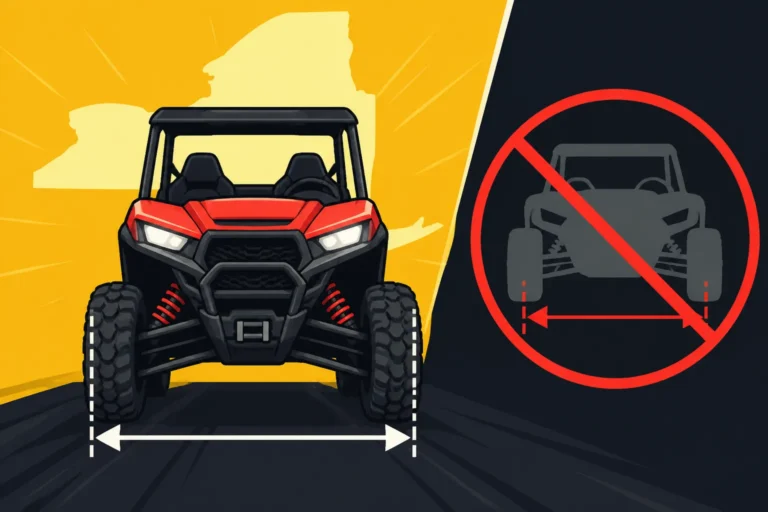
New York's Vehicle and Traffic Law defines an ATV as a self-propelled vehicle that is:
- 70 inches or less in width
- 1,000 pounds or less in dry weight
- Designed to travel on unpaved surfaces
- Has four wheels (or three or six, but generally four is implied for most quads)
- Is designed for recreational use off-highway
Those first two criteria – the 70-inch width limit and the 1,000-pound dry weight limit – are the absolute killers for most modern side-by-sides. Even many larger, sport-utility ATVs with extended chassis can struggle to meet the weight limit. These numbers are a remnant of older ATV designs and haven't kept pace with the evolution of the off-road vehicle market. It's a frustrating reality for many enthusiasts. Check out [New York's 70-Inch Width Limit] and [New York's 1,000-Pound Weight Limit] for more on this.
Why Most Side-by-Sides Fall Outside the Definition
If you've ever stood next to a modern side-by-side, you'll immediately see why they rarely qualify as ATVs under New York law. Most popular UTVs, like the Polaris Ranger or Can-Am Defender lines, are significantly wider than 70 inches and weigh well over 1,000 pounds dry. Even many smaller, two-seater sport UTVs often exceed one or both of these limits. They are fantastic machines, incredibly versatile, and perfect for work or play, but their dimensions simply don't fit into New York's outdated ATV definition.
This means that if you own a side-by-side that exceeds these limits, it cannot be registered as an ATV in New York. Consequently, it cannot be legally ridden on designated ATV trails, public lands, or public roads that are open to registered ATVs. This doesn't mean you can't own one; it just means your riding options are extremely limited, primarily to your own private property or other private lands where you have explicit permission. This is often the biggest shock for people moving to New York or new to the sport. Read [Why Most Side-by-Sides Cannot Be Registered in New York] for a deeper dive.
What About Modified ATVs?
This question often comes up: "What if I modify my ATV, does it then become unregistered?" This is a tricky area. If you start with a machine that does meet the New York ATV definition and then add accessories or modifications, you need to be very careful. Adding heavy bumpers, a winch, a full cab enclosure, or a significant amount of gear could push your machine over the 1,000-pound dry weight limit. If that happens, your formerly registered ATV might now technically fall outside the legal definition, potentially invalidating its registration or at least putting you in a grey area with law enforcement.
Similarly, extensive suspension modifications or wider tires could push you past the 70-inch width limit. It's your responsibility as the owner to ensure your machine continues to meet the legal definition if you intend to ride it on public trails. When in doubt, measure and weigh your machine in its typical riding configuration. The law doesn't care about your intentions; it cares about the physical dimensions and weight of the vehicle being operated.
Understanding the Consequences of Misinterpreting Exemptions
It's easy to get lost in the nuances of New York's ATV registration laws, and sometimes, a well-meaning but mistaken interpretation of an exemption can lead to serious consequences. Thinking you're exempt when you're actually not can turn an enjoyable ride into a costly and frustrating experience. The state takes its registration and safety regulations seriously, and ignorance of the law is generally not considered a valid excuse. It's far better to err on the side of caution and ensure you're fully compliant than to face the repercussions of an unregistered machine.
Potential Fines and Penalties
Operating an unregistered ATV in New York can lead to significant fines. These aren't just minor parking tickets; they can be substantial and hit your wallet hard. The exact amount can vary depending on the jurisdiction and the specific circumstances, but you could be looking at hundreds of dollars for a first offense. And it's not just the fine; you might also incur court costs, and your ATV could potentially be impounded, leading to additional towing and storage fees. Imagine the frustration of having your machine towed away from a trailhead, knowing you could have avoided it with a simple registration.
Beyond monetary penalties, operating an unregistered ATV means you're almost certainly operating without the mandatory liability insurance, which is a separate and even more serious offense in New York. The state requires all registered ATVs to carry minimum liability insurance coverage. If you're caught without both registration and insurance, the penalties escalate dramatically, including even higher fines and potential suspension of your driver's license for other vehicles. It's a domino effect that can quickly spiral out of control. [What New York Fines for an Unregistered ATV] can be quite steep.
The Importance of Due Diligence and Double-Checking
Given the complexities, due diligence is paramount for any ATV owner in New York. Don't rely solely on what a friend told you, or what you read in an old forum post. Always verify the current regulations directly with the New York State Department of Motor Vehicles (DMV) or by consulting a legal professional who specializes in vehicle and traffic law. Laws can change, and interpretations can evolve. A quick call or a thorough review of the official DMV website can save you a lot of grief.
If you're buying a used ATV, especially from a private seller, always confirm its registration status and ensure it meets the current New York definition if you intend to ride it anywhere other than your own private land. A bill of sale, often available as a template from services like LawDepot, is crucial for proving ownership, but it doesn't replace the registration process. Furthermore, if you're ever stopped by law enforcement, having your proof of registration (if required) and insurance readily available, along with any relevant safety certificates, will make the encounter much smoother. A [New York Officer Checks Roadside] for these documents, so be prepared.
Summary of ATV Registration Exemptions in New York
To help clarify the various scenarios, here's a table summarizing the common situations and whether they typically require ATV registration in New York State. Remember, these are general guidelines, and specific details can always lead to exceptions. When in doubt, always verify with the New York DMV.
| Scenario | Requires NY ATV Registration? | Key Conditions/Notes |
|---|---|---|
| Riding on public ATV trails/lands | YES | Mandatory for legal operation on state or county designated trails. |
| Riding on your own private property ONLY | NO | Machine never leaves the bounds of your privately owned land. |
| Riding on someone else's private property | NO (with permission) | Requires explicit permission from the landowner; machine never leaves their property. |
| Farm use for agricultural purposes | NO | Used solely for direct agricultural production, never on public roads. |
| Snow removal on your own private property | NO | Used solely for snow removal on your own private land, never on public roads. |
| Dealer inventory/demo | NO (dealer plate required) | Covered by dealer registration/plates for business purposes, not individual use. |
| Manufacturer testing | NO (special permits) | Covered by manufacturer permits for R&D. |
| Crossing a public road (even briefly) | YES | Any operation on public roads/shoulders typically requires registration. |
| ATV too wide (>70") or heavy (>1000 lbs) | NO (cannot be registered) | Falls outside NY's ATV definition; cannot be registered as an ATV. Limited to private land. |
| Youth machine (rider 10-15) on private land | NO | Rider typically needs ATV Safety Certificate and adult supervision. |
Final Thoughts on Navigating New York's ATV Rules
Understanding New York's ATV registration exemptions is truly about playing by the rules and being a responsible rider. The state isn't trying to make things difficult just for the sake of it; these regulations are in place to ensure safety, fund crucial trail maintenance, and provide a framework for accountability in the off-road community. Whether you're a farmer using a quad as a workhorse, a homeowner relying on an ATV to clear snow, or simply someone who enjoys the thrill of riding on your own private land, knowing where you stand legally is invaluable.
The best advice I can offer is this: if you have any doubt about whether an exemption applies to your specific situation, assume it doesn't. The cost and effort of getting your ATV registered in New York are minimal compared to the fines, legal headaches, and potential liabilities that come with operating an unregistered machine. For formal agreements, like landowner permissions, a template from LawDepot can provide clarity. Always double-check current DMV guidelines, keep your paperwork in order, and most importantly, ride safely and responsibly. The trails and open spaces of New York are incredible, and by understanding the rules, we can all ensure they remain accessible and enjoyable for years to come.
Disclaimer
This article is for general informational purposes only and does not constitute professional advice. Laws, prices and regulations vary by location and change over time. Consult a qualified professional for guidance on your specific situation.