What Happens When Your Muffler Fails the Noise Standard
There's nothing quite like hitting the New York trails, feeling the power of your ATV under you, and enjoying the great outdoors. But let's be honest, that experience can quickly turn sour when your machine's exhaust system is belching out more than just exhaust fumes – it's spewing out noise that frustrates residents, annoys fellow riders, and can land you in a heap of legal trouble. This guide is here to cut through the confusion, explaining exactly what happens when your ATV's muffler fails New York's noise standard, how it's enforced, and what you can do to keep your rides smooth and compliant.
Understanding New York's ATV Noise Regulations
It's easy to think that if your ATV came from the factory, it must be compliant, right? Or perhaps you added an aftermarket exhaust for a little more growl and assumed it was fine. The reality in New York is a bit more nuanced, and it’s critical to understand the regulations to avoid a frustrating encounter with law enforcement or a disgruntled homeowner.
The Federal Noise Standard and New York Law
When we talk about ATV noise, we're not just talking about a vague concept of "too loud." There are specific standards in place, and New York leans heavily on federal guidelines to set its own rules. The primary standard many states, including New York, refer to for off-highway vehicles is the SAE J1287 standard. This standard outlines how sound levels should be measured and what the acceptable limits are. Generally, it's about making sure your machine isn't exceeding a certain decibel level, usually in the range of 96 to 101 decibels, when measured at a specific distance and RPM.
New York law specifically requires all ATVs operating off private land to be equipped with an exhaust system that "is in good working order and in constant operation to prevent excessive or unusual noise." This isn't just about the muffler itself; it also extends to the presence of a spark arrester. Spark arresters are crucial safety devices designed to prevent hot carbon particles from escaping the exhaust and potentially starting a fire, especially when riding in wooded or grassy areas. A missing or damaged spark arrester isn't just a fire hazard; it can also make your ATV significantly louder and lead to a violation. For more specific details, you might want to read up on [Mufflers Under the Federal Noise Standard] and [New York ATV Muffler Requirements].
The spirit of these laws isn't to kill your fun; it's about protecting the peace and quiet of communities and ensuring a harmonious coexistence between ATV riders and other land users, as well as residents who live near trails or riding areas. Think about the impact on families trying to enjoy their backyard or hikers seeking solitude in the woods. Excessive noise disrupts everyone and can quickly turn public opinion against ATV riding, leading to more restrictions or even trail closures. It's not uncommon for local municipalities to have their own noise ordinances that might be even stricter than state law, especially within village or town limits. This means what's acceptable on a remote Lewis County trail might not fly when you're crossing a town road.
What Makes a Muffler "Fail" the Standard?
So, how does a muffler go from being perfectly fine to failing the noise standard? There are a few common culprits, and many of them stem from either neglect or intentional modification.
One of the most obvious failures comes from straight pipes or gutted mufflers. Some riders, seeking to maximize performance or simply wanting a "meaner" sound, will remove the internal baffles of their muffler or replace the entire system with a straight pipe. While this might indeed give you a louder, more aggressive sound, it almost always pushes your ATV far beyond legal noise limits. These modifications are a red flag for law enforcement and are almost guaranteed to result in a ticket.
Another common issue is wear and tear. Over time, mufflers can rust out, develop holes, or have their internal components degrade and fall apart. A rusty, leaky muffler not only sounds terrible but also fails to properly dampen the exhaust noise, making your machine excessively loud. If you hear rattling inside your muffler, or notice new holes, it's a clear sign you're heading toward, or already in, violation territory. Similarly, a missing or damaged spark arrester will not only increase noise but also pose a significant fire risk, which is taken very seriously in New York, especially during dry seasons.
While officers can sometimes use specialized decibel meters for precise measurements, especially in response to specific noise complaints, often, the determination of excessive noise comes down to an officer's trained ear and experience. If your ATV sounds significantly louder than other similar machines, or if the noise is clearly disruptive, it's likely to be deemed non-compliant. The "ear test" is a powerful tool for enforcement, and if you can hear your ATV from a quarter-mile away, chances are it's too loud.
The Unpleasant Consequences of a Loud Exhaust
Riding with an exhaust system that fails New York's noise standard isn't just a minor inconvenience; it carries a range of unpleasant consequences that can put a serious damper on your riding enjoyment and hit you where it hurts: your wallet and your freedom to ride.
Fines, Tickets, and the Hit to Your Wallet
The most immediate and common consequence of a loud muffler is a traffic ticket and a fine. While I can't give you specific dollar amounts as they can change and vary by jurisdiction, rest assured that these fines are not trivial. A single violation can be a real sting, and it's a cost that could have easily been avoided with proper maintenance or a compliant exhaust system. Imagine getting pulled over on a beautiful day on the Tug Hill Plateau, only to have your fun cut short by a costly citation.
The frustration doesn't stop at the initial fine. You might also incur court fees if you decide to contest the ticket, and dealing with the legal system takes time away from your work, your family, or your precious riding hours. It's a hassle nobody wants. What's more, a noise violation might not be the only thing an officer finds. If your muffler leads to a stop, they might also check your registration, insurance, and other equipment. If any of those are also non-compliant, you're looking at multiple tickets, significantly multiplying the financial pain. For a broader understanding of potential penalties, check out [New York Fines for an ATV Violation]. It really highlights how quickly these costs can add up.
Beyond the immediate financial hit, there's the cost of remediation. After receiving a ticket for excessive noise, you'll likely be required to fix the issue. This means either repairing your existing muffler or buying a new, compliant one. That's an additional expense that comes after paying the fine, further increasing the overall cost of your non-compliance. It's a stark reminder that cutting corners on equipment can end up being far more expensive than doing it right the first time.
Potential Impoundment and Loss of Riding Privileges
While not every noise violation leads to impoundment, it's a very real possibility, especially if your machine is deemed excessively loud, unsafe, or if you're found to be in violation of multiple laws. If an officer determines your ATV is too non-compliant to continue operating legally, they have the authority to prevent you from riding it away. This means your ATV could be towed and impounded, leaving you stranded and facing hefty towing and storage fees on top of all the other penalties. Retrieving an impounded machine is a bureaucratic headache and a significant drain on your time and money.
Furthermore, repeated violations or particularly egregious noise offenses could lead to a temporary or even permanent loss of your riding privileges in certain areas. Many designated trail systems, like those managed by counties or clubs, have strict rules about noise. If you're consistently disturbing others or caught riding with a non-compliant exhaust, you could have your trail permit revoked, or be banned from those trails altogether. This is a huge blow for riders who rely on these areas for their passion.
On a broader scale, unchecked noise pollution from ATVs erodes public support for the sport as a whole. When residents living near trails are constantly bombarded by loud exhausts, they are far more likely to lobby their local governments to close trails, enact stricter ordinances, or limit access. This can affect all riders, even those who meticulously maintain their machines. Noise complaints can also strain relations with private landowners who generously allow trails to cross their property. A few loud machines can quickly lead a landowner to pull their permission, forcing trail reroutes or closures. This is why being a responsible rider, which includes having a compliant exhaust, is so vital for the long-term health and accessibility of New York's ATV trails.
How Enforcement Happens on the Trails and Roads
Understanding the rules is one thing, but knowing how those rules are enforced can help you ride smarter and avoid unwanted attention. Law enforcement in New York uses a combination of direct observation, specific equipment, and responding to public complaints to ensure ATVs adhere to noise standards.
Roadside Checks and Officer Discretion
It’s a scenario many of us have experienced: you’re out on the trail or crossing a designated road, and you see an officer. During a routine roadside check, law enforcement officers aren't just looking for registration and insurance. They're also visually and audibly inspecting your machine for obvious equipment violations, and a loud muffler is often one of the first things they'll notice. An officer will often perform a quick visual inspection of your exhaust system, looking for missing components, obvious damage, or signs of modification. If they don't see a proper muffler or spark arrester, that's an immediate red flag. [What a New York Officer Checks Roadside] covers many of the elements an officer considers during such an interaction.
Beyond the visual, there's the "ear test." While not scientific, an experienced officer can often tell if an ATV's exhaust noise is "excessive" or "unusual" based on their training and comparisons to other machines they've encountered. If your ATV's sound stands out significantly from the norm, expect to be pulled over. Some law enforcement agencies are also equipped with decibel meters, especially if they're part of a dedicated off-highway vehicle enforcement unit or are responding to specific noise complaints in an area. These meters provide an objective measurement of your ATV's sound output and can solidify a violation. So, while your muffler might pass the "eye test," if it's genuinely too loud, a decibel reading will confirm it. Getting stopped, for example, by a trooper at a popular spot like a [Being Stopped by a Trooper at a Tug Hill Trailhead] is a common scenario where equipment checks, including mufflers, are routine.
Complaints from Residents and Landowners
Perhaps the most potent driver of noise enforcement in New York is public complaint. Unlike other violations that an officer might stumble upon, noise complaints are often direct appeals from residents and landowners who are being disturbed. Whether it's the constant drone of ATVs on a nearby trail, machines ripping through a quiet neighborhood, or repeated noise late at night, people will call the police. And when they do, law enforcement takes notice.
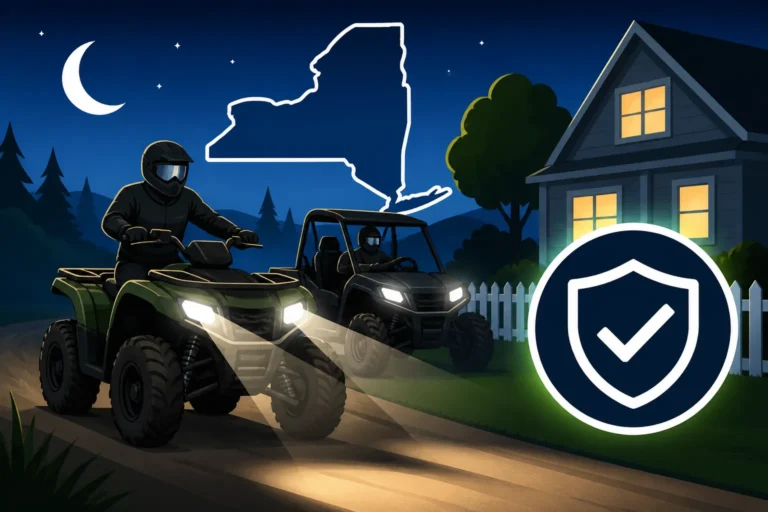
These complaints can lead to targeted enforcement efforts in specific "hot spots." If an area frequently generates noise complaints, officers might increase patrols there, specifically looking for loud machines. This means even if you're riding in an area you think is remote, if a single residence is within earshot and frequently disturbed, you could be the target of a focused patrol. The rules against riding too close to homes at night, covered in [New York Rules for Riding Near a House at Night], are particularly relevant here, as noise complaints often intensify during quieter evening hours.
For trails that cross private land – and many of New York's beloved trail systems do – landowners have the ultimate say. If a landowner is inundated with noise complaints from their neighbors or is personally bothered by excessive noise from machines using their property, they can revoke permission for the trail to cross their land. This has a cascading effect, potentially forcing trail closures, reroutes, and diminishing the overall riding experience for everyone. This is why maintaining good relationships with landowners and respecting their peace, including managing your machine's noise, is paramount. Even when riding on your own property, outlined in [Riding Your Own Land Under New York Law], neighbors can still lodge complaints if your machine is excessively loud and crosses property lines audibly. Many towns, as detailed in [What a New York Town May Be Stricter], can enact local ordinances specifically targeting excessive noise, making it even more crucial to be considerate.
Staying Compliant: Tips for Your ATV's Exhaust System
Navigating New York's ATV noise regulations doesn't have to be a guessing game. By taking a few proactive steps, you can ensure your machine is compliant, you avoid fines, and you contribute to a positive riding environment for everyone.
Regular Maintenance and OEM Replacements
The simplest and most effective way to keep your ATV's exhaust compliant is through diligent, regular maintenance. Your muffler isn't a "set it and forget it" component; it experiences extreme heat, vibration, and exposure to the elements, especially with the mud, water, and grit found on New York trails.
Make it a habit to visually inspect your muffler and exhaust pipe before and after every few rides. Look for any visible cracks, holes, or signs of rust. Pay close attention to the welds and mounting points, as these can weaken over time, leading to leaks that increase noise. Listen for any unusual rattling noises, which could indicate loose internal baffles that are no longer doing their job of dampening sound. If you discover any damage, address it promptly. Small holes can sometimes be temporarily patched with specialized exhaust repair kits, but often, a damaged muffler needs to be replaced.
When it comes to replacement, choosing OEM (Original Equipment Manufacturer) parts is often the safest bet for compliance. These mufflers are designed by the manufacturer to meet specific noise and emissions standards set for your ATV model. They are engineered to provide the optimal balance of performance and sound dampening. While they might not be the cheapest option, they offer peace of mind, knowing you're installing a part that is inherently designed to be compliant. Don't forget the spark arrester! Ensure it's clean, intact, and properly installed. A clogged spark arrester can restrict exhaust flow and sometimes alter the sound, while a missing one is a clear violation and fire hazard. Keeping all your [New York Equipment Requirements for ATVs] in check is part of being a responsible rider.
Exploring Aftermarket and Performance Options Responsibly
For many riders, the appeal of an aftermarket exhaust system is strong – perhaps for a boost in performance, a different aesthetic, or a slightly throatier sound. The good news is that not all aftermarket options are inherently non-compliant. The key is to choose responsibly and do your research.
When considering an aftermarket muffler, look for manufacturers that explicitly state their products are designed to meet SAE J1287 standards or are "trail legal" in states with similar regulations to New York. Reputable brands often provide decibel ratings for their exhausts or specify if they come with a forest-service-approved spark arrester. Avoid anything marketed as a "race exhaust" or "straight pipe" if you plan to ride on public trails or designated riding areas, as these are almost universally too loud for legal operation. Companies like SuperATV offer a wide range of accessories, including exhaust components, but it's always the rider's responsibility to verify that any modification, including those from SuperATV or similar brands, adheres strictly to New York's specific noise and equipment regulations. Always double-check product specifications against the current New York laws.
It's crucial to understand that there's often a trade-off between maximizing performance and maintaining legal noise levels. An exhaust system that gives you a significant horsepower boost might also be considerably louder. Before making a purchase, read reviews, check with other riders in New York, and if possible, listen to the exhaust on a similar machine. Don't be swayed by marketing that promises extreme performance without any mention of sound compliance. Investing in a high-quality, compliant aftermarket muffler will allow you to potentially enjoy some performance benefits or a different sound profile without the constant worry of a ticket or disturbing others. Remember, the goal is to enhance your riding experience, not to jeopardize it with non-compliant equipment.
Disclaimer
This article is for general informational purposes only and does not constitute professional advice. Laws, prices and regulations vary by location and change over time. Consult a qualified professional for guidance on your specific situation.