Putting an Inherited Quad in Your Own Name
When a loved one passes, the process of handling their affairs can be incredibly complex and emotionally draining. Discovering an ATV among their possessions might bring back cherished memories, but the thought of navigating the paperwork to put that inherited quad in your name in New York can quickly turn sentimental feelings into frustration, especially since New York doesn't issue titles for these machines. This guide is here to untangle that process, helping you understand precisely what's needed to legally register that machine in your name, allowing you to continue its legacy on the trails.
Navigating the Emotional Landscape and New York's Unique ATV Registration Rules
Inheriting anything from a loved one carries a heavy emotional weight. It's not just an item; it's a piece of their life, a connection to memories shared or even just imagined. An ATV, with its promise of adventure and connection to the outdoors, can be particularly poignant. But as soon as the initial sentiment wears off, the practicalities hit you: how do you transfer ownership of something that, in New York State, doesn't even have a traditional title?
This is where New York's specific approach to ATV registration can feel like an extra layer of complexity on top of an already difficult situation. Unlike cars and trucks, which have clear, government-issued titles that prove ownership, ATVs in New York are generally not titled. [Why New York Issues No ATV Title]. This means when you inherit a quad, you won't be looking for a pink slip with the previous owner's name on it. Instead, you'll be gathering a collection of documents that collectively establish a chain of ownership and prove your right to register the machine. It's a system that relies heavily on careful record-keeping, which, let's be honest, isn't always at the forefront of our minds during joyous purchases, let alone during times of grief.
The Immediate Aftermath: What to Consider First
Once you've had a moment to process, your first step is to gently sift through any paperwork your loved one might have kept regarding the ATV. Think old folders, glove compartments, or even digital files. You're looking for anything that points to their ownership: past registration cards, original bills of sale from when they purchased it, insurance documents, or even repair receipts that list the Vehicle Identification Number (VIN). Even if these documents seem old or incomplete, they can serve as crucial building blocks in establishing a history of possession.
It’s completely normal to feel overwhelmed at this stage. You might be dealing with many other estate matters, and adding "figure out ATV registration" to the list can feel like too much. But taking it one step at a time, starting with this initial document hunt, will make the rest of the process much smoother. Remember, you're not just doing paperwork; you're preserving a part of your loved one's passion.
Essential Documentation: Proving Inheritance and Prior Ownership
Without a traditional title, the New York Department of Motor Vehicles (DMV) relies on a combination of legal inheritance documents and historical proof of ownership for the ATV itself. This means you need to gather documents related to the estate and documents related to the quad's past. It's like putting together a puzzle, with each piece confirming your right to the machine and its journey to your hands.
Legal Proof of Inheritance: Wills, Letters, and Affidavits
The first and most critical set of documents establishes you as the legal heir or representative of the estate. This part is about proving that the ATV has legitimately passed from the deceased to you.
- The Will (Certified Copy): If your loved one had a will and specifically bequeathed the ATV to you, or if you are the residual beneficiary who inherits everything else, a certified copy of the will is essential. Along with this, you'll need the "Letters Testamentary" (if the will names an executor) or "Letters of Administration" (if there was no will, and the court appointed an administrator). These official court documents empower the executor or administrator to act on behalf of the estate and distribute assets. The DMV needs to see these to confirm that you have the legal authority to claim the ATV.
- Small Estate Affidavit: In cases where the estate is relatively small and doesn't require formal probate proceedings, many states, including New York, allow for a "Small Estate Affidavit" (sometimes called an affidavit of voluntary administration). This is a sworn statement, often filed with the Surrogate's Court, that affirms who the heirs are and how assets will be distributed. This document can be a lifesaver for simpler estates, making the process less cumbersome. If you find yourself needing to draft such an affidavit, resources like LawDepot can provide customizable templates, helping you ensure all the necessary legal language is included. It’s a good idea to check with your local Surrogate's Court or an attorney to confirm if your specific situation qualifies for a small estate affidavit.
Establishing the ATV's History of Ownership
Beyond proving you're the rightful heir, you also need to show the DMV that the deceased was the rightful owner. Since there's no title, this involves piecing together the paper trail. [Proving Ownership Without a Title in New York].
- Bill of Sale: The original bill of sale from when your loved one purchased the ATV is invaluable. This document, detailing the transaction, the VIN, and the parties involved, acts as a primary proof of their ownership. If the original is missing, look for a copy.
- Previous Registration Cards: New York issues yearly registration cards for ATVs. If you can find any of the deceased's past registration cards for the quad, especially the most recent one, these are strong evidence of ownership and that the machine was previously registered in their name.
- Affidavit of Ownership: If you lack a clear bill of sale or previous registration, or if the documentation is spotty, you might need to create an "Affidavit of Ownership" yourself. This is a sworn statement explaining how the deceased acquired the ATV and attesting to their ownership. This is another area where tools like LawDepot can be incredibly helpful for creating legally sound documents to present to the DMV. You'll want to include the VIN, make, model, and any known history of the machine, signed and notarized.
- The MV-51B Form: This is the specific New York DMV form for registering vehicles that do not have a title. [New York's Form MV-51B Explained]. You will be filling this out to register the inherited ATV in your name. On this form, you'll indicate how you acquired the vehicle – in this case, through inheritance.
- VIN Tracing: New York requires a pencil tracing of the ATV's VIN for registration. This helps prevent fraud and ensures the VIN on your paperwork matches the machine itself. You'll need to locate the VIN (usually stamped on the frame), place a piece of paper over it, and rub a pencil across the paper to create a clear impression. It's a bit old-school, but it's a mandatory step. [New York ATV VIN Tracing Requirement].
Here's a handy checklist to help you organize your documents:
| Document Type | Purpose | Status (Yes/No/Need to Get) | Notes |
|---|---|---|---|
| Certified Copy of Will | Proof of legal inheritance, if applicable | ||
| Letters Testamentary | Authorizes executor to act for the estate (if there's a will) | ||
| Letters of Administration | Authorizes administrator to act for the estate (if no will) | ||
| Small Estate Affidavit | For smaller estates, if applicable | Check local court requirements; LawDepot can help with templates. | |
| Original Bill of Sale | Proves prior ownership by the deceased | From when the deceased bought the ATV. | |
| Previous Registration Card | Confirms past registration in the deceased's name | The most recent one is best. | |
| Affidavit of Ownership | If other proofs are weak or missing, attests to deceased's ownership | LawDepot templates are useful here for formalizing the statement. | |
| NY DMV Form MV-51B | The registration application for non-titled vehicles | You'll fill this out at the DMV. | |
| VIN Tracing | Physical proof that the VIN on the machine matches your paperwork | Do this before you go to the DMV. | |
| Proof of Insurance | Mandatory for registration | [New York's Mandatory ATV Insurance] |
The DMV Visit: Registering Your Inherited Machine
With your stack of meticulously gathered documents, the next step is to visit your local New York DMV office. This can sometimes feel like a daunting task, but being prepared will make all the difference. Remember, the clerks are there to help, but they also have strict rules to follow. Having everything in order helps them help you efficiently. [New York ATV Registration Paperwork].
What to Expect and What to Bring
Before you even step foot in the DMV, ensure you have every single document from your checklist. Seriously, double-check! Missing even one item can mean another trip, which is the last thing anyone wants. You'll need:
- All your legal inheritance documents (will, letters, affidavits).
- All your proof of the ATV's prior ownership (bill of sale, old registrations, ownership affidavit).
- Your completed (or mostly completed) MV-51B form. You can often download this from the DMV website beforehand to get a head start.
- Your pencil tracing of the ATV's VIN.
- Proof of New York ATV insurance. This is mandatory, and you cannot register without it. Make sure your policy is active and covers the ATV.
- Your New York State Driver's License or other acceptable proof of identity.
- Payment for the registration fees and any applicable sales tax.
When you arrive, be prepared for questions. The DMV clerk will review all your documents thoroughly. They might ask for clarification on how you acquired the ATV, especially if your documentation isn't straightforward. Be patient and polite, and clearly explain your situation.
Understanding Sales Tax for Inherited ATVs
This is a point of frequent confusion. Generally, property inherited from an estate is not subject to New York State sales tax. However, the DMV's systems are designed to collect sales tax on vehicle transfers, and an inherited ATV can sometimes trigger questions.
If the will or estate documents clearly state that the ATV was bequeathed to you as part of the inheritance, you should typically not owe sales tax. You'll want to clearly explain this to the DMV clerk. However, if the estate sold the ATV to you (even if for a nominal fee) or if the transfer doesn't look like a direct inheritance, sales tax might apply. It's always best to be clear about the nature of the transfer. For instance, if you acquired the machine from an estate sale rather than direct inheritance, standard sales tax rules would likely apply. [New York ATV Registration and Sales Tax]. The key is to communicate clearly that the transfer is due to inheritance from a deceased individual, supported by your legal estate documents.
What Happens at the Counter
The clerk will process your MV-51B, verify your identification, review your inheritance and ownership proofs, and confirm your insurance. They'll also check your VIN tracing. Once everything is approved, you'll pay the registration fee and the one-time plate fee. Remember, the [New York ATV Registration Cost] is a relatively small annual fee, plus a fee for the plate that you pay only once. You’ll be issued a new registration certificate, a validation decal, and your shiny new New York ATV plate. The clerk can also tell you about [Where New York ATV Fees Go].
Congratulations! At this point, the inherited quad is legally registered in your name, ready for you to hit the trails and make new memories. Remember, even after you’ve completed the registration, it’s always wise to keep copies of all your original inheritance and ownership documents in a safe place, separate from the ATV itself, in case you ever need to reference them again. This is also important if you are stopped by an officer on the trail, as they will check for your registration. [What a New York Officer Checks Roadside].
Addressing Common Roadblocks and Specific Scenarios
Even with the best preparation, dealing with an inherited ATV can throw curveballs. What if there's no clear will? What if the original owner never registered it? What if the machine itself doesn't meet New York's specific requirements? Let's explore some common hurdles you might encounter.
When There's No Will or Formal Estate Process
It's a common scenario: a loved one passes without a formal will, or their estate is small enough that no extensive probate is initiated. This doesn't mean the ATV is stuck in limbo forever. If you are the closest living relative and there are no other claimants, a small estate affidavit (as mentioned earlier) can often be used. These documents essentially declare you as the rightful heir based on intestacy laws (laws that govern inheritance when there's no will). As noted, resources like LawDepot are quite handy for generating these types of affidavits, ensuring they meet the basic legal requirements. You'll need to research your local Surrogate's Court's specific requirements for these affidavits.
Another option, if the estate is very informal, might be to have all other potential heirs sign a "Waiver of Interest" or "Affidavit of Heirship" that explicitly states they are waiving any claim to the ATV, granting you full ownership. Again, a legal template provider could be invaluable here. The DMV needs to be convinced that you are the undisputed owner, and multiple affidavits from family members can help establish that. This might be particularly relevant for something like [Registering an Estate's Farm Quad].
The Unregistered Quad: When the Deceased Never Registered It
This is a tougher nut to crack. If the ATV was never registered by your loved one, or if they let the registration lapse years ago and never renewed it, you essentially have no official DMV record of their ownership. In this situation, you'll need to rely even more heavily on other forms of proof:
- Original Bill of Sale: This becomes paramount. If you have the bill of sale from when they bought the ATV, that's your strongest piece of evidence.
- Affidavit of Ownership: Draft an affidavit detailing how the deceased acquired the machine, when they owned it, and why it was never registered. Be as specific as possible. Include any unique identifying features, photos, or witness statements from people who knew the deceased owned the ATV.
- Insurance Records: Even if unregistered, they might have insured it. Old insurance cards or policy documents listing the VIN can help establish prior ownership.
The DMV’s goal is to ensure legitimate ownership and prevent theft. The more convincing evidence you can provide, the smoother this process will be. Expect that the clerk may need to consult with a supervisor in such unusual circumstances.
When the Inherited Machine Doesn't Meet New York's ATV Definition
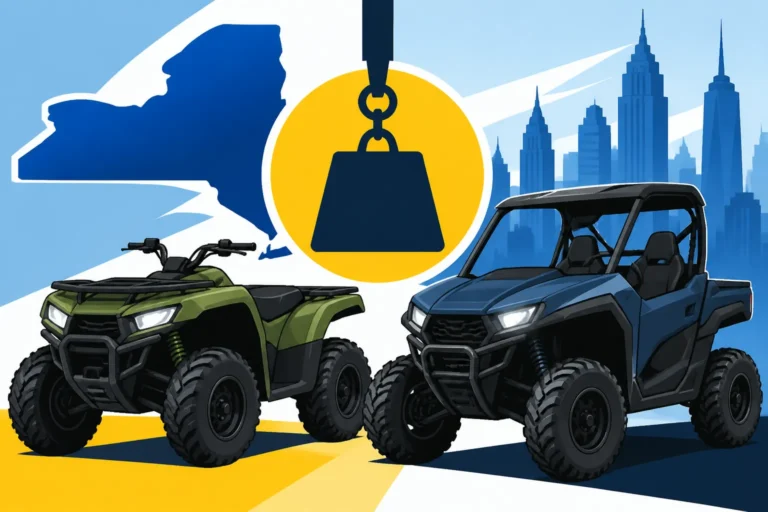
New York has specific definitions for what constitutes an "ATV" for registration purposes. Primarily, this includes limits on width and weight. An ATV must generally be no more than 70 inches wide and weigh no more than 1,000 pounds. [New York ATV Width Limit for Registration] and [New York ATV Weight Limit for Registration].
This is a significant roadblock for many modern side-by-sides (UTVs) which often exceed these limits. If the inherited machine is wider than 70 inches or heavier than 1,000 pounds, it simply cannot be registered as an ATV in New York. This can be heartbreaking if you inherited a larger UTV with plans to ride it legally on trails. In such cases, your options become limited to riding it only on private land where you have permission, or exploring if any specific exemptions apply (which are rare for general recreational use). There are ongoing discussions and proposed legislation in New York to address UTV registration, but these changes are not yet law.
The Mandatory Insurance Requirement
Finally, remember that you cannot register any ATV in New York State without proof of insurance. This is a non-negotiable requirement. Before you head to the DMV, make sure you have an active ATV insurance policy in your name, covering the inherited quad. This policy needs to meet New York’s minimum liability requirements. It’s always a good idea to shop around for coverage that fits your needs and budget, but securing that basic coverage is a critical prerequisite to registration.
Putting an inherited quad in your name in New York is definitely a process that requires patience, organization, and a good understanding of the specific rules for non-titled vehicles. But with the right documents in hand and a clear explanation of your situation, you’ll soon be able to honor your loved one’s memory by keeping their machine out on the trails, where it belongs.
Disclaimer
This article is for general informational purposes only and does not constitute professional advice. Laws, prices and regulations vary by location and change over time. Consult a qualified professional for guidance on your specific situation.