Can You Register a Side-by-Side in New York?
It’s a truly frustrating experience for many New York riders: you get your hands on a fantastic new side-by-side, eager to hit the trails or tackle some work on your property, only to discover a huge roadblock when you try to register it. New York State has some very specific definitions for what constitutes an "All-Terrain Vehicle," and unfortunately, most modern UTVs just don't fit the bill. This guide will walk you through exactly why your side-by-side likely can't be registered for public use in New York, what your options are, and what legislative changes might be on the horizon.
The Core Problem: New York's ATV Definition
The heart of the issue lies in how New York Vehicle and Traffic Law defines an "All-Terrain Vehicle." When these laws were first drafted, side-by-sides as we know them today simply didn't exist in their current form. The legislation was designed around the smaller, single-rider or two-up quad-style ATVs. This means that if your machine doesn't meet these decades-old specifications, it's not legally considered an ATV by the state, and therefore, it cannot be registered under the existing ATV program. It's a classic case of modern technology outgrowing antiquated laws, leaving many riders in a tough spot.
The Narrow Width Limit for Registration
One of the biggest hurdles for side-by-sides is New York's strict width limit. The law currently states that an ATV cannot exceed 70 inches in width. Think about that for a moment. Go out and measure your typical modern UTV, whether it's a recreational sport model or a utility workhorse. You'll quickly realize that the vast majority of these machines are wider than 70 inches. They’re built for stability, comfort, and capacity, all of which contribute to a wider stance.
This limit means that even if you have a smaller, entry-level side-by-side, it’s highly probable it will still push past that 70-inch mark. For example, many popular models designed for two people already sit at or beyond this threshold. It doesn't matter if it's technically a "utility vehicle" or a "recreational off-highway vehicle" in the manufacturer's terminology; if it's more than [New York's 70-Inch Width Limit] from the outside of one tire to the outside of the other, it simply doesn't fit the state's definition of an ATV for registration purposes. This leaves countless riders with perfectly capable machines unable to obtain the necessary plate to ride on designated trails or roads where ATVs are permitted. It's a real head-scratcher when you see smaller, older quads registered, but your brand-new, safer, and often more environmentally friendly UTV is stuck in the garage.
The Strict Weight Restriction
As if the width limit wasn't challenging enough, New York law also imposes a weight restriction on what it considers an ATV. An ATV, for registration purposes, cannot exceed 1,000 pounds. Again, take a moment to consider how much your average side-by-side weighs. Even without passengers, cargo, or accessories, most modern UTVs, even two-seaters, are well over this limit straight from the factory. The robust frames, powerful engines, extensive suspension systems, and safety features all add significant heft.
This 1,000-pound ceiling is incredibly restrictive. While there might be a few very old or highly specialized, lightweight two-up ATVs that barely squeeze under this, virtually no modern side-by-side, not even the most compact models, can meet this criterion. The state's definition truly focuses on what we typically think of as a "quad." This weight limit, combined with the width restriction, creates a formidable barrier for UTV owners. It's not just a matter of having one feature out of spec; often, both the width and the weight of contemporary side-by-sides far exceed what New York permits for ATV registration. It’s a double whammy that keeps many UTVs from ever seeing a New York registration sticker.
Why Your Modern Side-by-Side Doesn't Qualify
So, let’s bring it all together. Your typical modern side-by-side is built for more than just single-rider, light-duty use. They are designed to carry multiple passengers, haul gear, offer substantial ground clearance, and provide a comfortable, stable ride over various terrains. To achieve this, manufacturers have naturally made them wider and heavier than the traditional ATV. These design choices, while beneficial for the user experience, unfortunately put them squarely outside New York's legal definition.
The consequence is that most popular UTVs, whether you're looking at a sport-oriented two-seater for aggressive trail riding or a four-seater utility model meant for farm work, will fail the test. They will be too wide, too heavy, or most often, both. This is [Why a Modern Side-by-Side Fails the Test] to qualify for an ATV registration in the state. This means that if you own one of these machines, you won't be able to get a standard New York ATV registration plate for it. It's a tough pill to swallow for many, especially those who come from states with more inclusive definitions that allow for UTV registration and access to extensive trail networks. The frustration is palpable when you're looking at a map of designated ATV trails and know your capable machine is excluded by a technicality.
Navigating the Registration Landscape (or Lack Thereof)
Since registering a side-by-side for public use in New York is largely off the table, understanding where and how you can use your machine, and what that means for ownership, becomes incredibly important. You’re not entirely out of luck, but your options are significantly more limited than those with a registrable ATV. It's crucial to be aware of these restrictions to avoid legal trouble and to make informed decisions about your side-by-side ownership.
Understanding Exemptions and Private Land Riding
While a state registration for your side-by-side might be impossible, that doesn't mean your machine is entirely useless. The most common and straightforward way to use a UTV in New York is on private land with the landowner's explicit permission. If you own the land, you're generally free to ride your UTV there without registration. This is a huge relief for farmers, hunters, or anyone with extensive private acreage. You still need to adhere to general safety rules, operate the machine responsibly, and ensure you have liability insurance, but the state registration issue becomes moot.
Beyond personal property, some closed-course events, private parks, or specific work sites may also allow UTV operation. These are typically self-contained environments where the state's public road and trail registration laws don't apply. It's always essential to confirm the rules with the venue or landowner before you trailer your UTV. Furthermore, New York does offer an [The Agricultural Exemption in New York] for ATVs used exclusively for farming, though this primarily relates to sales tax and doesn't grant widespread public road or trail access for your side-by-side if it doesn't meet the core definition of an ATV. The key takeaway is: if you can't get a plate, stick to private property or very specific, controlled environments. To avoid trespass and potential fines, always ensure you have explicit, verifiable permission to ride on any land you don't own. You'll want to be familiar with [Riding Your Own Property Under New York Law] to ensure you're compliant.
The Challenge of Proving Ownership Without Registration
Since most side-by-sides can't be registered in New York, they also won't have a New York title. This presents a unique challenge when it comes to proving ownership, especially if you ever decide to sell your machine or need to report it stolen. Unlike a car or a registrable ATV which has clear DMV documentation, a UTV typically relies on a paper trail that can be less robust.
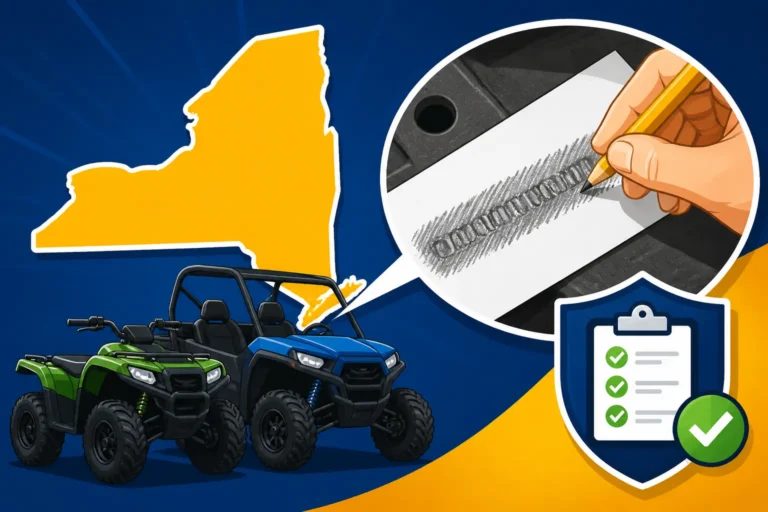
When buying or selling a side-by-side in New York, a comprehensive bill of sale becomes your single most important document. This isn't just a scribble on a napkin; it needs to be a detailed, legally sound document that clearly identifies the buyer, seller, machine (including VIN), sale price, and date. Without a state-issued title or registration to back it up, this bill of sale is your primary proof of ownership. Reputable dealers will provide one, but if you're buying from a private party, you need to be diligent. Using a standardized bill of sale template, perhaps from a resource like LawDepot, can help ensure all necessary information is captured and the document holds up legally. It's also vital to get a full chain of custody if possible, tracing the machine back through previous owners. Understand [New York ATV Bill of Sale Requirements] to protect yourself. In the absence of a title, documenting the transaction thoroughly is critical for establishing legitimate possession, which is directly related to [Proving Ownership Without a Title in New York].
Looking to the Future: Potential Changes for UTVs in New York
The current situation for side-by-side owners in New York is clearly restrictive and, for many, quite frustrating. However, the conversation around updating New York's ATV laws is not static. There's a growing understanding among lawmakers and advocacy groups that the existing definitions are outdated and don't reflect the reality of modern off-road vehicles. While change is often slow in the legislative process, there have been efforts and discussions about bringing UTVs into the fold.
Current Legislative Efforts and Their Status
For years, there have been various legislative proposals aimed at modernizing New York's ATV definition to include side-by-sides. These bills typically seek to raise the width and weight limits to accommodate the dimensions of most UTVs, or to create a separate registration category entirely for these larger machines. You might hear about [A New York Bill to Widen the ATV Definition] or [New York's Proposed 2,000-Pound ATV Weight Limit] from time to time. The goal behind these efforts is clear: to provide a legal pathway for UTV owners to register their machines and, in turn, gain access to designated public trails, similar to how ATVs are currently permitted.
However, getting these bills passed through the state legislature has proven to be a significant challenge. Many factors contribute to the slow pace of change, including concerns from environmental groups, land-use debates, and the complexities of amending existing vehicle and traffic laws. Often, these bills face scrutiny in committees and may never make it to a full vote. As a result, despite the ongoing discussions and the clear demand from the riding community, [Why New York's UTV Bills Are Not Law Yet] remains a question of political will and the ability to find common ground among various stakeholders. Riders often feel stuck in limbo, hopeful for change but repeatedly disappointed by the lack of progress.
What Wider and Heavier Limits Could Mean for Riders
Should a bill ever pass that widens the definition of an ATV or creates a separate UTV category with more realistic width and weight limits, the impact on riders in New York would be monumental. Imagine being able to legally register your side-by-side and then, with proper permits and insurance, explore designated trail systems across the state, like those on Tug Hill, or even participate in organized club rides. This would unlock vast recreational opportunities that are currently inaccessible to UTV owners.
The benefits would extend beyond just individual riders. It could lead to increased tourism in rural areas, as UTV enthusiasts from within and outside the state would seek out new riding destinations. It could also encourage more responsible riding, as registered machines would fall under the state's oversight, requiring insurance and adherence to established rules. Trail systems might see increased funding through registration fees, leading to better maintenance and expansion. Of course, this would also mean new responsibilities for UTV owners, including potential safety course requirements and adhering to specific trail etiquette. But for many, the potential for vastly expanded riding access would far outweigh these additional requirements, transforming the landscape of off-road recreation in New York.
Disclaimer
This article is for general informational purposes only and does not constitute professional advice. Laws, prices and regulations vary by location and change over time. Consult a qualified professional for guidance on your specific situation.