Spring Thaw and Rutted Trails
A trail that looks firm from the parking area can turn into deep, sticky ruts a few hundred yards in. During New York’s spring thaw, that damage can close routes, strain landowner relationships, and leave riders stuck. This guide explains how to judge soft-trail conditions, find reliable opening information, and make a safer call about whether to ride or wait.
Why New York trails become fragile during spring thaw
Freeze-thaw cycles soften the ground beneath the surface
In places such as Tug Hill and the Black River Valley, winter can leave the ground frozen well below the top layer. As temperatures rise, that upper layer thaws first while deeper soil remains hard or saturated. Water has nowhere easy to drain, so the surface can feel spongy even when parts of the trail still look solid.
A trail may also be firm in the morning after a cold night and soft by afternoon. Sunlight, warmer air, rain, and snowmelt all change conditions, sometimes within a single ride. A tire that rolls across a frozen section can sink once it reaches a shaded low spot or a stretch where water is collecting.
That’s why a trail’s appearance can be misleading. A shallow wet sheen or a few muddy patches may be the first sign that the soil is losing strength. If tires begin cutting into the surface or the machine leaves a clear track, the ground may be too soft for repeated traffic. The broader seasonal pattern is covered in [New York Riding in Spring Mud].
Ruts form quickly and can persist long after the trail dries
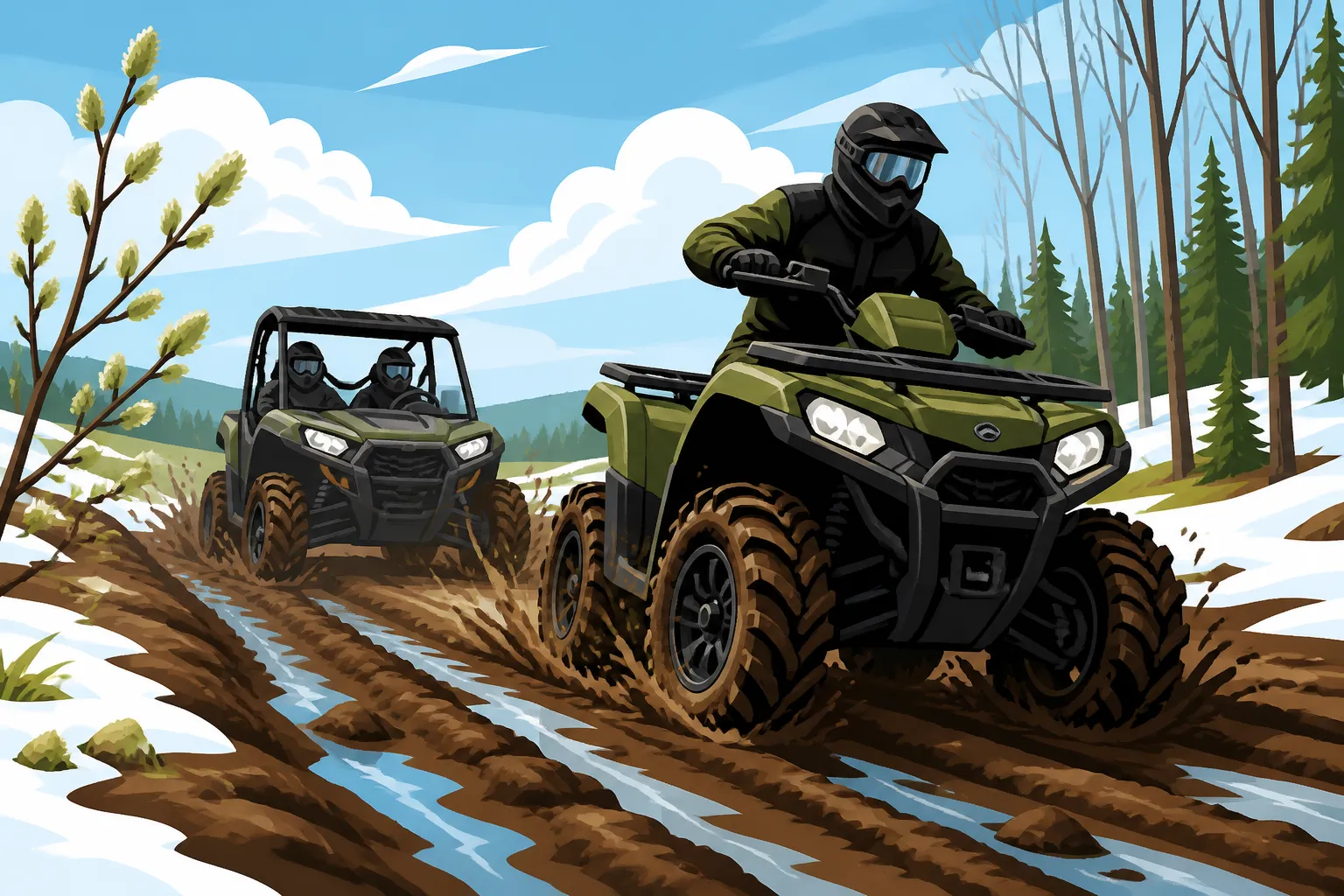
When a tire breaks through the surface, it presses into soil that is already weakened by water. If a rider keeps moving forward by adding throttle, the tire may dig deeper rather than climb out. Following riders can then deepen the same groove, turning a minor soft spot into a rut that channels water and erodes the trail.
Ruts are not just an eyesore. They can make a route harder to navigate, especially for narrower machines, and can force riders toward the edge of the trail where plants and soil are vulnerable. Once a rut dries and hardens, it may remain rough for the rest of the season unless trail crews can repair it.
Avoiding that damage is part of keeping trails available. New York routes often depend on local access decisions and landowner cooperation, not just a trail’s physical condition. [Landowner Agreements That Keep Trails Open] explains why considerate riding matters beyond the immediate ride.
How to decide whether a trail is rideable
Check local trail notices before loading your machine
There is no single spring opening schedule that applies to every trail in New York. A county system, club trail, private riding area, and town route may each have separate access rules. Even routes in the same region can open at different times because drainage, elevation, shade, and maintenance needs vary.
Before leaving home, check the official county, club, or property manager updates for the specific route you plan to use. Look for closures, seasonal restrictions, detours, and notes about wet conditions. A trail shown on a general mapping app is not necessarily open to riding today. [New York Trail Conditions Before You Ride] and [New York Trail Closures to Check First] offer more guidance on checking conditions.
Mapping tools can help you understand where you intend to go. For example, onX Offroad may be useful for reviewing routes and planning a ride, but a mapped line should not be treated as proof that the trail is open or suitable after thaw. Check the managing organization’s latest notice as well. If a trail crosses private land, access can depend on current permission; do not assume last season’s access still applies.
If the notice is unclear, contact the trail manager or club before loading. A quick question can save a long drive and prevent an accidental ride on a closed route. [Checking a County Notice Before You Load] is a useful next step when you need to confirm what a local notice means.
Read the ground, not just the calendar
A date on the calendar cannot tell you whether a trail has dried out. Recent rain, snowmelt, overnight temperatures, and the route’s drainage all matter. A higher, open section may firm up while a shaded low area remains saturated.
Use a staging area or an authorized access point to assess conditions without riding far into the network. If the ground at the entrance is soft enough to hold a deep tire mark, that is a strong reason to postpone. Watch for standing water, flowing runoff, deep footprints, and mud that clings heavily to tires. If a tire spins on ordinary throttle or the machine begins to sink, turn around rather than trying to push through.
| Trail condition | What it may indicate | Sensible response |
|---|---|---|
| Firm surface with no deep impressions | The trail may be supporting traffic, but conditions can still change farther along | Proceed only if the route is officially open and stays firm |
| Damp surface with light tire marks | Soil may be softening, especially in shaded or low areas | Reduce disturbance and turn back if marks deepen |
| Standing water or soft mud | The trail may be saturated or draining poorly | Do not ride through; check for a closure or choose another day |
| Tires sink, spin, or leave deep ruts | The surface is not supporting the machine | Stop, avoid adding throttle, and leave by the least damaging route if safe |
| Fresh closure signs or a posted barrier | Access is restricted regardless of how dry the trail looks | Do not pass the closure |
Conditions can vary over a short distance, so don’t use one firm patch as permission to keep going. A second check at the first soft section is often a better choice than discovering the problem after you have traveled several miles.
What to do if conditions turn soft during a ride
Stop before a small rut becomes a recovery problem
If you feel the machine begin to bog down, ease off the throttle and stop somewhere stable if you can do so safely. Spinning the tires can dig a deeper hole, send mud onto vegetation, and make it harder to recover. Avoid repeatedly rocking the machine with aggressive throttle; that often enlarges the rut without improving traction.
Tell your riding group what is happening and keep other machines from following into the same soft spot. If there is a safe, already disturbed route back, use it carefully rather than making a new track around the mud. Going around a wet section can widen the trail and damage its edges, so don’t create a bypass unless the trail manager has designated one.
If you cannot move without causing more damage, pause and consider the safest recovery option. A winch may help in some situations, but anchoring to a live tree or another unsuitable object can cause harm or injury. Keep people clear of tensioned equipment, and don’t attempt a recovery that puts a rider in a dangerous position. In some cases, contacting a riding partner or local trail manager is safer than forcing the machine out.
Turn around early and report the problem clearly
A responsible turnaround is not a failed ride. If the route is too soft, head back before the damage spreads. When possible, make the decision at the first sign of sinking, deep impressions, or sustained wheel spin—not after several machines have churned the trail.
If you encounter a closure or a particularly damaged section, report it to the organization that manages the route. Include the trail name or nearby marker, the direction of travel, and a clear description of what you saw. A photo can help if it can be taken safely and without entering a closed or hazardous area.
Respect signs, barriers, and marked routes. [Following County Trail Markers] helps riders stay on authorized paths, while [New York Trail Etiquette With Landowners] covers the everyday choices that help preserve access. If a route is closed, don’t look for a way around the barrier or assume another rider’s tracks mean it is open.
How to plan a lower-impact spring ride
Choose a route based on current access and drainage
If local trails are closed or still wet, postpone the ride or choose a different activity. A nearby route is not automatically a suitable substitute: it may have its own closure, different landowner permissions, or a separate permit requirement. Verify the status of each route rather than relying on a general regional map.
When trails do open, consider starting with a shorter ride and checking conditions as you go. Routes with better drainage may firm up sooner than low, shaded stretches, but that is not a guarantee of access. Avoid making assumptions based on a prior visit, since recent weather can change a trail quickly.
onX Offroad can help with route planning, but combine it with official local updates and posted signs. If an app’s route line and a trail manager’s closure notice disagree, follow the closure notice. For public and club systems, rules and access arrangements may differ from one location to the next.
Prepare for changing conditions without treating gear as permission to push on
Bring basic recovery and safety equipment appropriate to your machine and group, and make sure everyone knows how to use it. A charged phone, first-aid supplies, and a plan for contacting your group can be useful, particularly where cell service is inconsistent. Let someone know your intended route and expected return time.
Preparation does not make a saturated trail rideable. A winch, aggressive tires, or a more powerful machine can help in some legitimate riding situations, but they can also make it easier to cause extensive trail damage. If your machine starts leaving deep ruts, the right choice is to stop or turn around—not to use added traction to push farther into fragile ground.
Finally, clean mud from your machine before moving to another riding area. Mud can carry seeds and debris between locations, and a quick inspection may reveal damage from the ride. Good spring riding starts with checking access, continues with honest attention to the ground, and ends with leaving the trail in a condition that does not make the next rider’s decision harder.
Disclaimer
This article is for general informational purposes only and does not constitute professional advice. Laws, prices and regulations vary by location and change over time. Consult a qualified professional for guidance on your specific situation.