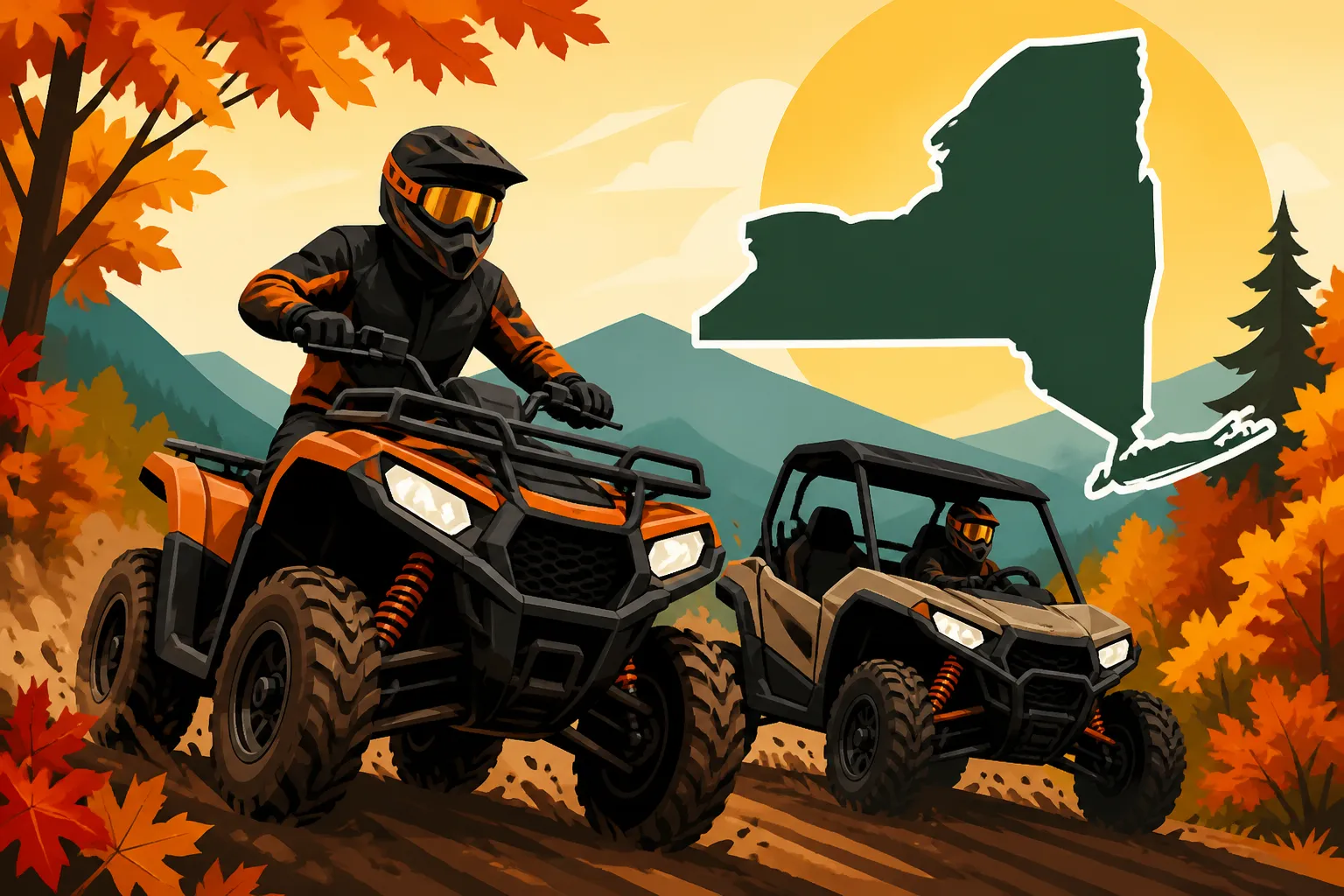
New York Trails Open in October
October can be one of the prettiest months to ride in New York, but fall color does not mean every trail is open. County systems and private club routes may close on different schedules, and wet leaves, hunting activity, and early snow can change conditions quickly. This guide explains where to look, what to check before you haul your ATV, and how to plan a safer fall ride.
How October trail access works in New York
Trail openings depend on the system
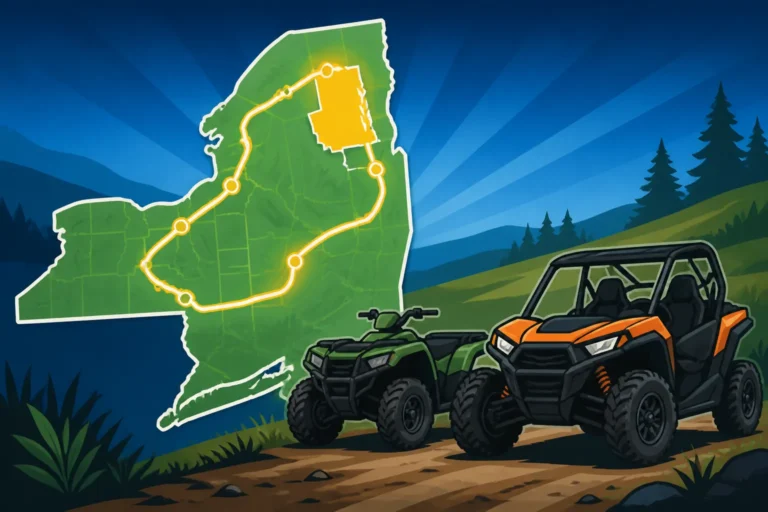
New York does not have one statewide October opening or closing date for ATV trails. Many riding areas are managed by counties and clubs, often through agreements that allow trails to cross private property. That means a route’s status can depend on the landowner, trail manager, weather, maintenance work, and the season’s schedule—not simply the date on the calendar.
In some areas, trails remain open well into autumn; in others, the riding season ends earlier. A trail shown on an older map may no longer be available, and a route that was open last weekend could be closed after heavy rain, a landowner request, or a seasonal change. Check the relevant county or club information before each trip rather than assuming that an October ride is allowed because the same route was open in September.
Start by identifying the specific system you want to ride. For example, riders looking at Tug Hill should check local conditions and access information for the area described in [New York's Tug Hill Riding]. If you are considering Oswego County, look for current information from the trail managers connected with [Oswego County's 100 Miles of New York Trail]. The details for one system do not automatically apply to another.
Check the closing schedule and the day’s conditions
The posted closing schedule is only one part of the decision. A trail might be scheduled to stay open into October but close temporarily because of saturated ground, storm damage, logging, or another local issue. Conversely, the fact that a neighboring trail system remains open does not mean your intended route is open too.
Look for an announcement from the county, club, or trail manager responsible for that exact route. Pay attention to the date of the notice and whether it applies to all trails, a particular section, or a specific access point. This is especially important late in the month, when conditions can shift from dry and firm to muddy or icy in a short time. Reviewing [New York Trail Closing Day] alongside [New York Trail Conditions Before You Ride] can help you separate the seasonal calendar from real-time trail status.
A map app can help you understand where a route goes, but it is not a substitute for an official closure notice. onX Offroad can be useful for reviewing route context and planning how trails connect, particularly when you are organizing a trip in unfamiliar territory. Still, confirm that the route is currently authorized for ATV use through the responsible local trail manager before riding it.
| What to check | Why it matters in October | Where to confirm |
|---|---|---|
| Seasonal opening and closing dates | Trail seasons vary by county and club | County or club trail information |
| Temporary closures | Weather, maintenance, or landowner needs may change access | Recent notices from the trail manager |
| Route and access points | Not every mapped road or path is open to ATVs | Official system maps and posted signs |
| Permit requirements | Some systems require local access permits | County or club permit information |
| Weather and ground conditions | Rain, frost, and early snow can make a route unsafe or damaging | Local forecasts and trail updates |
Where to look for October ATV riding
Start with county and club trail systems
County-supported and club-managed trail networks are often the most practical places to investigate for a fall ride. Their routes may connect public roads, private parcels, and designated trail corridors, so access depends on staying on the approved route and respecting the rules attached to it. The map, permit rules, and seasonal schedule can differ even between nearby systems.
If you are planning a trip in northern New York, check the local trail system rather than relying on a general description of the region. A county may publish a map while a club provides the latest notice about a particular segment. Ask whether the system is open to nonmembers, whether a permit or club membership is required, and whether all routes remain open through the date you plan to visit.
For additional planning, [New York Trail Maps From a County] is a useful topic to review before you choose a staging area or build a route. onX Offroad may also help you see the broader geography and compare possible route connections, but treat it as a planning aid, not proof of legal access. If the app’s map and a current local notice appear to conflict, follow the posted closure and contact the system manager for clarification.
Do not assume state land is open to ATVs
A common fall-planning mistake is to see a road or trail on a map and assume it is open to motorized riding. New York State Forest Preserve lands are not a general-purpose ATV trail network, and many state parks and public lands restrict or prohibit ATV use. A road that appears to connect two riding areas may be closed to ATVs, even if other users are allowed there.
Check the land manager’s rules for the specific property, and follow signs at entrances and trail junctions. Do not ride around a gate, use an unmarked bypass, or continue down a route because another vehicle has left tracks. Those choices can create damage and threaten the permission that keeps nearby private trails available.
This distinction matters in scenic places such as the Adirondack and Catskill regions, where a map may show extensive public land but motorized access is limited to designated locations. Review [Why New York's Forest Preserve Is Closed] and [New York's Adirondack Park and Motor Vehicles] when planning around those areas. A scenic road or trail corridor is not automatically an ATV route.
Plan for fall weather, hunting season, and changing daylight
Expect conditions to change during the ride
October riding can mean crisp mornings, wet leaves, muddy low spots, and a temperature swing by afternoon. In northern and higher-elevation areas, an early frost or snowfall can arrive before riders expect it. Leaves can hide rocks, ruts, branches, and washouts, so a route that looks smooth from the seat may conceal hazards beneath the surface.
Give yourself extra time and avoid turning a short ride into a race against sunset. A group that starts late may find that the last section takes longer than expected because of slippery ground, a detour, or a slow rider who needs a break. Check the forecast for the trail area rather than only the town where you live; weather can differ across the Tug Hill Plateau, the Black River Valley, and the surrounding lowlands.
Carry a charged phone, a basic tool kit, water, and suitable layers. If you use onX Offroad or another navigation app, download or prepare the information you need before entering an area with weak cell service. Keep a paper or offline backup when possible, and agree on a regrouping point in case the group becomes separated. A navigation app can help you find your planned route; it cannot guarantee that the route is open or that your phone will have a signal.
Be thoughtful around hunting activity and private property
Fall is a busy season for hunters, landowners, and trail volunteers. Wear visible clothing where appropriate, keep noise and speed under control, and do not leave designated routes to explore a field or woods. A club trail may cross a working farm or private parcel, and access can depend on riders respecting the agreement between the landowner and trail organizer.
If you encounter a gate, closure sign, logging operation, or active work area, stop and follow the instructions. Do not treat a temporary closure as an invitation to find an alternate path across nearby land. A detour that seems harmless can become trespass or damage crops, soil, and trail infrastructure.
Review local rules for the system you are using, including any hunting-season notices or restrictions. [New York Trail Etiquette With Landowners] offers useful background on why considerate behavior matters to continued access. For broader route planning, [New York Trails Closed by Weather] can help you think through the kinds of conditions that may interrupt an autumn ride.
Prepare your machine and paperwork before you go
Confirm registration, insurance, and any local permit
Before leaving home, make sure your machine is properly registered and that you have the required paperwork with you. New York riding requirements can apply even when a route is on private property or part of a local trail system. If you are visiting from another state, do not assume that your home registration settles every New York requirement; review [New York ATV Reciprocity With Other States] and confirm the rules that apply to your situation.
Insurance is another item to verify before the ride. New York has specific ATV insurance requirements, and visitors should check that their coverage and proof meet the rules that apply in the state. See [New York's Mandatory ATV Insurance] for a focused explanation. Keep your registration and insurance information accessible so you are not searching through a trailer or glove compartment at a trailhead.
Local trail access requirements are separate from state registration and insurance. A county or club system may require a trail permit, membership, or other authorization. Check the relevant manager’s instructions before you arrive, because a valid registration does not necessarily grant access to a particular trail network.
Do a fall-specific machine check
A basic pre-ride inspection is especially useful in autumn, when damp conditions can make small mechanical problems more troublesome. Check tire condition and pressure, brakes, lights, throttle operation, and the general security of racks and cargo. Make sure your plate is visible and firmly attached, and bring the tools needed for minor adjustments.
Think about what the machine will encounter. Wet leaves can make slopes slick, and muddy sections can conceal ruts or standing water. Avoid forcing your way through deep mud or riding around a soft section; doing so can damage the trail and create a hazard for the next group. If conditions are deteriorating, turn around rather than assuming the route will improve farther ahead.
Finally, set a conservative plan. Choose a route that fits the least experienced rider in your group, identify a sensible turnaround point, and tell someone where you expect to ride and when you expect to return. October trails can offer memorable color and quieter riding, but the best trip is one that ends with everyone—and the trail—coming home in good shape.
Disclaimer
This article is for general informational purposes only and does not constitute professional advice. Laws, prices and regulations vary by location and change over time. Consult a qualified professional for guidance on your specific situation.