Riding a Trail That Cuts Across a Working Dairy Farm
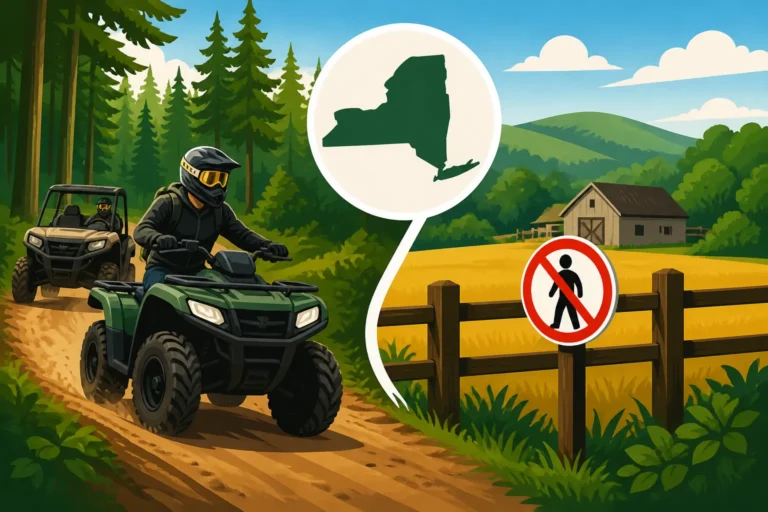
A trail crossing a working dairy farm is not just a line through open fields: it may pass close to livestock, equipment, feed, and active farm work. Riders can protect access by confirming the route is open, following its markers, and giving the farm room to operate. This guide explains how to plan and ride that kind of New York ATV trail responsibly.
Confirm the farm crossing is an authorized trail
A trail on a map is not permission to ride
Some New York riding routes cross private property because a landowner has agreed to allow trail access. That agreement may cover only a specific marked corridor, certain dates, or particular kinds of use. A line on a phone map, an old route description, or tire tracks across a field does not by itself establish that riders have permission to be there.
Before setting out, check the current information from the county or club responsible for the route. Look for notices about seasonal closures, reroutes, landowner restrictions, or changed access. If you cannot confirm that the crossing is open, choose a different route rather than treating uncertainty as permission. The rules for private property are worth reviewing in New York Rules for Riding Private Land and New York Landowner Permission Rules.
Check official trail information, not just your navigation app
A mapping app can help you plan a route and understand where you are, but it should not be your final authority on access. Use the county or trail-club map and updates first, then use an app such as onX Offroad as a supplementary navigation aid. Keep a downloaded map or another backup available in case cell coverage drops along a rural route.
A mapped trail may run close to a property boundary, cross a farm lane, or appear to continue where the authorized route actually turns. Zoom in before you ride, compare the route with posted signs, and pay attention to junction markers on the ground. If the map and the signs disagree, stop somewhere safe and verify the route instead of guessing.
Confirm that your other riding requirements are in order
Trail permission is only one part of being ready to ride. Registration, insurance, trail permits, and rider requirements can depend on the machine, location, and trail system. A machine’s registration does not automatically grant access to every private or county trail, and a trail permit does not replace permission to cross land outside the system.
Check the specific rules for the route you plan to use, including New York Club Trail Rules and Do You Need a Trail Permit in New York?. If you are riding with a visitor or a young rider, make sure their paperwork and supervision arrangements fit the applicable New York rules too. Sorting this out before unloading at the trailhead is much easier than discovering a problem at a farm crossing.
Ride so the farm can keep working
Stay on the marked corridor
A farm trail can look like a broad open area, but the riding route is usually limited to a defined path. Do not cut across a field, use a field edge as a shortcut, or ride down a farm lane simply because it seems to point toward the next trail marker. Turning off the corridor can damage crops, compact soil, widen the trail, or bring a machine close to livestock and farm operations.
Follow signs and markers even when the route is muddy or uneven. If a gate is closed or a trail is marked closed, do not go around it or lift it to continue. A closure may be temporary, but bypassing it can put the landowner’s agreement—and access for other riders—at risk. New York Trail Etiquette With Landowners offers a useful framework for treating trail access as something to preserve, not take for granted.
Give livestock and farm workers generous space
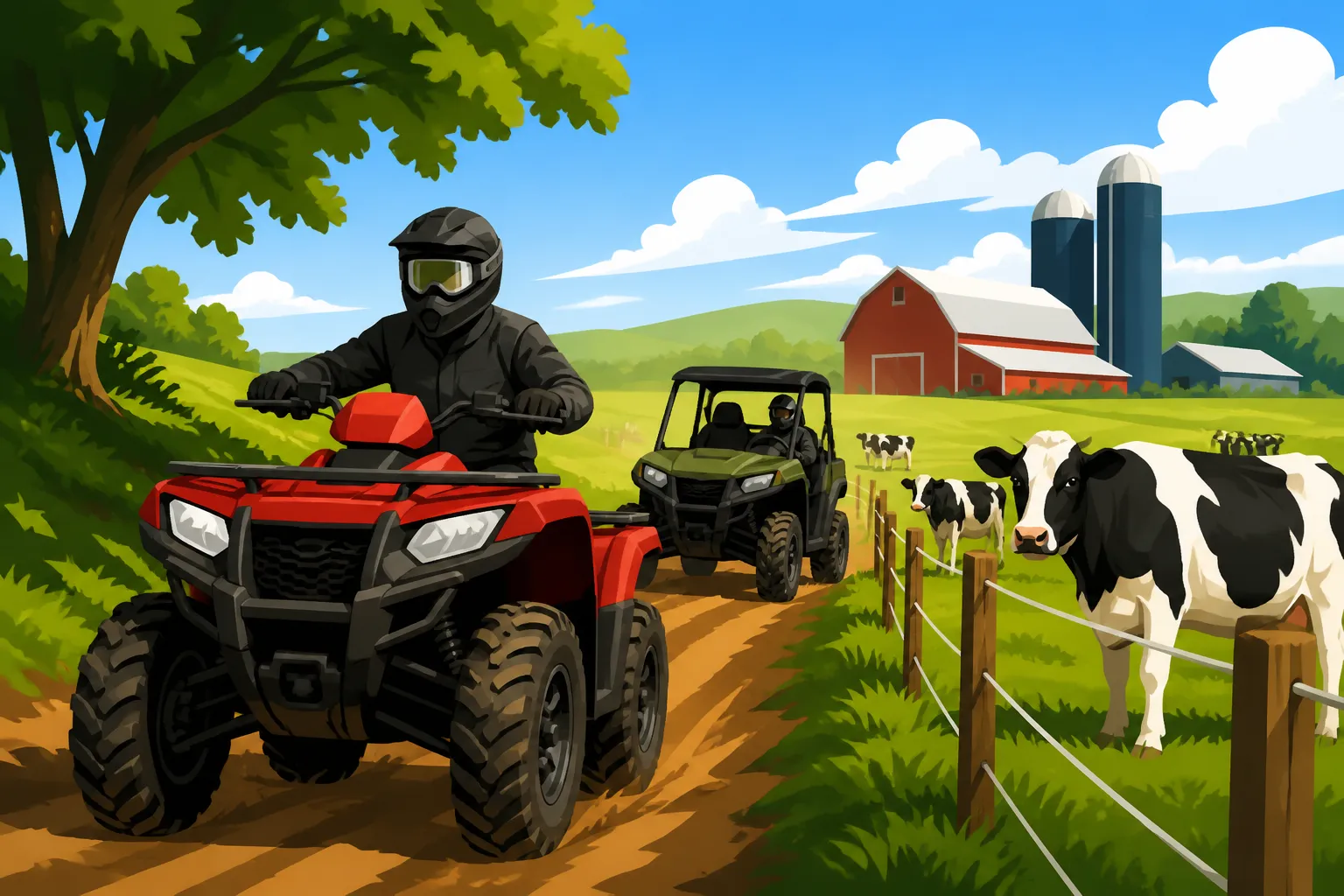
Dairy cows are accustomed to farm routines, but an unexpected engine, a fast approach, or a machine revving beside a fence can startle them. Slow down well before reaching animals, keep a steady and predictable line, and avoid sudden acceleration. Never chase livestock, stop to crowd them for a photo, or reach through a fence.
Farm workers may be moving between barns, fields, lanes, and equipment without expecting a recreational rider at every moment. Watch for tractors, milk trucks, feed deliveries, trailers, and people on foot. If a worker signals you to stop or wait, do so in a safe place and follow their instructions. They may need to move an animal or piece of equipment through the crossing before you can continue.
Treat gates, fences, and farm lanes with care
A gate is there for a reason: it may keep animals in a pasture, separate parts of the farm, or control access to a working area. Do not assume that an open gate means riders may pass through, and do not leave a gate open after crossing. If the trail’s instructions say to close it, close it carefully and make sure it latches. If the instructions are unclear, do not improvise—check with the trail operator.
Avoid parking in gateways, blocking farm roads, or stopping where a tractor needs room to turn. If a farm vehicle approaches on a narrow lane, pull over only where you can do so without entering a field or damaging the shoulder. Give it time to pass; a loaded tractor or trailer may need more space than it first appears.
Plan for conditions and unexpected closures
Check the route shortly before riding
Trail conditions can change after rain, during planting or harvest, or when a landowner needs to move equipment or animals. A route that was open on a previous ride may be closed today. Check the county or club’s latest notices before leaving home and again at the trailhead when posted information is available.
For a longer outing, keep the route’s operator or county trail information easy to access. onX Offroad may help you follow your planned line, but it cannot tell you that a private trail agreement is still active unless the relevant information is provided and current. Treat route-planning tools as aids, not as permission or a closure bulletin. For broader planning, see New York Trail Conditions Before You Ride and Checking a County Notice Before You Load.
| What you notice | A safer response |
|---|---|
| A gate is closed or chained | Stop and do not bypass it. Check for a closure notice or contact the trail operator. |
| A worker is moving animals or equipment | Wait at a safe distance and follow the worker’s directions. |
| The marked route seems to enter a field | Stop and verify the route rather than following tire tracks. |
| The trail is badly rutted or waterlogged | Avoid widening it; turn around if continuing would damage the route or leave the corridor. |
| The signs and your map disagree | Pause in a safe spot and confirm the route with official trail information. |
| You encounter a temporary closure notice | Follow it and use only a clearly authorized alternative route. |
Do not turn a farm detour into an improvised reroute
A blocked trail can be frustrating, especially after you have hauled your machine a long way. Still, riding around a barrier through a field, along a fence line, or down a farm road can create a new problem for the landowner and the trail system. Turn back to the last confirmed junction and use a route that the county or club identifies as open.
If you cannot find a verified alternative, end the ride or relocate to another riding area. Do not rely on another rider’s guess, a social post without a clear date, or the fact that a route appears on an older map. A polite report to the trail operator—with the location and description of the closure—can help them update information for everyone.
Expect changing surfaces and limited room
Farm crossings can include gravel, packed earth, grass, mud, and ruts made by agricultural vehicles. Conditions may shift quickly after rain or during heavy farm traffic. Reduce speed, leave space between machines, and avoid spinning tires. A rider who powers through soft ground may widen a rut or damage the trail edge, making it harder for the landowner to keep the route open.
Dust can also be a concern around barns, feed, and nearby homes. Ride smoothly and avoid unnecessary revving or repeated passes. If the trail is narrow, let faster riders pass only where the route safely allows it; do not pull into a field or crop area to make room. Respectful riding is especially important where the trail passes through a place people live and work.
Leave the crossing in good shape for the next ride
Keep noise, litter, and stops under control
A working dairy farm is not a recreational staging area. Do not stop beside a barn, approach animals, or leave the marked trail to explore. Keep conversations and engine noise considerate, particularly near homes or during early or late hours. If the route allows a stop, choose an authorized spot that does not block access or interfere with farm work.
Pack out everything you bring in, including food wrappers, drink containers, and broken straps. Do not toss cigarette ends or other debris along the route. Small acts of care matter because a landowner may judge the trail by what riders leave behind, not only by whether their machines stay on the path.
Ride as though access depends on your choices
In practice, the next rider’s access can depend on how the last group behaved. One person opening a gate and leaving it unsecured, tearing up a wet section, or startling animals can sour a landowner on hosting a route. Conversely, predictable riding, patience around farm work, and respect for closures help demonstrate that trail users can share space responsibly.
If you see a damaged marker, a downed branch, or a confusing junction, report it to the club or county rather than making an unauthorized change. Do not move signs, repair a fence, or alter a gate unless the landowner or trail operator has asked you to. Clear communication helps the people managing access address issues without creating new hazards.
Choose a different route when the crossing is not suitable
A farm crossing may not be the right choice for every ride. If conditions are muddy, animals are being moved, the route is closed, or you are unsure where the authorized corridor goes, skip it. A shorter ride on a confirmed open trail is better than a longer ride that risks trespass, crop damage, or conflict with farm operations.
Use county and club information to find an appropriate alternative, and check the route’s rules before you go. New York Trail Closures to Check First and New York Trails That Cross Private Land can help you think through access and closures when planning. A map can make a ride easier to navigate, but the best guide at a working farm is still the posted route, current trail information, and the landowner’s boundaries.
Disclaimer
This article is for general informational purposes only and does not constitute professional advice. Laws, prices and regulations vary by location and change over time. Consult a qualified professional for guidance on your specific situation.