Town Forests That Set Their Own ATV Rules
A town forest can look like an open riding area, especially when you see a trail, a parking pull-off, or tire tracks leading into the woods. But public ownership does not automatically mean ATV access. This guide explains how to check a New York town forest’s rules, distinguish local permission from statewide requirements, and avoid an expensive mistake before unloading your machine.
Why Town Forest ATV Access Varies
Public land does not always mean open riding
A town forest is land owned or managed by a municipality, but that label alone does not tell you whether ATVs are allowed. One town may permit riding on a specifically marked route, while another may allow only walking, hunting, or other nonmotorized recreation. A third may open a trail seasonally or close it when conditions become muddy.
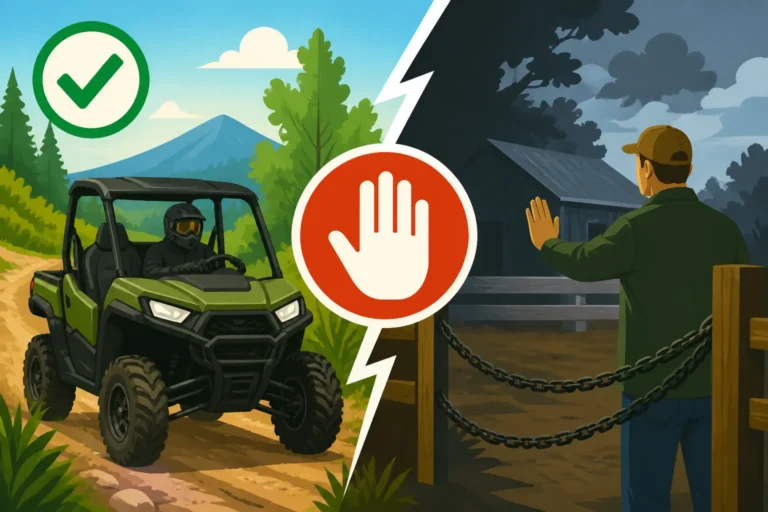
The key point is that ownership and permission are separate questions. A town’s right to manage its land does not create a general right for riders to use it. You need to find out what the town has actually authorized, and whether that authorization applies to the particular trail, machine, season, and type of riding you have in mind.
It also helps to distinguish a town forest from county forest land, state land, and a privately owned trail that happens to pass near a public parcel. Rules can differ even when parcels share a boundary or trail corridor. For a comparison with another local public-land category, see [New York Rules on County Forest Land]. State-owned recreation areas have their own restrictions, so do not assume a town’s permission extends onto a neighboring state parcel. The rules for those areas are covered in [New York Rules for Riding State Land].
The local decision may apply only to a specific route
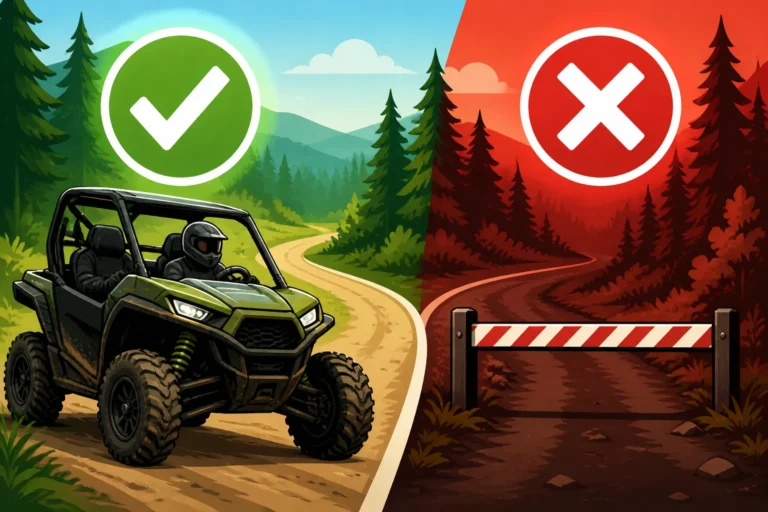
A town may allow ATVs on one signed road or trail while prohibiting them elsewhere in the same forest. Permission to use a route does not necessarily include permission to ride side trails, cut through a field, park beyond a gate, or make a loop across adjoining land.
That distinction matters when a route appears to continue beyond a sign or forest boundary. The next section could be managed by a county, a private landowner, a state agency, or a trail club operating under a limited agreement. Even if the ground looks continuous, the access arrangement may not be.
For example, imagine a rider unloading near a town forest outside Lowville and following a marked route toward a wider gravel road. The first segment might be open under a town policy, while the gravel road is a town highway with separate rules—or it might cross private land where riding requires the owner’s permission. Before riding across a boundary, check the rules for each parcel and route rather than relying on how the trail looks.
How to Confirm a Town Forest’s Rules
Ask the town office a precise question
Start with the town’s official website, posted notices, recreation information, or land-management documents. If those materials do not clearly answer the question, contact the town clerk, recreation department, highway department, or other office responsible for the property. Which office handles it can vary by town, so ask to be directed to the person who manages the forest or trail.
A useful question is not simply, “Can I ride an ATV in the town forest?” Ask whether ATVs are permitted on the specific named or marked route you plan to use, during the date range of your visit, and whether any permit, registration, insurance proof, club membership, or seasonal restriction applies. If you plan to bring a side-by-side, ask about that machine specifically. A rule that allows certain ATVs may not cover every UTV or side-by-side.
When possible, request the answer in writing or ask where the town’s official policy is posted. Keep a copy or screenshot with your ride information. A verbal answer can be helpful, but a written policy, current notice, or posted sign is easier to refer back to if signs are unclear or a trail has changed.
Use maps to plan, not to establish permission
County trail maps, town maps, and GPS apps can help you understand where a route appears to go. They can also help you notice when a trail approaches a boundary, road, or neighboring parcel. But a line on a map is not the same as permission to ride it. Maps may be incomplete, outdated, or designed for general orientation rather than showing current motorized access rules.
Tools such as onX Offroad can be useful for reviewing mapped routes and property boundaries before a trip. Treat that information as a planning aid, not as proof that a town forest or connecting trail is open. Confirm access with the town or the trail operator, and follow signs on the ground. You can also consult [New York Trail Maps From a County] for ways to use local maps as part of your planning, while checking separately for access restrictions.
| What you find | What it can tell you | What you still need to confirm |
|---|---|---|
| Town forest map | Approximate parcel location and named roads or trails | Whether motorized riding is allowed on the route |
| Trail app or GPS map | Route context, junctions, and nearby boundaries | Whether the route is open now and who authorizes access |
| Posted sign | A local restriction or direction at that location | Whether other rules apply farther along the route |
| Town policy or notice | The municipality’s stated access rules | Whether it is current and covers your machine and dates |
| Trail club information | Possible trail access details and closures | Whether the town’s land-use permission is still active |
Check for temporary closures before leaving home
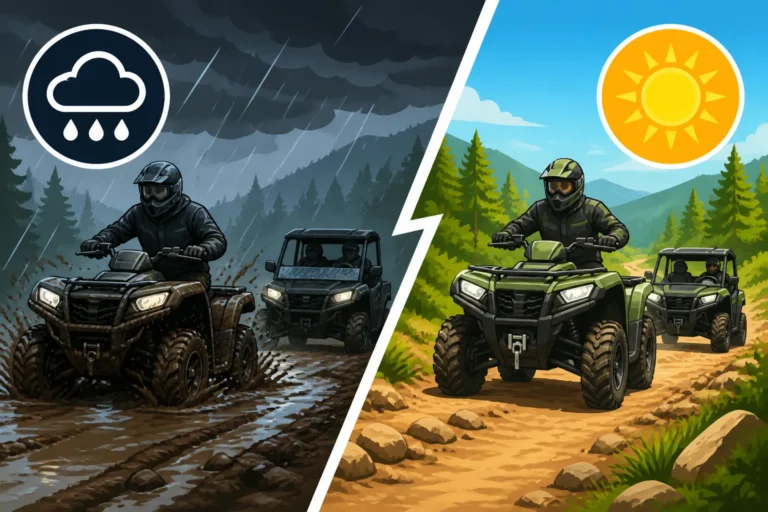
A route that is normally open can be closed temporarily because of mud, storm damage, logging, maintenance, a landowner concern, or a special event. A trailhead sign may not be visible until you have already driven a long way, so check for notices before loading your machine.
Look for updates from the town, county, or trail organization responsible for the route. A club post can be a helpful alert, but the town or managing authority is the best place to confirm a municipal closure. If information conflicts—for example, an old map shows a route but a recent town notice says it is closed—follow the current closure notice. [New York Trail Conditions Before You Ride] offers additional planning context for checking conditions and access before a trip.
What Permission Does and Does Not Allow
Local approval does not replace statewide requirements
A town’s decision to open a forest route does not waive New York’s applicable ATV laws. Registration, insurance, equipment, helmet, age, and passenger requirements may still apply. The rules can depend on the machine, the rider, and where the machine is being operated. Review the relevant state requirements before riding, including [Do You Need to Register an ATV in New York?] and [New York ATV Insurance Requirement].
This is easy to overlook when the ride feels informal. Someone may say, “It’s just the town woods,” or a neighbor may have ridden there for years. But local permission to enter the property and compliance with state requirements are separate responsibilities. If an officer or land manager checks your machine, permission to be on the trail may not resolve an issue involving an expired registration or required insurance.
Likewise, approval to ride a town forest does not automatically make every connecting road or public trail legal for ATVs. A town may designate or post particular roads under a local process, and the route’s status can change at intersections. For a separate discussion of local road access, see [How a Town Designates a Road]. Check the status of the exact road rather than assuming that a nearby forest route grants access to it.
Permission is not necessarily a right to leave the marked route
Even when riding is allowed, stay on the routes the town identifies as open. Do not widen a trail to get around a puddle, ride through a planted area, bypass a closed gate, or follow fresh tire tracks into an unmarked section. A visible track may be unauthorized, abandoned, or left by a maintenance vehicle.
This matters especially after rain or during spring thaw. Riding around a wet spot may turn a narrow trail into a broad muddy rut, damage drainage, and create pressure on the town to close the route. A closure can affect every rider, including people who followed the rules. If the route is too wet or blocked, turn around and report the issue through the town’s preferred channel.
Permission to use the forest also may not include permission to cross neighboring private land. A trail can leave town property without an obvious fence or gate. If the path crosses private land, access depends on the landowner’s authorization and any conditions attached to it. See [New York Landowner Permission Rules] for more on why visible trails and informal local custom do not, by themselves, establish permission.
A Practical Plan for Riding a Town Forest
Verify the route and prepare before loading
Use this checklist before you make the drive:
- Identify the exact property. Confirm the town name, forest name, trailhead, and route you intend to use. A nearby trail system or county route may have different rules.
- Confirm motorized access with the town. Ask whether your ATV or UTV is allowed on that specific route and whether access is seasonal or limited.
- Check current closures. Look for recent town, county, or trail-operator notices, especially after heavy rain, thaw, storms, or logging activity.
- Ask about conditions of access. Confirm whether a permit, club membership, parking arrangement, or other condition applies.
- Check each connection. Find out whether roads and trails beyond the town forest are also authorized for your machine.
- Review state requirements. Make sure your registration, insurance, required equipment, and rider preparation are in order.
- Bring the information with you. Save the town’s notice, contact details, and route information where you can refer to them without relying on cell service.
A map app can help you plan where a route turns or approaches a parcel line. For instance, you might use onX Offroad to study the route before heading toward a town forest near the Tug Hill region, then compare that map with the town’s own access notice. If the mapped line and town information do not match, pause and ask for clarification rather than treating the app as the final word.
Follow signs and adjust when the route is unclear
At the trailhead, read all signs before unloading or riding through a gate. Pay attention to symbols and wording that limit access by season, vehicle type, or route. A sign that says a road is closed to motor vehicles may apply even if you see ATV tracks beyond it. A gate may be closed for a reason that is not obvious from the trailhead.
If a sign is missing, damaged, or hard to interpret, do not treat the uncertainty as permission. Check with the town or trail manager. If you are already on the route and encounter a closure, turn around safely instead of riding around the barrier. Avoid blocking access for residents, forestry crews, emergency services, or other authorized users.
Technology can help with navigation, but it cannot replace careful riding and local confirmation. onX Offroad may help you keep track of your planned route and nearby boundaries; make sure you have the town’s directions and closure information available separately. It is also sensible to save key details offline when you expect weak reception in rural areas.
Be a good guest on municipal land
Town forests serve many people, and local support can be essential to keeping appropriate routes open. Ride at a reasonable speed, yield to hikers and other trail users, avoid unnecessary noise, and leave gates and signs as you find them. Do not leave trash, wash mud into streams, or create a new bypass around an obstacle.
If you notice a washed-out section, damaged sign, or unsafe condition, report it to the town or trail operator rather than trying to make an unauthorized repair. Stay clear of logging equipment and work areas. A route that crosses a working landscape may be shared with forestry, utility, or road crews, and conditions can change while work is underway.
When local rules are clear, follow them even if another rider appears to be doing something different. One person’s shortcut can create a complaint, damage the trail, or jeopardize the town’s willingness to allow access. Being considerate is not only good trail etiquette; it helps maintain the trust that makes local riding opportunities possible.
Disclaimer
This article is for general informational purposes only and does not constitute professional advice. Laws, prices and regulations vary by location and change over time. Consult a qualified professional for guidance on your specific situation.