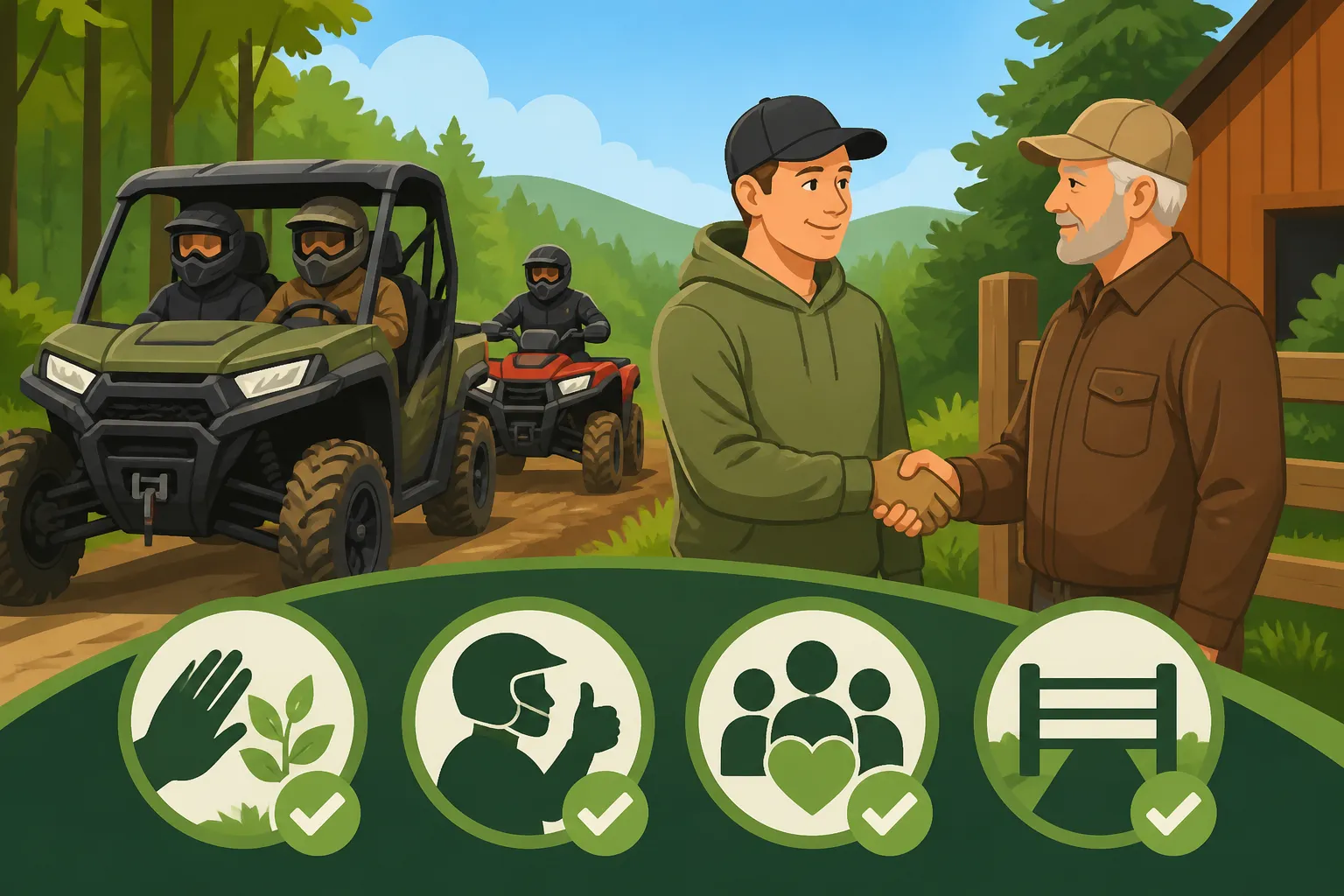
New York Trail Etiquette With Landowners
Private land is part of many New York ATV routes, and one rider cutting a corner, rattling a gate, or leaving trash behind can put access at risk for everyone. Good trail etiquette is more than being friendly: it means following the authorized route, respecting working properties, and making your group easy for landowners to welcome back. This guide covers practical habits that help protect access.
Understand who allows access and where you may ride
A marked trail is permission for a route, not a whole property
New York trail networks often depend on landowners agreeing to let a club, county, or other organizer route riders across specific parts of private property. That permission is usually limited to a particular corridor and may come with conditions. A trail marker does not mean the surrounding woods, fields, driveways, or farm lanes are open to explore.
Stay on the route shown by the official map and marked on the ground. Don’t cut across a field to avoid a muddy section, follow an attractive woods road because it looks familiar, or leave the trail to reach a stream. Even a short detour can take you somewhere the landowner never agreed to open. For more on the access arrangements behind these routes, see [Landowner Agreements That Keep Trails Open] and [New York Trails That Cross Private Land].
This matters on a group ride, too. The first machine may stay on the trail while the rest spread out, make a wider turn, or take a shortcut. Agree before setting out that everyone will follow the same marked route. If you’re unsure whether a spur or crossing is part of the open trail, stop somewhere safe and check rather than treating uncertainty as permission.
Permission and access can change
Trail access isn’t permanent simply because a route appeared on a map last season. A landowner may need to close a section for logging, repairs, livestock movement, a property sale, or another practical reason. A club or county may reroute the trail, and a temporary closure may not be obvious until you reach a sign or barrier.
Check current trail notices before loading your machine, then look for posted signs and trail markers when you arrive. An app such as onX Offroad can help you plan and understand your surroundings, but a map layer is not permission to ride across private property. Use official county or club information for trail status and obey signs on site. If those sources disagree, don’t assume the route is open.
Be especially cautious with old screenshots, saved tracks, and routes shared in a group chat. They may show a trail that has since closed or moved. If you find a closure notice, turn around and use an authorized alternative only if one is clearly available. [What Happens When a Landowner Pulls Trail Permission] explains why a familiar section can disappear from a route.
Ride in a way that feels safe to the people who live and work there
Slow down around homes, livestock, and farm activity
A machine approaching a house or barn can sound much louder than it does to the rider. Slow down well before reaching homes, driveways, yards, or places where people are working. Keep noise to a minimum, avoid revving for fun, and don’t stop to look around in someone’s yard. Give people space and let them know you’ve seen them by riding predictably, not by accelerating or crowding them.
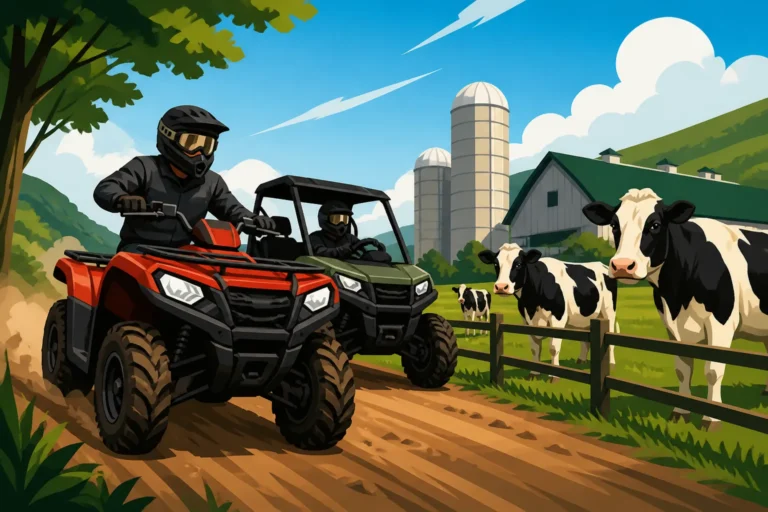
Farm properties need particular care. A field entrance may be in use, a tractor may be backing out, or livestock may be close to the trail. Don’t assume an animal is accustomed to ATVs just because it is behind a fence. Reduce speed, avoid sudden movements, and follow any posted direction. If an animal appears distressed or is loose near the route, stop at a safe distance and notify the trail organizer if the situation affects access or safety.
A courteous pace also gives you time to respond when the trail crosses an active work area. In places such as Lewis County or around Tug Hill, riders may encounter trucks, farm equipment, or logging activity on roads used by multiple people. Give workers room and follow any temporary signs. For a closer look at sharing a route with active work traffic, see [Meeting a Logging Truck on a Trail Road].
Be considerate at road crossings and shared access points
A trail crossing, parking area, or narrow access lane can be a pressure point for residents and other users. Don’t block a driveway, gate, farm entrance, or road while waiting for your group. Keep machines together where it is safe to do so, but leave room for vehicles to pass. At a crossing, follow the signs and applicable rules; don’t treat a public road as a place to gather or warm up engines.
If a resident or worker approaches, stay calm and give them space to speak. A simple greeting and a willingness to pause usually work better than arguing about whether the trail should be open. If someone asks you to stop because of a hazard or an active operation, stop where it’s safe and contact your club or trail authority later to clarify the route. Don’t try to settle a land-access dispute from the seat of your machine.
Keep the same courtesy when another trail user approaches. Slow down, communicate clearly, and pass only when there is room. A group that rides as though every road and trail belongs exclusively to it can make landowners less comfortable hosting any riders. Courtesy at shared points is one of the easiest ways to show that the route is being used responsibly.
Treat gates, signs, and closures as boundaries
Never bypass a closed gate or barrier
A gate may protect livestock, prevent unauthorized vehicle traffic, or mark a section that is closed for a reason riders cannot see. Don’t go around it, squeeze through beside it, or follow another rider who does. A closed gate is a clear signal to stop and reassess, even if the trail appears to continue on the other side.
If a trail is open and the route instructions require you to pass through a gate, follow the posted directions. In some situations, that may mean closing it after you pass. Don’t leave a gate open because it is inconvenient to dismount, and don’t assume someone else will take care of it. If the gate is damaged, locked unexpectedly, or difficult to operate, don’t force it; report the issue to the club or trail manager. See [Gates on a Club Trail] for more about why a small action at a gate can matter.
A closure sign may be temporary, but that doesn’t make it optional. Logging, weather damage, repairs, or a landowner request can require a route to close with little notice. Check for updates before your trip using the relevant county or club information, including [Checking a County Notice Before You Load]. If you discover a closure after arriving, turn back rather than inventing a detour through private land.
Follow markers and report problems without moving them
Trail markers help riders stay on the approved route, especially where a track crosses a road, changes direction, or passes through a wooded area. Follow the marked route rather than relying only on memory or another rider’s tire tracks. Markers can be hard to spot in poor weather or after vegetation grows in, so slow down where the route is unclear.
Don’t move, remove, cover, or add signs and markers. A marker that looks inconvenient may be directing riders away from a home, a sensitive area, or a closed section. If a sign is down or a trail seems to have become ambiguous, report the location to the appropriate club or county contact. A note with the nearest road, trail junction, or visible landmark is more helpful than a general message that “the trail is confusing.” [Following County Trail Markers] offers more context on reading and respecting route signage.
If you use a mapping app such as onX Offroad, treat it as a planning aid rather than the final authority on access. A recorded track may have been uploaded by a rider who left the official route, and property boundaries shown on a map do not establish that a trail is open. Compare what you see with current official trail information and the signs at the site. When the information doesn’t line up, staying off the uncertain section is the safer choice.
Keep your group from becoming a burden
Plan ahead for noise, parking, and group size
A considerate ride begins before the engine starts. Choose a legal staging area, park so other visitors can get in and out, and avoid lining a road or driveway with trailers. Don’t use a private lot or farm entrance as overflow parking unless you have permission. If the designated staging area is full, look for an authorized alternative rather than squeezing vehicles onto nearby land.
Talk through expectations before your group sets off. Agree on a pace, a meeting procedure, and a plan if someone takes a wrong turn or has a mechanical problem. Keep the group compact enough to avoid unnecessary noise and dust, but leave room for safe stopping and passing. If your group includes new riders, explain how to follow markers, handle gates, and respond to a closure before reaching the trail.
Noise affects more than the person standing beside the trail. It can carry toward houses, working farms, and neighboring roads, especially when riders accelerate repeatedly or gather in one spot. Use a properly maintained machine and avoid unnecessary idling or throttle bursts. A quiet arrival, orderly parking, and a prompt departure are small courtesies that residents notice.
Leave the property as you found it
Carry out everything you bring in, including drink containers, food wrappers, tie-down scraps, and broken parts. Don’t leave trash at a trailhead or toss it into a ditch because you plan to pick it up later. If you see litter, picking it up when it’s safe can help, but don’t trespass or leave the marked route to retrieve it.
Avoid spinning tires, digging trenches, or making new tracks around puddles and obstacles. Going around a muddy patch may widen it and damage the ground, while repeated wheelspin can leave a rut that takes effort to repair. If a section appears unsafe or badly damaged, don’t create a bypass. Turn around if needed and tell the trail organizer what you found.
Keep fires, camping, target practice, and other off-trail activities separate from a marked riding route unless they are specifically allowed in that location. Trail access is not a general invitation to use the property for other recreation. When riders respect that distinction, landowners have fewer reasons to worry that permission for a trail will turn into broader, uncontrolled use.
Respond well when something goes wrong
Stop, communicate, and avoid escalating a disagreement
Sometimes a rider will encounter an upset resident, an unexpected barrier, or a confusing sign. Stop somewhere safe, switch off the engine if appropriate, and listen. Don’t crowd the person, shout over a running machine, or insist that a map proves you have a right to be there. A calm explanation of your route and a willingness to turn around can keep a tense interaction from becoming worse.
If you realize you have left the marked route, return to it by the shortest safe path without making more tracks or crossing additional areas. Don’t continue exploring to “find out where this road goes.” If you can’t confidently get back to the authorized trail, stop and contact your ride leader or the relevant trail organization for direction.
For a genuine safety emergency, focus first on getting help and keeping people safe. For a non-emergency access problem, note the location and report it afterward to the appropriate club or county contact. Avoid posting a landowner’s name, home, or private property details online to vent about the encounter. Public arguments can make a local access issue harder to resolve.
Help protect access for the next rider
If a landowner asks for a trail to be closed or rerouted, don’t treat the request as a personal challenge. Leave the affected area and let the club or managing organization handle the conversation. Trail groups often have relationships and agreements that individual riders may not know about. [New York Trail Conditions Before You Ride] can help riders understand why checking the status before a trip matters.
Report hazards accurately and without speculation. A useful message says where the problem is, what you observed, and when you saw it. For example, report a downed tree blocking a marked section or a washed-out crossing. Avoid claiming that a landowner “closed the trail” unless you know that is what happened; a temporary work sign or damaged marker may have a different explanation.
If you ride during hunting season, take extra care to stay on the authorized route, follow posted notices, and avoid disturbing people using the property for another permitted activity. Courtesy and clear communication matter when several groups share a landscape. For related considerations, see [Sharing a County Trail With Hunters]. A rider’s behavior becomes part of the landowner’s experience of the entire trail system, so leave the property—and the relationship—better than you found it.
| Situation | Courteous response | Avoid |
|---|---|---|
| A gate is closed | Stop and check for an authorized route or closure notice | Going around it or forcing it open |
| A marker is missing | Slow down and contact the trail organization with the location | Following an unverified track off route |
| Farm or logging equipment is working nearby | Yield, give the operator room, and follow signs | Racing past or blocking an access lane |
| A resident asks you to stop | Stay calm, listen, and contact the trail manager afterward | Arguing or claiming a map proves access |
| A trail is muddy or damaged | Stay on the marked route or turn back if needed | Creating a new bypass or spinning tires |
| Your group reaches a full staging area | Use an authorized alternative | Parking across a driveway or private entrance |
Disclaimer
This article is for general informational purposes only and does not constitute professional advice. Laws, prices and regulations vary by location and change over time. Consult a qualified professional for guidance on your specific situation.