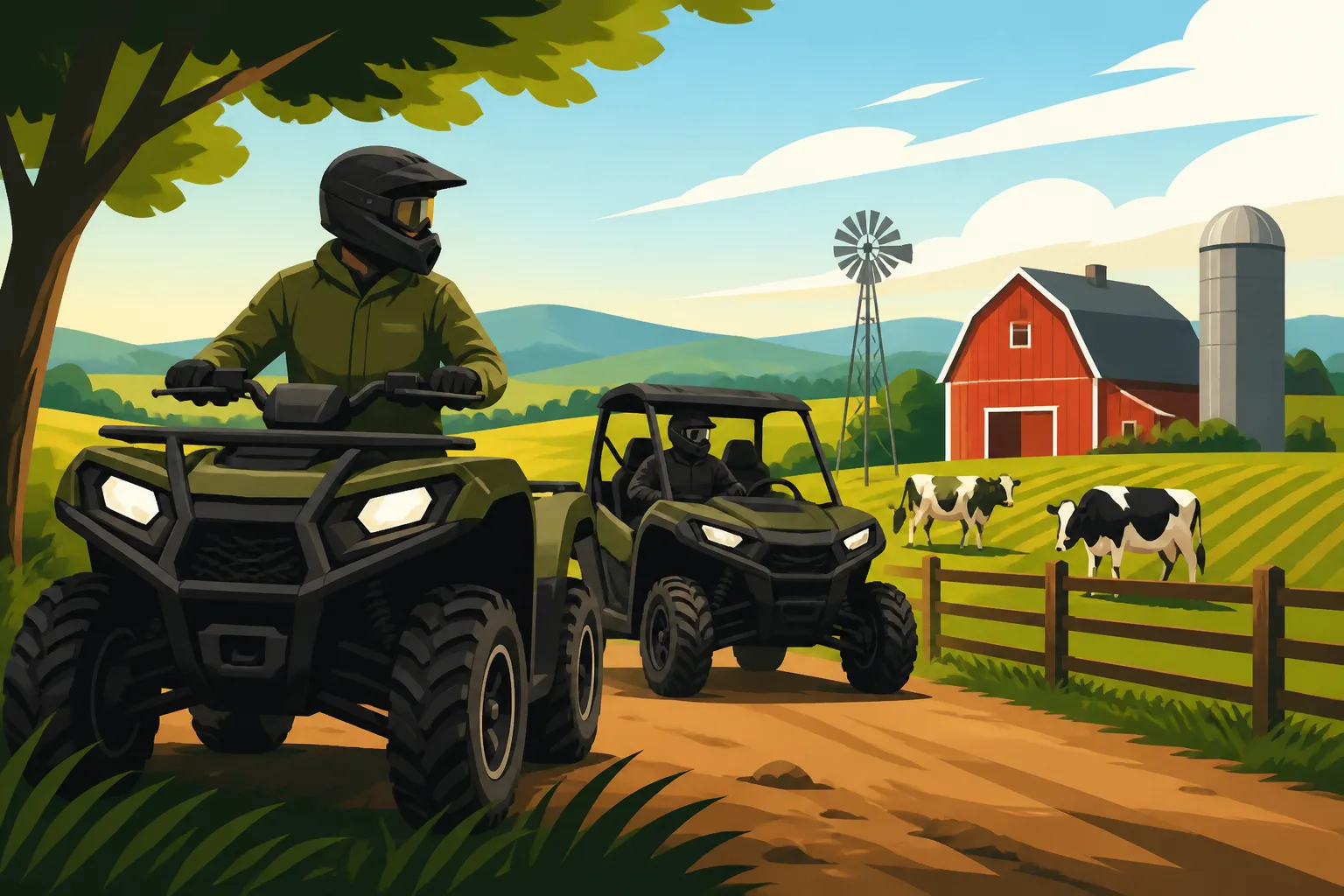
Riding Beside a Working Farm
Riding beside a working farm can feel like a peaceful part of a New York ATV ride, until a gate, tractor, grazing animal, or muddy field makes it clear the land is also someone’s workplace. This guide explains how to use authorized farm-side trails responsibly, avoid common conflicts, and know when a route is not yours to ride.
What riding beside a working farm really means
A trail near a farm is not automatically a trail through it
In New York, a marked ATV route may run near a farm, follow an agreed corridor across agricultural land, or pass a working property at its edge. Those situations are not interchangeable. Seeing tire tracks, an open gate, or another rider cross a field does not establish that you have permission to follow. Private land remains private even when a trail appears to continue across it.
The safest distinction is simple: ride only on a route that is currently open and authorized for your machine. A county trail map, club map, posted signs, or a landowner’s direct permission can help clarify the route. If the map is vague or a marker has fallen, stop and check rather than guessing. A mapping app such as onX Offroad can help you orient yourself and review available route information, but a map layer does not grant access or replace current trail instructions.
The issue matters especially in agricultural country, where a route can sit close to a farm lane, pasture, drainage ditch, or crop field. A quad may look small beside a broad field, but even a short detour can damage crops, compact wet soil, or bring a rider too close to livestock. For a useful overview of permission and courtesy, see [New York Trail Etiquette With Landowners] and [New York Rules for Riding Private Land].
Why farm access depends on cooperation
Many trails that cross private property exist because owners and trail organizations have worked out access arrangements. A farm owner may allow a club to route riders along a particular lane or field edge, with conditions about gates, dates, speed, or which machines may pass. Those details can be specific, and they can change when farm operations, ownership, or trail conditions change. A route that was open on your last visit is not a promise that every branch remains open today.
That arrangement is a privilege, not a public right-of-way. Landowners may be balancing trail access with crop work, animal care, deliveries, repairs, and the safety of people working on the property. If riders cut a corner, ignore a closure, or leave litter, an owner may decide the disruption is no longer worth it. When a trail agreement ends, a whole stretch of riding can disappear for everyone, not just the person who caused the problem. [Landowner Agreements That Keep Trails Open] explains why respectful use matters to the long-term availability of routes.
A good rule is to treat every farm-side trail as a shared corridor with boundaries. Do not assume that the farm lane, field, barnyard, or adjoining woods are included just because the marked trail passes nearby. Stay on the signed route, keep to the surface provided, and leave room for farm traffic. If you cannot tell where the authorized trail goes, do not use a convenient-looking shortcut to answer the question.
How to prepare before riding a farm-side trail
Check the route, access rules, and closures
Before loading your ATV, check the official map or trail information for the area you plan to ride. New York trail networks may be managed by counties, clubs, private operators, or other local partners, and access rules can differ from one system to the next. A trail may be open to registered ATVs but not wider side-by-sides, or it may have seasonal restrictions, membership requirements, or a local permit. Do not assume your usual registration or permit covers every place you want to ride.
For example, riders looking around Tug Hill or in parts of Lewis and Oswego counties should use the current information for the specific trail system they intend to visit. An open section on one map does not prove that a connecting road, farm crossing, or neighboring trail is open as well. Start with [Downloading a County Trail Map] and [New York Trail Conditions Before You Ride]. If you use onX Offroad to plan, compare what it shows with the official trail map and any posted notices before you set out.
Pay special attention to signs at trailheads and at the farm crossing itself. A gate may be closed because of livestock movement, field work, maintenance, a landowner request, or a temporary safety issue. Do not open it just to find out what is beyond it. If an official map and a sign appear to conflict, respect the closure on the ground and contact the relevant trail organization or managing office for clarification before returning.
Think about the farm calendar as well as your ride
Farms are active places, and their busiest tasks may not align with a rider’s preferred weekend. Planting and harvest periods can bring tractors, wagons, trucks, and other large equipment onto lanes and fields. A narrow route beside a crop may also leave little room for a machine to pass safely. Wet ground is particularly vulnerable: a tire rut can damage soil and drainage, and repairs may interfere with planting or field access.
Animal care can require quiet, predictable movement. Cattle may be moved between pasture and barns; horses may be near a lane; poultry or other animals may be kept in areas not visible from the trail. Sudden acceleration, revving, or a group bunching up beside a fence can startle animals. That is one reason a posted speed limit is a ceiling, not a target. Slow down further when visibility is limited or animals are close.
A little planning helps avoid a frustrating mid-ride reversal. Ask your club or trail contact whether a farm section is open, whether a seasonal closure is in effect, and whether a route has special instructions. If you are visiting an unfamiliar area, build a route that has a safe turnaround point rather than relying on a single crossing to complete a long loop. Use onX Offroad or another mapping tool to understand the general layout, while remembering that the landowner or trail manager’s current instructions govern access.
| Before the ride | What to check | Why it matters |
|---|---|---|
| Route access | Official county or club map and current notices | A route may be closed, rerouted, or limited to certain machines |
| Farm crossing | Signs, gates, and marked trail direction | A visible lane or opening is not proof of permission |
| Machine fit | Width restrictions and trail surface | A wide machine can be unsuitable for a narrow farm-side corridor |
| Conditions | Mud, standing water, and recent maintenance updates | Wet ground and soft field edges are easily damaged |
| Group plan | Speed, spacing, and meeting points | A long or noisy group can obstruct farm traffic and disturb animals |
How to ride respectfully beside farm operations
Keep your machine on the authorized surface
Stay on the marked trail, even when the ground looks easier a few feet to the side. Cutting around a puddle may widen the trail into a crop edge or soft shoulder. Riding around a gate can create a new route that was never approved. If a crossing is muddy, blocked, or visibly damaged, turn back or follow the official detour rather than making one of your own. A short delay is better than creating a repair problem for the landowner.
Farm lanes are not necessarily built for recreational riding. They may have soft shoulders, drainage features, buried lines, or entrances used by trucks and tractors. Keep enough space for farm equipment to pass, and stop in a safe place if a large machine approaches. Do not park at a field entrance, barn access, loading area, or gate where you could block work. If there is no safe place to wait, move only as far as needed to clear the route without leaving the authorized corridor.
Trail markers help, but they do not give permission to explore every adjacent track. On a familiar ride, riders can become casual and start treating a farm access lane as an extra loop. Resist that temptation. If the marked route is confusing, pause and consult the official map or contact the responsible club. [Following County Trail Markers] is a helpful reference for staying on the intended route, while [Riding a Trail That Cuts Across a Working Dairy Farm] focuses on the extra care needed around active agricultural land.
Manage noise, speed, and group behavior
A machine’s sound carries across open fields, especially when riders are close to a farmhouse, barn, or grazing area. Use a steady throttle, avoid unnecessary revving, and do not race on farm-side sections. If your group is large, keep it organized and compact enough not to block a lane, but leave safe gaps between machines so riders can respond to hazards without crowding one another. The first rider should signal a stop or slowdown clearly, and the last rider should know when the group has cleared the crossing.
Be considerate when passing people working outdoors. Slow to a controlled pace well before reaching them, give them space, and follow any direction they give about where to wait. Do not assume they have heard you approaching; tractors and other machinery can be loud, and a worker may be focused on a task. If someone signals you to stop, stop in a safe location and listen rather than trying to squeeze past.
The same care applies to homes and animals near the trail. Avoid lingering, shouting, or gathering in a way that feels intrusive. Do not feed or approach livestock through a fence. Keep dogs under control and away from animals, and never let a passenger reach toward a horse or cow as you pass. A calm, predictable ride is easier for farm workers, residents, and animals to tolerate—and makes it more likely that the trail will remain welcome.
Gates, livestock, and unexpected hazards
Treat every gate as a working part of the property
A gate can be there to contain animals, separate fields, control vehicle access, or protect equipment. Follow the signs and instructions for that specific crossing. Some gates may be intended to stay closed; some may have an agreed rider procedure. Do not assume a common practice from another trail applies here. If the instruction is not clear, do not improvise by opening a gate and leaving it unsecured.
If a trail’s written instructions say to open and close a gate, handle it gently and check that it is secure before riding away. A gate left open can allow animals onto a road or into a crop area. A gate left unsecured can swing into a rider or machine. Avoid leaning your ATV against the gate or using it as a place to stop and regroup, since that can obstruct the access point.
If you find a gate damaged, a fence down, or livestock loose near the route, do not try to manage the situation yourself unless there is an immediate safety need. Keep your group at a safe distance, avoid startling the animals, and notify the trail contact or landowner using the appropriate contact information. Continue only if the route is clearly safe and authorized. Do not publish a private contact number or farm location online without permission.
Give animals and farm equipment room
Animals can behave unpredictably when startled, especially if they are young, crowded, or being moved. Approach slowly, avoid sudden noise, and stop if an animal is near or on the trail. Wait for the farm worker’s direction if someone is present. Do not ride between animals and a person moving them, and do not try to herd animals by driving behind them. If the trail is blocked, turn around or use an official alternate route.
Farm equipment can be wide, slow, and difficult to maneuver. A tractor pulling a wagon may occupy the full lane, and the operator may have limited visibility behind or beside the machine. Stop well back rather than squeezing into a ditch or crossing a field to get around it. Make yourself visible, keep your group together, and wait for a safe opportunity to pass only when the operator clearly indicates it is safe. Never assume a worker has seen you.
Other hazards include hoses, irrigation lines, electric fencing, loose gravel, manure, mud, and drainage channels. These are not merely nuisances: a hidden line can snag a wheel, and a soft shoulder can pull a machine off the trail. Ride at a pace that lets you stop within the distance you can see. In poor visibility or after heavy rain, reconsider whether the farm section is appropriate for your group that day. For riders planning around seasonal activity, [New York Rules for Riding During Hunting Season] is also worth reviewing when trails and nearby land may be used for other outdoor activities.
If permission is unclear or a problem comes up
Know the difference between a trail crossing and personal permission
A trail agreement may authorize use of a defined route, not general access to the whole farm. That is why a landowner’s permission to ride one marked corridor should not be treated as permission to explore a woodlot, field, yard, or farm road beyond it. If you want to ride on private land outside an established route, get clear permission from the owner before entering. For a closer look at the basics, read [Written Permission From a New York Landowner].
A verbal conversation can be helpful, but it is easy to misunderstand what was agreed to—especially if the permission concerns dates, machines, gates, or a specific section of property. Ask which route is allowed, what conditions apply, and whether permission covers the other people in your group. Do not assume permission granted to a friend, club, or previous owner automatically applies to you. If access is arranged through a club, follow the club’s instructions rather than seeking a separate route through a different part of the property.
If someone tells you the trail is closed, leave the area by the route you are directed to use, if it is safe and authorized. Do not argue from a map screenshot or from the fact that the crossing was open last season. Trail arrangements can change, and a landowner may need to close a section temporarily. [What Happens When a Landowner Pulls Trail Permission] explains why a route can change even when riders have used it before.
Make a safe choice when the route is uncertain
When you reach an unmarked fork, a newly closed gate, or a damaged sign, stop before crossing onto land you cannot identify. Check the official map, trail notices, and your group’s route plan. A mapping app, including onX Offroad, can support orientation, but it should not be treated as definitive evidence that the route is open. Property boundaries and access permissions are different questions: knowing where a parcel line appears on a screen does not tell you whether a trail agreement allows riding there.
If the information remains unclear, turn around and report the issue to the trail organization or local manager. Note the trail name or nearby landmark and describe the problem without posting a private person’s details. A clear report can help the organization replace a missing marker or update its map before another group encounters the same confusion. It is also better than creating a new track that later riders mistake for an authorized trail.
Before leaving, make sure your group has a practical fallback plan. Carry enough fuel and supplies to retrace your route, keep phones or maps accessible, and agree on where to regroup if the trail is blocked. Riders who are prepared to turn around are less likely to pressure a landowner, cross a field, or continue into an unsafe area just to finish a loop. On a farm-side trail, flexibility is part of being a responsible guest.
Disclaimer
This article is for general informational purposes only and does not constitute professional advice. Laws, prices and regulations vary by location and change over time. Consult a qualified professional for guidance on your specific situation.