Riding a Town Road Plowed to Bare Pavement
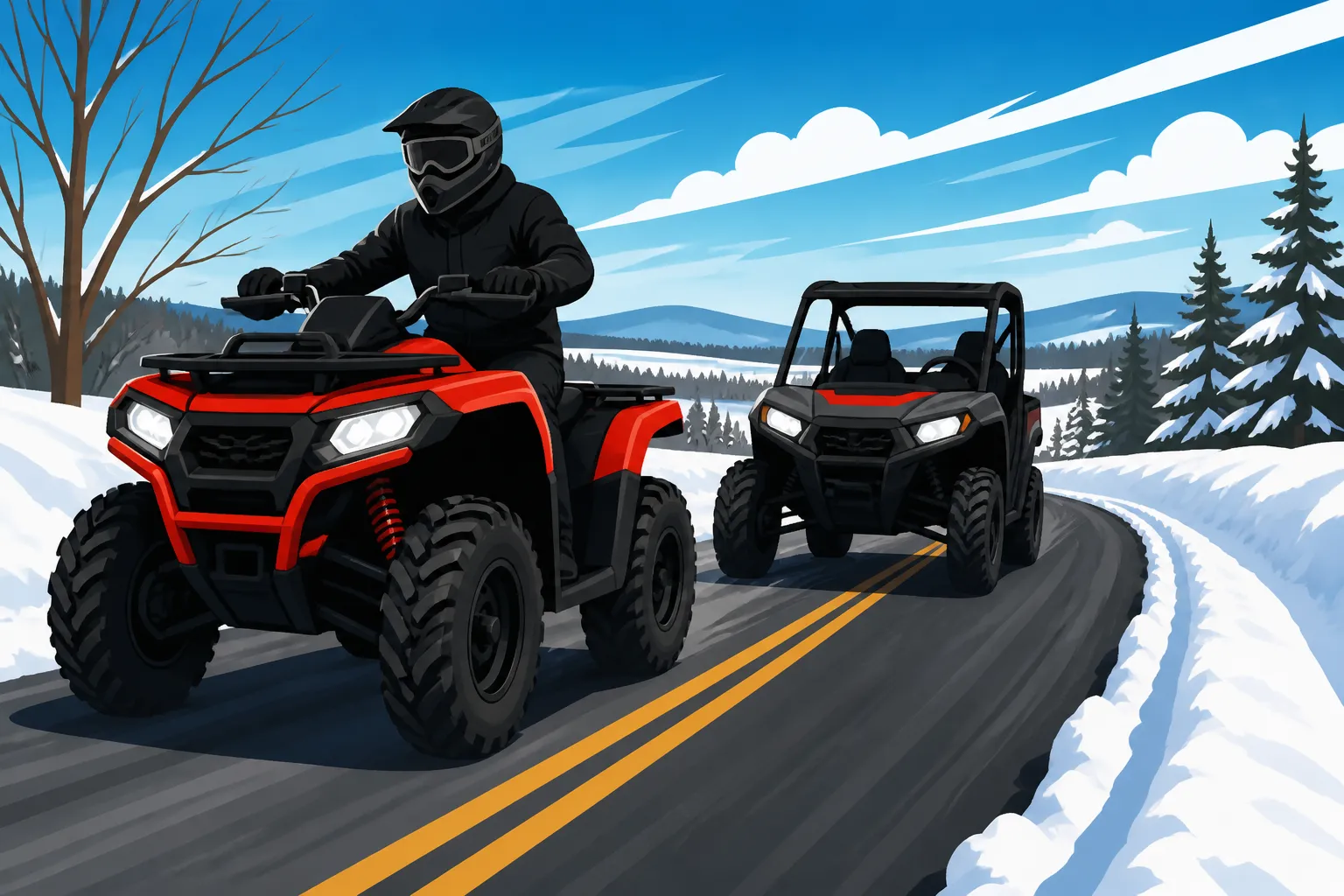
It’s a frustrating scenario many New York ATV riders face as winter rolls in: you look out the window, see the snowplows have done their work, and a town road is now cleared down to bare pavement. The thought inevitably crosses your mind – "Finally, a clear path! Can I just hop on my quad and ride down to the neighbor's, or maybe cut across town to the gas station?" It feels like it should be okay, right? The snow is gone, the road is open, and it's certainly easier than trying to navigate the deep stuff. However, that tempting stretch of bare pavement, no matter how clear, is almost certainly still off-limits for your ATV under New York law, and this guide is here to explain why, helping you avoid costly mistakes.
The Myth of the Plowed Pavement
That feeling of freedom, of wanting to just ride your ATV down a freshly plowed road, is totally understandable. After all, when the snow is deep, our ATVs are often the most capable machines we own for getting around. But the unfortunate truth is that a town road cleared of snow, even if it's perfectly dry and visible, does not automatically become a legal riding area for your all-terrain vehicle in New York. This is a common misconception that can lead to some pretty significant headaches and fines.
Why a Clear Road Isn't an Open Road
New York State law has very specific regulations governing where ATVs can and cannot be operated, and these rules generally prohibit ATVs from public highways, streets, and roads. The presence or absence of snow doesn't change this fundamental restriction. While snowmobiles have specific provisions in the law that allow them on certain public roads under certain conditions (often when covered with sufficient snow), ATVs do not share these same privileges. A clear, plowed road, from the perspective of an ATV, is just another public highway, and public highways are largely off-limits unless explicitly designated.
Think of it this way: the pavement itself is not the issue; the classification of the land as a "public highway" is. Whether it's covered in three feet of snow, an inch of slush, or completely bare, a town road remains a public thoroughfare intended primarily for cars, trucks, and other on-road vehicles. Your ATV, by definition, is an off-highway vehicle, and its operation on these paved surfaces is heavily restricted. This can be particularly frustrating when you've invested in a robust machine, perhaps even one upgraded with durable components from a brand like SuperATV, designed for tackling tough terrain, only to find it restricted on seemingly simple stretches of road.
The "Street Legal" Conundrum for ATVs
Many riders, especially those new to the sport or coming from states with different laws, often wonder if they can simply make their ATV "street legal." In New York, for true ATVs, the short answer is generally no. New York law defines an ATV as a motor vehicle designed for off-highway use, having at least three wheels, weighing less than 1,000 pounds, and being no more than 70 inches wide. These characteristics inherently clash with the requirements for street-legal vehicles, which must meet federal safety standards for on-road use, including things like specific lighting, mirrors, and emissions.
While some might consider adding turn signals, horns, or mirrors, these modifications do not magically transform an ATV into a vehicle that can legally be registered and operated on public roads in New York State. The state does not offer a path to register a standard ATV for general street use. This often leads to confusion, particularly for owners of side-by-sides (UTVs) which often look more like small cars. However, most side-by-sides also fail to meet New York's strict definition of an ATV due to their weight and width, meaning they also cannot be [Registering an ATV in New York] or operated on public roads. It's a key distinction that catches many riders off guard.
Understanding New York's Road Rules for ATVs
Navigating the rules for ATV use in New York can feel like walking through a minefield, especially when it comes to public roads. The general rule is clear: ATVs are prohibited on public streets and highways. However, like most rules, there are very specific, narrow exceptions that you absolutely need to understand before you consider riding anywhere near pavement.
The "Designated and Posted" Standard
The most critical exception to the "no roads" rule in New York is the concept of "designated and posted" roads. A town, county, or other municipality can pass an ordinance to specifically allow ATV use on certain roads or sections of roads. However, this isn't just a casual decision. For a road to be legal for ATV use, it must be both:
- Designated: Meaning the local legislative body (like a town board or county legislature) has formally passed a law or resolution explicitly allowing ATVs on that specific road or segment. This isn't just a verbal agreement or a general understanding; it must be codified into local law.
- Posted: Once designated, the road must be clearly marked with signs indicating that ATV use is permitted. These signs are crucial because they inform riders and law enforcement alike about the road's status. Without clear signage, even if a road has been technically designated, you could still be cited for illegal operation.
This "designated and posted" rule is why simply seeing a plowed, clear road doesn't make it legal. That road hasn't undergone the specific legislative process, nor has it been marked for ATV use. Unless you see those official signs, assume it's off-limits. You'll often find these designated roads acting as connectors between different trail systems, or providing access to trailheads, rather than being routes for general travel. It’s always best to check with the local municipality or official trail maps, like those for the [The Lewis County ATV Trail System in New York], to understand which roads, if any, are truly open.
Limited Exceptions for Road Use
Beyond "designated and posted" roads, New York law does offer a few extremely narrow exceptions where an ATV might briefly operate on a public highway. These are not licenses for recreational riding on roads, but rather specific allowances for necessary tasks:
- Crossing a Highway: An ATV can cross a public highway or street at approximately a ninety-degree angle to the direction of the highway, provided the crossing is made at a place where no obstruction prevents a quick and safe passage. The operator must come to a complete stop before crossing and yield the right of way to all traffic. This is for getting from one side of a trail to another, or from one piece of private property to another, not for traveling along the road. For more details, refer to [Crossing a Highway on an ATV in New York].
- Operating on the Shoulder: An ATV can operate on the shoulder of a public highway for the purpose of gaining immediate access to an authorized trail or route, or to cross a bridge or culvert where riding on the shoulder is the only safe way to proceed. Again, this is not for extended travel, but for very short, practical distances.
- Emergency Situations: In true emergencies, such as assisting with a search and rescue operation or responding to a declared emergency, law enforcement and authorized emergency personnel may operate ATVs on public roads. This exception does not apply to the general public.
- Agricultural Purposes: Farmers may use ATVs on public highways for short distances when directly related to farming operations, such as moving between fields. However, this is a specific exemption tied to agricultural work, not general recreational riding. If you're using your quad to check fences or move equipment, this might apply, but riding it to the diner certainly would not. For an in-depth look at this, see [The Agricultural Exemption in New York].
It's absolutely crucial to remember that these exceptions are highly specific and do not grant permission for leisurely rides on public roads, plowed or otherwise. Misinterpreting these exceptions is a surefire way to find yourself facing a ticket and a hefty fine.
Legal Riding: Where You Can Go
Given the strict rules against riding ATVs on most New York roads, it’s natural to wonder, "So, where can I actually ride my machine legally?" The good news is that New York does offer legitimate and fantastic opportunities for ATV enthusiasts, but it almost always boils down to two main categories: dedicated trail systems and private property with permission. Embracing these legal avenues not only keeps you safe from fines but also helps preserve the positive reputation of the ATV community.
Exploring Dedicated Trail Systems
New York is home to several excellent dedicated ATV trail systems that provide thousands of miles of legal, managed riding. These are the places where you can truly let your machine stretch its legs without worrying about law enforcement.
- County-Managed Trails: The most prominent example is the Lewis County ATV Trail System, a massive network spanning over 600 miles. This system offers diverse terrain, from mud bogs to rocky climbs, and is a prime destination for riders across the state and beyond. These trails are maintained, signed, and often connect to small towns where you can refuel and grab a bite. To ride these trails, you'll need a [Lewis County ATV Trail Permit Cost and Rules], which contributes directly to trail maintenance and expansion.
- Club Trails: Many local ATV clubs across New York maintain their own private trail networks, often through agreements with private landowners. Membership in these clubs not only gives you access to these exclusive trails but also connects you with fellow enthusiasts and opportunities to participate in group rides and trail work. Oswego County, for example, has active clubs that manage significant mileage. [Joining a New York ATV Club] is a great way to discover these hidden gems and ensure you're riding legally and responsibly.
- Pay-to-Ride Parks: A few privately owned parks, like Tall Pines ATV Park in Andover, offer controlled environments for ATV riding. These parks typically have varying terrain, from beginner-friendly loops to advanced technical challenges, and often include amenities like camping. They are excellent options for a day trip or a weekend adventure, providing a safe and legal place to ride without needing to navigate complex public land rules.
When planning to ride any dedicated trail system, always check their specific rules, opening and closing dates (which can vary with weather conditions), and permit requirements. Many trails have width restrictions, making some larger side-by-sides, even those from manufacturers like SuperATV, unsuitable for certain narrow sections.
The Importance of Landowner Permission
Aside from designated trail systems, riding on private land with the explicit permission of the landowner is one of the most common and enjoyable ways to operate your ATV legally in New York. This might be your own property, a friend's farm, or a large tract of hunting land you have access to.
- Your Own Property: Riding on land you own is generally permissible, provided you adhere to local noise ordinances and operate safely. This is often where riders learn the ropes, practice their skills, or simply enjoy casual rides without needing permits or following specific trail signage.
- Friends, Family, or Leased Land: If you plan to ride on someone else's property, always get clear, explicit permission first. It's best to have this in writing, even if it's just a text message, to avoid any misunderstandings. Verbal permission is good, but written proof can protect you in case of an incident. Respecting private property rights is paramount. This includes staying on agreed-upon routes, closing gates, and not disturbing livestock or crops. Many trail systems, in fact, rely on these very [Landowner Agreements That Keep Trails Open] to connect sections of trail across private parcels.
- Hunting or Agricultural Land: Many hunters use ATVs to access remote areas, retrieve game, or perform property management tasks on leased or owned land. Farmers use them for daily operations. In these scenarios, the ATV is often considered a tool for a specific purpose on private land, which is perfectly legal. However, even on private land, riders are still subject to [New York's Mandatory ATV Insurance] requirement and helmet laws.
Always remember that obtaining permission is not just a courtesy; it's a legal necessity. Riding on private land without permission is trespassing, a serious offense that can lead to fines, your machine being impounded, and a damaged reputation for all ATV riders.
The Repercussions of Illegal Road Riding
Thinking you can sneak a quick ride down that freshly plowed town road might seem harmless, but the consequences of operating an ATV illegally on public roads in New York can be severe. It's not just a slap on the wrist; it can hit your wallet hard, affect your driving record, and even result in the loss of your machine. Understanding these repercussions is a crucial part of responsible ATV ownership in the state.
Fines, Penalties, and More
Operating an ATV on a public highway or road that is not specifically designated and posted for such use is a violation of New York State Vehicle and Traffic Law. The penalties can escalate depending on the severity and frequency of the offense:
- Fines: You can expect a significant fine for illegal road operation. These fines can vary by jurisdiction but are often several hundred dollars, easily outweighing any convenience you might have gained from a quick illegal ride. For instance, [New York Fines for an Unregistered ATV] can be substantial, and riding on a prohibited road can carry similar or even higher penalties.
- Impoundment: Law enforcement has the authority to impound your ATV if you are caught riding it illegally. Getting your machine back often involves paying towing fees, storage fees, and any associated fines, which can quickly add up to thousands of dollars. Imagine having your prized quad, perhaps even one equipped with specialized SuperATV components, sitting in an impound lot for weeks.
- Points on Your Driver's License: While an ATV is an off-highway vehicle, violations related to its operation on public roads can sometimes result in points being assessed against your standard New York driver's license, affecting your insurance rates and potentially leading to license suspension if you accumulate too many points.
- Insurance Ramifications: Your ATV insurance policy is likely void if you are operating the machine illegally. This means if you have an accident on a prohibited road, your insurance company could deny coverage for damages to your ATV, injuries to yourself, or damage/injury to others. This financial risk alone should be a powerful deterrent, especially considering [New York's Mandatory ATV Insurance] requirement.
- Criminal Charges: In more severe cases, such as reckless operation, causing damage to property, or operating while intoxicated, charges can escalate beyond traffic violations to misdemeanors or even felonies, leading to much more serious consequences including jail time.
It's clear that the "quick spin" isn't worth the risk. Law enforcement, especially in areas with known ATV activity, is well aware of these common violations and patrols accordingly.
Impact on the ATV Community
Beyond personal penalties, illegal road riding casts a long shadow over the entire ATV community in New York. Every time a rider is caught operating illegally on a public road, it reinforces negative stereotypes about ATV users being reckless and disrespectful of laws and private property.
- Erosion of Public Trust: Incidents of illegal riding erode public trust and make it much harder for legitimate ATV clubs and advocates to work with landowners, towns, and state agencies to create more legal riding opportunities. When a town board considers opening a road or creating a new trail, they often look at the past behavior of riders. A history of illegal activity makes them much less likely to approve such initiatives.
- Trail Closures: Landowners who previously allowed trail access might revoke permission if they observe or hear about illegal ATV use on adjacent public roads, fearing liability or simply not wanting to be associated with rule-breakers. This can lead to the closure of vital trail segments, impacting everyone.
- Increased Scrutiny and Restrictions: Persistent illegal activity can lead to stricter enforcement, more aggressive patrols, and even calls for outright bans on ATV use in certain areas. This makes it harder for everyone to enjoy the sport responsibly.
As responsible riders, it's our collective duty to adhere to the rules. By sticking to designated trails and private land with permission, we not only protect ourselves from fines and legal trouble but also contribute to a positive image for ATVing in New York, helping to ensure the sport remains vibrant and accessible for years to come.
Disclaimer
This article is for general informational purposes only and does not constitute professional advice. Laws, prices and regulations vary by location and change over time. Consult a qualified professional for guidance on your specific situation.