A Constitution Clause From 1894
For those of us who love the roar of an ATV engine and the thrill of exploring the great outdoors, New York State can sometimes feel like a land of contradictions. We see vast, stunning landscapes, from the Adirondacks to the Catskills, but often find ourselves wondering why so much of it is off-limits to our machines. This frustration often boils down to a single, powerful piece of legislation: a constitutional clause dating back to 1894 that forever shapes where and how we can ride our ATVs and UTVs in the Empire State. This guide will unravel the mystery of this historic clause, explaining its origins, its profound impact on access, and why it remains such a significant barrier for riders today.
The "Forever Wild" Clause and Its Origins
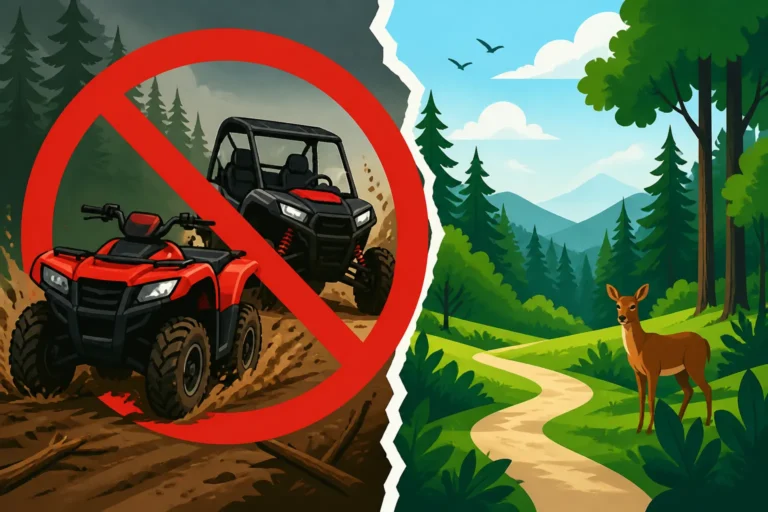
It's easy to look at a "No ATVs" sign on a gorgeous trail and feel like it's a recent, arbitrary decision, but often, the roots of these restrictions run incredibly deep in New York. One of the most fundamental reasons for the limited public land access for motorized vehicles, particularly in the state's iconic parks, can be traced back over a century to a pivotal moment in New York's history. Understanding this history is key to grasping the current landscape of riding opportunities.
What is Article XIV, Section 1?
At the heart of New York's unique approach to its wild lands is Article XIV, Section 1 of the New York State Constitution. This isn't just a law; it's a constitutional mandate, meaning it's incredibly difficult to change. It was adopted in 1894, a time when rapid industrialization and unchecked logging were devastating the state's forests, particularly in the Adirondacks. People saw the destruction and recognized a critical need for protection.
The clause itself is remarkably clear and direct: "The lands of the state, now owned or hereafter acquired, constituting the forest preserve as now fixed by law, shall be forever kept as wild forest lands." It goes on to state that these lands "shall not be leased, sold or exchanged, or be taken by any corporation, public or private, nor shall the timber thereon be sold, removed or destroyed." This wasn't just about preventing logging; it was about preserving the wild character of the land for future generations, ensuring it would remain untouched by commercial exploitation or extensive development. The framers of this clause envisioned a sanctuary, a place where nature would reign supreme, largely free from human intervention, and certainly free from the machines of industry or, as it turns out, recreation. It's a powerful statement of environmental protection, perhaps one of the earliest and strongest in the nation, but one that undeniably impacts how we interact with these lands today.
Why 1894 Matters for ATV Riders Today
The year 1894 might seem like ancient history to a modern ATV rider, but its significance cannot be overstated. When the constitutional convention drafted this "Forever Wild" clause, they used language that, while progressive for its time, didn't anticipate the advent of modern recreational vehicles like ATVs and UTVs. The intent was to prevent logging, mining, and other destructive industrial uses, not necessarily to ban a quad from a trail. However, the legal interpretation over the decades has consistently leaned towards a strict reading of "wild forest lands," concluding that motorized vehicle trails, especially those specifically built for recreational machines, fundamentally alter the "wild" character of these areas.
This means that while the clause doesn't explicitly mention ATVs, its broad protective language has been applied to restrict their presence. Every proposal for a new trail, every attempt to open a road within the Forest Preserve to ATVs, runs headlong into this century-old constitutional wall. It's not a matter of a bureaucrat deciding on a whim; it's a matter of deeply entrenched law that has been consistently upheld. This makes any legislative effort to expand ATV access in these areas an uphill battle, often seen as an attempt to undermine the foundational protection of the Forest Preserve. Riders are essentially grappling with the legacy of environmental foresight from a bygone era, applied rigidly to a form of recreation that didn't even exist when the rule was written.
How "Forever Wild" Impacts ATV/UTV Access
For many New York ATV and UTV enthusiasts, the state's vast Adirondack and Catskill Parks represent a tantalizing but largely inaccessible wilderness. This sense of frustration stems directly from the "Forever Wild" clause and its rigorous application, which creates a complex patchwork of regulations. Understanding the distinctions within these areas is crucial for knowing where you can and cannot legally ride.
The Forest Preserve: Adirondack and Catskill Parks
When we talk about the Forest Preserve, we're primarily referring to lands within New York's two great parks: the Adirondack Park and the Catskill Park. These aren't like national parks where the federal government owns all the land; rather, they are complex mosaics of public and private property. However, it's the state-owned lands within these parks that fall under the ironclad protection of Article XIV, Section 1. And for ATV riders, this means significant restrictions.
The interpretation of "forever kept as wild forest lands" has led to a near-total prohibition on ATV and UTV use in the designated Wilderness, Primitive, and Canoe Areas within the Forest Preserve. These areas are managed to preserve their natural, undeveloped character, with an emphasis on non-motorized recreation. Imagine trying to get a permit for an ATV trail through a designated wilderness area – it simply won't happen. The legal framework is designed to prevent any activity that could be seen as altering the wild nature of these lands. This means that while these areas offer breathtaking scenery, they remain largely untouched by the tracks of our machines. It's a beautiful vision of conservation, but it undeniably restricts where we can explore on our quads. The article [Why New York's Forest Preserve Is Closed] delves deeper into these specific prohibitions.
Wilderness vs. Wild Forest Land
This is where things get a little more nuanced, and where a critical distinction exists for those dreaming of riding in New York's iconic parks. Not all state-owned land within the Adirondack and Catskill Parks is classified the same way. The Department of Environmental Conservation (DEC) manages these lands under different classifications, and understanding these is key to identifying any potential, albeit limited, riding opportunities.
The primary distinction is between "Wilderness" and "Wild Forest" land. Wilderness areas, as discussed, are managed for maximum wildness and typically prohibit all motorized vehicles. These are the places where you truly have to hike, paddle, or ski to explore. However, "Wild Forest" lands are a bit different. While still part of the Forest Preserve and under the general "Forever Wild" umbrella, they are managed with a slightly broader approach that can sometimes include limited motorized access on existing, designated roads or trails.
The crucial word here is "designated." This doesn't mean you can just drive down any old logging road you find. Any road or trail open to motor vehicles, including ATVs (which are exceedingly rare and typically for administrative or specific access purposes only), must be explicitly designated and maintained for that purpose by the DEC. These opportunities are generally scarce and are not designed for extensive recreational ATV trail networks like those found in other states. Most Wild Forest roads, if they allow any motorized use, are geared towards standard vehicles or snowmobiles in winter, not ATVs. The interpretation of Article XIV by the DEC is very cautious, meaning new designations for ATV use are almost non-existent. For a deeper understanding of this crucial difference, explore [New York's Wild Forest Versus Wilderness Land]. This careful classification ensures that the core constitutional mandate to keep these lands "forever wild" is upheld, even if it means fewer places for us to ride.
The Broader Implications for New York Riding
The "Forever Wild" clause isn't just a historical footnote; it's a living, breathing legal entity that continues to shape the reality of ATV and UTV riding across New York State. Its influence extends beyond the boundaries of specific parks, coloring the entire discussion around public land access and what it truly means to be a powersports enthusiast in a state with such robust environmental protections.
Frustrations and Limited Public Riding Opportunities
It's completely understandable to feel a deep sense of frustration when you see maps of New York's vast public lands, know they are publicly owned, yet realize that the vast majority are simply closed to your ATV. This isn't just a minor inconvenience; it's a significant barrier to enjoying the sport on a larger scale. Riders often look at states like Pennsylvania, West Virginia, or even parts of New England and wonder why New York, with its immense natural beauty, offers so few large-scale public ATV trail systems. This disparity can lead to a feeling of being overlooked or misunderstood by policymakers who prioritize other forms of recreation or stricter conservation.
The simple fact is that the constitutional mandate makes it exceptionally difficult to create new, extensive public ATV trails in state-owned forests, particularly within the Adirondack and Catskill Parks. While there are some fantastic county-run trails, like the Lewis County system, and private parks, they don't cover the same expansive territory that some riders dream of exploring. This often means hauling your machine further, relying more on private land access, or simply accepting that the vast, publicly-owned wilderness of New York is largely off-limits for motorized adventure. It’s a bitter pill to swallow for many, and it often drives riders to seek opportunities in neighboring states. You can learn more about specific closures in [Where New York Bars ATV Riding].
Advocacy and Attempts at Change
Given the limitations imposed by the "Forever Wild" clause, it's no surprise that there have been, and continue to be, various efforts by rider advocacy groups to find ways to expand ATV and UTV access in New York. These groups work tirelessly, often engaging with local and state officials, to explore possibilities like reclassifying certain lands, designating specific multi-use trails, or supporting legislation that could incrementally open up new areas. However, these efforts always face an enormous hurdle: the New York State Constitution.
Amending a constitutional clause is not merely difficult; it's a monumental undertaking. It requires a lengthy legislative process, often followed by a statewide referendum, and typically faces fierce opposition from well-organized environmental groups who view any weakening of the "Forever Wild" protections as a dangerous precedent. Any proposed bill that seeks to open up designated Wilderness or Primitive areas to motorized recreation would undoubtedly face immediate legal challenges, likely being struck down as unconstitutional. This political and legal reality means that while advocacy continues, the path to widespread public ATV access in the Forest Preserve remains incredibly steep, almost vertical.
For many riders, this means focusing on the opportunities that do exist, such as county trail systems, private riding parks, and secured private land access. It also means ensuring your machine is well-equipped for the more rugged, often less-maintained conditions found on these accessible trails. Products from companies like SuperATV, known for their durable aftermarket parts like skid plates, A-arms, and winches, become essential for navigating the challenging terrain you can access, since the pristine, purpose-built trails you might find elsewhere are often a pipe dream in New York's more protected zones. This ongoing battle highlights the complex relationship between conservation, recreation, and deeply ingrained historical legal precedent in the Empire State.
| Land Classification | Primary Purpose | ATV/UTV Access | Example Areas |
|---|---|---|---|
| Wilderness Area | Maximize wildness, non-motorized recreation | Generally Prohibited | High Peaks Wilderness (Adirondacks) |
| Primitive Area | Similar to Wilderness, slightly less strict | Generally Prohibited | Pigeon Lake Wilderness (Adirondacks) |
| Canoe Area | Water-based primitive recreation | Generally Prohibited | St. Regis Canoe Area (Adirondacks) |
| Wild Forest Land | Natural resource protection, diverse recreation | Limited, Designated Roads/Trails Only | Hammond Pond Wild Forest (Adirondacks) |
| State Forest Land | Timber production, recreation | Varies, some multi-use trails, fewer constitutional restrictions | Many state forests outside Adirondack/Catskill Parks |
Disclaimer
This article is for general informational purposes only and does not constitute professional advice. Laws, prices and regulations vary by location and change over time. Consult a qualified professional for guidance on your specific situation.