Registering a Town’s Machine in New York
It’s a common misconception that anything owned by a town or municipality gets a free pass on state regulations. Many town officials, whether they’re in public works, park maintenance, or even emergency services, might find themselves scratching their heads when it comes to registering an ATV that will be used for official duties. This guide is here to clear up that confusion, breaking down exactly what New York towns need to do to register their ATVs, ensuring everything is above board and ready for action.
Why a Town Needs to Register Its ATVs in New York
When a town acquires an all-terrain vehicle, whether it’s a shiny new quad or a workhorse side-by-side (that meets the state's narrow definition of an ATV), the thought might cross someone's mind: "Does the town really need to register this?" After all, it's not a personal vehicle, and it's being used for public good, right? The answer, almost universally in New York, is a resounding yes, it does.
The Purpose of Government-Owned Machines
Towns across New York state put ATVs to work in a multitude of ways. Picture a parks department crew using a nimble quad to access remote sections of a municipal park for trail maintenance, litter collection, or even to check on the health of trees after a storm. Consider a public works team using a robust ATV to get to hard-to-reach utility boxes or storm drains for inspections, especially after heavy rains or snowmelt. In some communities, emergency services might rely on ATVs for search and rescue operations in wilderness areas or for accessing accident scenes where traditional vehicles can't go. Even for something as seemingly mundane as preparing town ball fields or plowing short stretches of sidewalks, an ATV can be an invaluable tool. These machines aren't just for recreation; they are essential equipment for maintaining public infrastructure and ensuring public safety, often in places cars and trucks simply cannot reach.
These uses, however vital, don't automatically exempt the machine from state law. New York’s ATV regulations are designed to ensure safety, accountability, and proper funding for trails and administration, regardless of who owns the vehicle. A registered machine can be tracked, and its operation falls under a framework of rules, which protects both the operators and the public. Without registration, a town's machine would essentially be an unidentifiable entity, making it difficult to enforce safety standards or address any incidents that might occur during its operation.
Dispelling the "Government Exemption" Myth
The idea that government vehicles are automatically exempt from registration, plates, or other state mandates is a persistent myth. While some specific types of government vehicles, like heavy construction equipment confined to work sites, might have different rules, for ATVs operated on any public land or designated trails, the rules are surprisingly similar to privately owned machines. New York law doesn't typically carve out a blanket "municipal exemption" for ATVs that would allow them to bypass registration when used off private town property. If a town plans to use its ATV in a town park, on a designated multi-use trail, or even to cross public roads, it needs to be registered.
There can be very narrow exceptions, of course. If a town were to acquire an ATV and only use it on a completely private, fenced-off parcel of land that is not open to the public, and never transports it on a public roadway, then registration might not be required. However, for the vast majority of municipal uses, where ATVs might operate on public easements, cross public roads (even briefly), or work within publicly accessible parks, registration is a must. Failing to register could lead to citations for the town or its employees, and more importantly, could complicate liability issues should an accident occur. It's simply not worth the risk, especially when the purpose is public service. The safest and most compliant route for any town machine that will see use beyond strictly private, inaccessible land is to get it properly registered.
The Specifics of Registering a Town's ATV
Registering a town's ATV isn't fundamentally different from registering a personal machine, but there are nuances in how the ownership is proven and who handles the paperwork. It requires attention to detail, but it's a straightforward process once you understand the steps.
Required Paperwork and Proof of Ownership
For a town-owned ATV, the "owner" isn't an individual, but rather the municipality itself. This means that instead of a driver's license for identification, the town will use its official name and address. When it comes to proving ownership, towns typically won't have a traditional certificate of title for an ATV, as New York doesn't issue titles for these machines. Instead, they'll rely on documentation that confirms the town legally acquired the vehicle.
This proof can include things like the original purchase order from the dealership, the invoice, or a bill of sale clearly stating the town as the purchaser. Sometimes, a formal resolution from the town board authorizing the purchase and designating its use can also serve as supporting documentation. It's crucial that these documents explicitly name the town as the owner, not an individual department head or employee. You'll also need the manufacturer's statement of origin (MSO) if the ATV is brand new. For a deeper dive into what documentation is accepted, you can check out resources like [New York ATV Proof of Ownership Requirements].
Just like with a privately owned ATV, the town will also need to provide a pencil tracing of the machine's Vehicle Identification Number (VIN). This is a standard requirement for registering non-titled vehicles in New York and helps prevent fraud. An employee will need to carefully rub a pencil over paper placed on the VIN plate, producing a clear impression. You can learn more about this specific requirement in [Why New York Wants a Pencil Tracing of the VIN]. All these documents, along with the completed registration form, make up the core of what the DMV needs to see. For a general overview of all the documents involved, the [New York ATV Registration Paperwork] guide can be quite helpful, even for municipal machines.
The Registration Form and Fees for Municipalities
When it comes time to actually fill out the paperwork, a town will use the same form that individual owners use: the MV-51B, otherwise known as the "Application for Registration/Title." On this form, instead of filling in a personal name and home address, the town's official name (e.g., "Town of Smithville Highway Department") and its official address will be entered. The details of the ATV itself – make, model, year, VIN – will be the same as for any other machine. Understanding this form is key, and you can find more detailed explanations in [New York's Form MV-51B Explained].
Regarding fees, municipalities generally pay the same registration and plate fees as private citizens. New York does not typically offer exemptions from these fees for town-owned ATVs. This means the town will pay the annual registration fee and the one-time [New York ATV Plate Fee]. While municipal purchases are usually exempt from state and local sales tax, this exemption typically applies to the purchase price of the vehicle itself, not to the state-mandated registration and plate fees. The exact figures should always be verified with the New York DMV, as fees can occasionally change. Payment will typically be made via a town check or through a municipal account, following standard town procurement and payment procedures.
Where to Complete the Registration
Once all the paperwork is gathered and the necessary funds are allocated, the registration process itself is typically handled at a local New York Department of Motor Vehicles (DMV) office. While some private registrations can be done by mail or through dealers, for a town's first-time registration of a machine, an in-person visit is often the most straightforward way to ensure all documentation is correct and accepted. A town employee, usually from the public works department, the town clerk's office, or another designated administrator, will bring all the required documents to the counter.
It's wise to call ahead to the specific DMV office to confirm their hours, what forms of payment they accept from municipalities, and if they have any specific departmental requirements. Sometimes, larger DMV offices might have dedicated commercial or government services counters, which can streamline the process. The staff at the DMV are there to help, and bringing all your organized paperwork will make the experience as smooth as possible. For more general advice on locations, you can reference [Where to Register an ATV in New York].
Ongoing Compliance and Operation for Town ATVs
Getting the initial registration done is a big step, but it's not the end of the road. Towns also need to consider ongoing compliance, ensuring their ATVs remain legal and operational year after year. This involves renewals, insurance, and proper operator certification.
Plates, Decals, and Annual Renewals
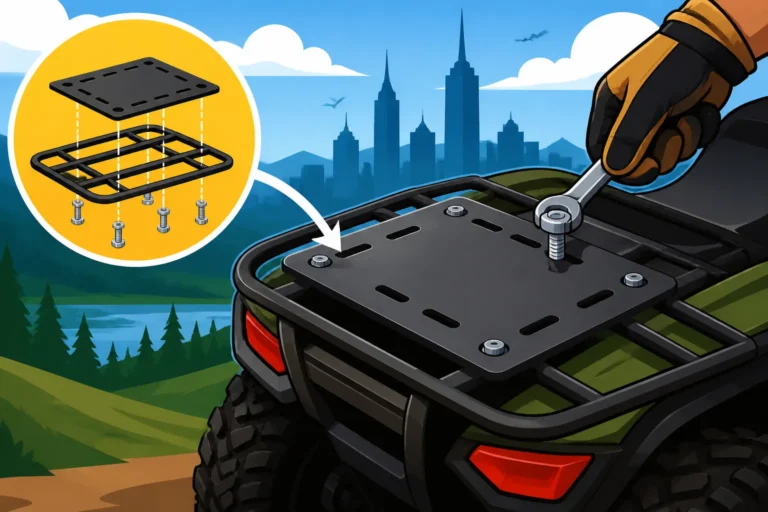
Just like privately owned ATVs, town machines must prominently display their New York ATV plate. This plate typically mounts on the rear of the machine, making it visible to anyone checking for compliance. Along with the plate, an annual validation decal, which indicates the current registration year, must be affixed to the plate. Directions on placement can be found in [New York ATV Plates and Where They Mount] and [Where to Stick a New York ATV Validation Decal]. These are not optional for municipal vehicles; they signify that the machine is legally registered and ready for use.
The registration for a town's ATV, like all ATVs in New York, will expire annually on August 31st. This is a fixed date, regardless of when the machine was originally registered. This means a town must proactively remember to renew its ATV registrations each year before this deadline to avoid any lapse in legal operation. Renewing can often be done by mail or online after the initial registration, making it easier for towns to manage their fleet. The process for renewing is explained in [Renewing a New York ATV Registration], and the fixed expiration date is detailed in [New York's August 31 Expiration]. Missing the renewal deadline means the machine cannot be legally operated off private land until it's brought back into compliance.
Insurance and Operator Requirements
For any ATV operating off private property in New York, insurance is not just a good idea; it's mandatory. This applies unequivocally to town-owned machines. Given the potential for liability when operating machinery in public spaces or for public service, ensuring adequate insurance coverage is paramount for a municipality. The town will need to secure a policy that meets New York's minimum liability requirements, which are the same for all ATVs. This coverage protects the town from financial responsibility in the event of an accident causing injury or property damage. For specifics on what's required, consult [New York's Mandatory ATV Insurance]. It's crucial that the town's insurance policy specifically covers ATV operation and lists the town as the insured party.
Beyond the machine itself, the operators also need to meet specific requirements. Any town employee operating an ATV, especially on designated trails or public lands, must adhere to New York's safety certificate rules. While adults typically aren't required to have a safety certificate for private land riding, operating on designated public trails often necessitates one, regardless of age. If the town's machines will be used in such areas, employees should obtain the proper certification. Details can be found in [New York ATV Safety Certificate Requirements]. Furthermore, all operators and passengers on town ATVs must wear approved helmets, as per [New York Helmet Law for ATV Riders]. Safety equipment isn't just a recommendation; it's a legal mandate that protects the town's employees and limits liability.
Common Pitfalls and Best Practices
One of the most common pitfalls for towns is simply assuming an exemption exists, leading to an unregistered machine being operated illegally. Another is forgetting the annual renewal deadline, resulting in an expired registration. In a busy municipal environment, it's easy for these administrative tasks to fall through the cracks. Using an ATV without current registration or insurance exposes the town to fines, legal repercussions, and significant liability in case of an accident.
To avoid these issues, here are some best practices:
- Designate a Responsible Party: Assign one person or department (e.g., the Town Clerk's office or Public Works supervisor) the responsibility for managing all ATV registrations, renewals, and insurance policies. This ensures accountability.
- Maintain Clear Records: Keep a dedicated file for each ATV, containing all purchase documents, registration forms, insurance certificates, VIN tracings, and renewal receipts.
- Calendar Reminders: Implement a robust calendar system with reminders for annual renewal dates well in advance of the August 31st deadline.
- Operator Training and Certification: Ensure all employees who operate ATVs receive appropriate training and acquire any necessary safety certificates. Regularly refresh their knowledge of New York ATV laws.
- Develop Internal Policies: Create clear internal operating procedures for town ATV use, covering everything from authorized operators and approved uses to safety protocols and incident reporting. For drafting general business and legal documents like internal operating procedures or asset management policies, a resource like LawDepot can provide useful templates, helping towns establish clear guidelines, although specific ATV registration details would always come from official DMV guidance.
- Regular Inspections: Periodically inspect town ATVs to ensure plates and decals are secure and legible, and that the machines themselves are in safe operating condition.
By following these guidelines, New York towns can ensure their valuable ATV assets are legally compliant, safely operated, and effectively serve their communities without unnecessary headaches or risks.
| Feature | Privately Owned ATV | Town-Owned ATV |
|---|---|---|
| Owner | Individual(s) listed | Town/Municipality listed |
| Proof of Ownership | Bill of sale, MSO, previous registration | Purchase order, invoice, town board resolution, bill of sale |
| Form Used | MV-51B (for non-titled) | MV-51B |
| VIN Tracing | Yes, for non-titled machines | Yes |
| Registration Fee | Yes (see DMV for current rates) | Yes (see DMV for current rates) |
| Plate Fee | Yes, one-time | Yes, one-time |
| Sales Tax | Yes, unless exempt | Generally exempt for municipal purchases |
| Annual Renewal | Yes, by August 31st | Yes, by August 31st |
| Insurance | Mandatory | Mandatory (for liability protection) |
| Safety Certificate | Required for certain ages/places | Required for operators on public trails |
| Plate/Decal | Required, displayed visibly | Required, displayed visibly |
Disclaimer
This article is for general informational purposes only and does not constitute professional advice. Laws, prices and regulations vary by location and change over time. Consult a qualified professional for guidance on your specific situation.