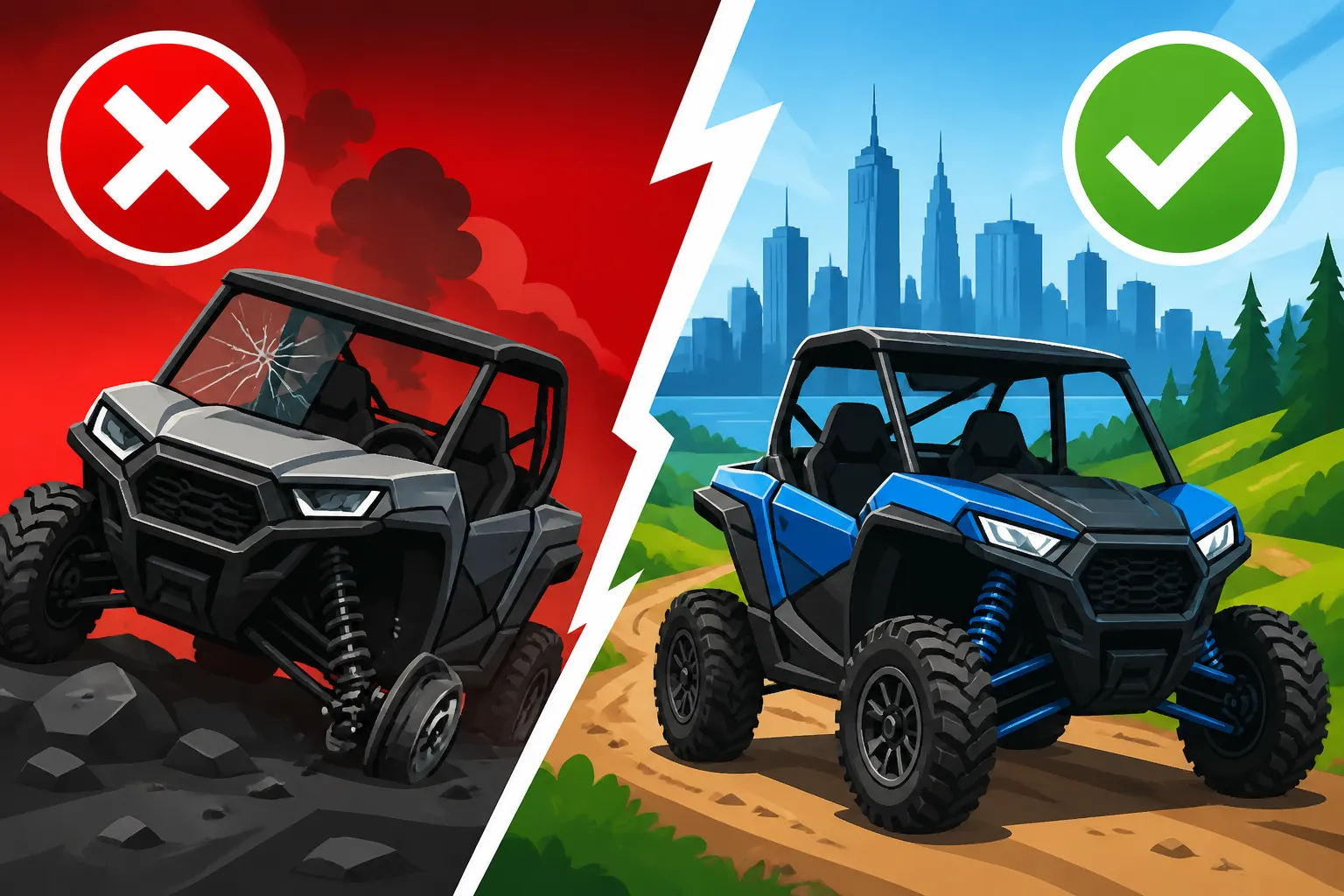
Why a Modern Side-by-Side Fails the Test
So you just bought a shiny new side-by-side, maybe dreaming of hitting the trails in the Tug Hill region or exploring some of the state's amazing backcountry, only to be hit with the frustrating reality that registering it in New York is an uphill battle, if not impossible. It's a common disappointment for many new owners, and it all comes down to how New York State defines an All-Terrain Vehicle (ATV) in its current laws. This guide is here to unravel that mystery, explain the strict limits that exclude most modern UTVs, and give you some clarity on your options.
The Defining Lines: New York's ATV Definition
New York State's Vehicle and Traffic Law has a very specific definition for what qualifies as an All-Terrain Vehicle, and this definition is the primary roadblock for most modern side-by-sides. When the law was originally crafted, the machines it aimed to regulate were quite different from the robust, multi-passenger utility and sport vehicles we see on the market today. This creates a significant disconnect between what the industry produces and what the state allows on its trails. It’s not about how powerful your machine is, or how many bells and whistles it has; it's about two very distinct physical measurements.
What New York Does Consider an ATV
New York State defines an ATV as a "self-propelled vehicle which is manufactured for off-highway use and which has a gross weight of less than one thousand pounds, and which has a width of no more than seventy inches, and which is designed to travel on not less than three low pressure tires and which has a seat or seats designed to be straddled by the operator and any passenger."
Let's break that down because every single word matters here. The key phrases that trip up most side-by-sides are "gross weight of less than one thousand pounds" and "width of no more than seventy inches." Notice the part about a seat designed to be "straddled"? That's also a big one for true ATVs, meaning quads. While some older, very small side-by-sides might technically squeak by on the width and weight, the "straddled" seat clause explicitly excludes them, as side-by-sides have bench or bucket seats. However, the width and weight are generally the bigger, more immediate issues that prevent registration. It’s a bit of a legislative maze, but the intent was clearly for smaller, traditional quads.
The Legislative Intent Behind the Definition
The current New York ATV definition wasn't conjured out of thin air; it reflects a specific legislative intent from a bygone era. These rules were established to classify smaller, traditional, single-rider or tandem-rider machines—the "quads" you typically picture when someone says "ATV." The goal was to ensure public safety, protect environmental resources, and manage trail access for vehicles that fit a certain profile. Back then, the concept of a multi-passenger, wide, and heavy "side-by-side" as we know it today simply wasn't prevalent, or even invented in many cases. So, the law wasn't written to exclude them intentionally; it just didn't anticipate their existence. This historical context is vital to understanding why your brand-new, powerful UTV often finds itself on the wrong side of the law for public trail riding in New York. The legislative wheels turn slowly, and updating definitions to match modern technology takes time, effort, and political will.
The 1,000-Pound Weight Limit: A Heavy Hurdle
One of the most significant barriers for modern side-by-sides seeking registration in New York is the strict 1,000-pound gross weight limit. This figure, set decades ago, is almost comically low when you consider the sheer mass of today's UTVs. It's a limit that most new machines exceed straight off the showroom floor, often before you even add a drop of fuel or a single accessory. It's a tough pill to swallow when you realize your dream machine is literally too heavy to be legally recognized as an ATV in the Empire State for public trail use.
How Modern UTVs Blow Past the Limit
Let’s be honest, nearly every modern side-by-side available on the market today, whether it's a utility workhorse or a high-performance sport machine, weighs well over 1,000 pounds. Think about it: a powerful engine, a robust frame, full roll cages, comfortable seating for two or more, sophisticated suspension systems, and sometimes even power steering or automatic transmissions. All these features, which contribute to a safer, more comfortable, and more capable ride, also add substantial weight.
Even a base model, two-seat utility UTV from brands like Polaris, Can-Am, or Honda often starts in the 1,200 to 1,500-pound range before any fluids or accessories are added. Once you factor in fuel, a spare tire, a winch, a roof, a sound system, and perhaps some tools or gear for a day on the trails, that weight quickly climbs. A four-seat sport UTV can easily push past 2,000 pounds, sometimes approaching 3,000 pounds for heavily customized models. The 1,000-pound limit essentially makes registering any contemporary side-by-side for public ATV trails in New York an impossibility. It's simply not what the law envisioned. You can delve more into this specific challenge by checking out [New York's 1,000-Pound Weight Limit].
The Impact on Two-Seaters: Not Just for Bigger Machines
It's a common misconception that perhaps a smaller, two-seat side-by-side might somehow slip under the weight radar. Sadly, this is rarely the case. While you might think of the massive four or six-seat UTVs as being the primary offenders, even compact two-seaters usually far exceed New York's restrictive weight limit. Manufacturers simply don't build machines for the U.S. market, especially for recreational use, that are designed to be that light while still offering acceptable performance, durability, and safety features.
Even utility-focused two-seater models, often marketed for farm work or light chores, still come equipped with engines, transmissions, and heavy-duty chassis components that push their dry weight well into the four-figure range. The comfort and utility features that draw buyers to these machines – like full independent suspension, robust cargo beds, and protective cages – all contribute to a weight that simply cannot meet New York's outdated standard. So, if you're eyeing a sleek two-seater, don't assume its smaller footprint guarantees compliance; always check its specifications against the 1,000-pound rule.
The 70-Inch Width Limit: Broader Than the Law Allows
Beyond the weight constraint, the other major hurdle that sidelines most modern side-by-sides in New York is the 70-inch width limit. Just like the weight restriction, this measurement reflects a time when off-road vehicles were generally much narrower, designed to fit through tight trails and forestry paths. Today's UTVs, particularly the popular sport and multi-passenger models, have evolved to offer greater stability, comfort, and performance, which often translates directly to a wider stance.
The Evolution of UTV Widths: From Narrow Utility to Wide Sport
When the ATV laws were written, the idea of a machine being 70 inches wide was likely considered quite generous for an "all-terrain vehicle." Early UTVs, or utility vehicles, were indeed often narrower, sometimes designed with specific tasks in mind, such as fitting down rows in a vineyard or through narrow gates. They prioritized maneuverability and utility over aggressive sport performance.
However, the market has dramatically shifted. As side-by-sides grew in popularity, manufacturers started designing them with wider track widths to enhance stability, especially at higher speeds or when navigating challenging terrain. A wider stance reduces the risk of rollovers, allows for more aggressive cornering, and provides a more planted feel for the occupants. This evolution has led to the vast majority of sport and recreational UTVs now measuring 64, 72, or even 77 inches wide, sometimes more, often before adding any aftermarket accessories. This wider design is fantastic for performance and safety, but it utterly fails to meet New York's registration criteria. You can learn more about [New York's 70-Inch Width Limit] here.
Measuring Your Machine: The Moment of Truth
For anyone hoping their side-by-side might somehow be an exception, taking an accurate measurement is crucial, though often a disheartening experience. You need to measure the widest point of your machine, which typically includes the outside edge of your tires. Don't forget about any accessories like fender flares, beadlock rings, or even mirrors if they protrude beyond the tires, as an officer would measure the machine at its broadest point.
Many people buy a UTV without ever considering this measurement, assuming it's an "ATV" and thus registerable. Imagine the frustration of bringing home your brand-new machine, only to lay a tape measure across it and find it's 66 inches wide, still within the 70-inch limit, but then you remember the chunky tires or the fender flares push it to 72 inches. Or, more commonly, you measure a common recreational UTV and find it's a standard 64 inches, but then you add a lift kit and wider tires, pushing it past the limit. It’s a bitter discovery, and it really highlights the need for careful research before you buy if public trail access in New York is a priority.
Why These Limits Exist: An Old Law for a New Machine
The frustration of discovering your side-by-side doesn't fit New York's ATV definition is compounded by the fact that these limits seem so out of step with today's technology. It begs the question: why are these specific numbers – 1,000 pounds and 70 inches – still so rigidly enforced? The answer lies in the age of the legislation and the original intent behind it, which predates the modern UTV boom.
An Old Law for a New Machine: The Legislative Lag
The primary reason these limits feel archaic is simple: the law is old. New York's ATV regulations, including these specific width and weight parameters, were established at a time when the market for off-road vehicles was dominated by smaller, single-rider or two-up (tandem) quads. The concept of a utility terrain vehicle (UTV) or side-by-side as a distinct category was either non-existent or in its absolute infancy. These machines were designed for very different purposes and had very different physical characteristics than the powerful, multi-passenger vehicles we see dominating showrooms today.
Legislative bodies, by their very nature, are slow to adapt to rapid technological change. Updating laws requires significant effort, debate, and consensus among lawmakers, as well as overcoming potential opposition from various interest groups. So, while manufacturers have innovated and expanded the capabilities and size of off-road vehicles, the legal framework in New York has largely remained stagnant, creating this wide chasm between what people want to ride and what the state allows them to register as an ATV. This "legislative lag" is a common source of frustration across many sectors, and the ATV/UTV world is certainly no exception.
The Safety and Environmental Concerns Driving the Limits
While the current limits might seem outdated, they weren't arbitrary when first enacted. They were rooted in legitimate concerns about safety and environmental protection. Smaller, lighter, and narrower vehicles were perceived as:
- Safer on existing trails: Many ATV trails were originally designed for motorcycles or traditional quads, meaning tight turns, narrow bridges, and specific clearances. Larger machines could struggle with these, increasing the risk of accidents, damage to the trail infrastructure, or going off the designated path.
- Less impact on the environment: Lighter machines are generally thought to cause less trail degradation, especially in sensitive ecosystems. Wider vehicles might be more prone to creating "braiding" (widening a single trail into multiple paths) or damaging vegetation along the trail edges.
- Easier to control: From a regulatory perspective, defining a smaller, lighter class of vehicle made it easier to set rules for operator age, training, and permissible riding areas, assuming a lower overall risk profile.
So, while the specifics no longer align with modern UTVs, the underlying principles of managing safety and environmental impact were sound. The challenge now is to modernize the law in a way that addresses these concerns for larger, more capable machines, without unnecessarily restricting responsible recreational use.
Side-by-Sides That Might (Rarely) Qualify: Hunting for a Unicorn
Given the stringent weight and width limits, most people assume that no side-by-side can be registered as an ATV in New York. While that's largely true for anything built in the last couple of decades, there are a few rare exceptions, often referred to as "unicorns" in the UTV world. These are typically very old, very basic utility vehicles that hail from a time before the performance UTV boom.
Unicorns of the UTV World: The Tiny Few
Imagine an ATV from the early 1990s or even late 1980s – small, often air-cooled engines, very basic suspension, and minimal features. Now imagine a side-by-side from that same era. These might have been purpose-built, stripped-down utility machines, perhaps used on golf courses or very specific industrial applications. They were often two-wheel drive, with small engines, no roll cages, and very basic seating.
Some examples might include certain extremely early models that were more like golf carts with knobby tires than modern UTVs. Think something truly bare-bones, almost a motorized wagon with a steering wheel. These rare birds might, by sheer chance, fall under the 1,000-pound weight limit and the 70-inch width limit. They would also likely have very low top speeds and minimal ground clearance, making them quite distinct from what most people envision when they think of a side-by-side today. It's truly like finding a needle in a haystack, and even then, its "ATV-ness" is debatable given the "straddled seat" clause.
The Practical Challenges of Finding One
Even if such a mythical, compliant side-by-side exists, the practical challenges of finding, purchasing, and maintaining one are immense.
- Rarity: These machines are exceedingly rare. They weren't produced in high numbers, and many have long since been retired, scrapped, or are in such disrepair that restoration would be a monumental task.
- Performance: Their performance would be laughably inadequate by modern standards. Forget hitting sustained speeds on a fire road or tackling any remotely challenging terrain. They were designed for very light-duty, slow-speed work.
- Safety: Lacking modern safety features like robust roll cages, seatbelts, and advanced braking systems, these older machines would present significant safety concerns compared to contemporary UTVs.
- Parts Availability: Finding replacement parts for a decades-old, low-production utility vehicle could be a nightmare, making maintenance incredibly difficult and expensive.
For all these reasons, chasing the "unicorn" of a registerable side-by-side in New York is generally not a viable or advisable path for anyone looking to enjoy the sport. It's far more realistic to assume that any side-by-side you encounter today will fail New York's ATV registration test.
Current Efforts to Change the Law: A Glimmer of Hope?
The glaring disparity between New York's outdated ATV definition and the reality of modern side-by-sides has not gone unnoticed. For years, riders, clubs, and industry advocates have been pushing for legislative change to modernize the state's laws, recognizing the immense popularity and capabilities of UTVs. While change has been slow, there have been various legislative efforts aimed at addressing this issue, offering a potential glimmer of hope for future UTV owners.
Bills on the Table: Attempting to Redefine
Several legislative proposals have been introduced in the New York State Assembly and Senate over the years, specifically targeting the expansion of the ATV definition to include side-by-sides. These bills typically aim to amend the Vehicle and Traffic Law to either create a new category for UTVs, or to significantly raise the existing weight and width limits for ATVs. For instance, some proposed legislation has sought to raise the weight limit to 2,000 pounds or even 2,500 pounds, and the width limit to 80 inches. These numbers would encompass a much larger segment of the modern side-by-side market, opening up many more machines to potential registration.
It's important to remember that the introduction of a bill is just the first step in a long and often arduous legislative process. These proposals must go through various committees, undergo review, potentially be amended, and then pass both the Assembly and the Senate before being signed into law by the Governor. This path is fraught with challenges, as different interest groups (conservationists, trail advocates, landowners, etc.) often have differing opinions on how best to regulate these machines. You can look into [A New York Bill on UTV Registration] for more context on these efforts.
Why Change Is Slow: The Legislative Labyrinth
Despite the clear need and the consistent efforts of advocates, legislative change in New York regarding UTV registration has been frustratingly slow. There are several reasons for this legislative labyrinth:
- Competing Interests: As mentioned, various stakeholders hold different views. Environmental groups may express concerns about larger machines impacting sensitive areas, while some landowners might worry about increased noise or trail damage. Balancing these concerns is complex.
- Focus on Other Priorities: Lawmakers often have many pressing issues on their agenda, and while ATV/UTV enthusiasts see this as a critical matter, it might not always rise to the top of the legislative priority list.
- Lack of Understanding: Some legislators may not fully grasp the distinction between traditional ATVs and modern UTVs, or the nuances of responsible off-road recreation. Education is a continuous effort.
- Funding and Resources: Creating new regulations or expanding existing ones can have implications for trail maintenance, enforcement, and state resources. These fiscal impacts need to be carefully considered.
- Political Inertia: Sometimes, the sheer momentum of established law makes it difficult to enact change, especially when there isn't an overwhelming, immediate crisis driving the need for reform.
So, while bills are introduced and discussions continue, the process is inherently slow. Owners of modern side-by-sides in New York should keep an eye on legislative developments, but for now, they must operate under the existing, restrictive framework. For more on the challenges, see [Why New York's UTV Bills Are Not Law Yet].
Alternatives for Side-by-Side Owners: Where to Ride in New York
So, you've got a fantastic side-by-side, but New York's registration rules mean it's practically impossible to get it registered for public ATV trails. Does that mean your machine is doomed to collect dust in the garage? Absolutely not! While you might not be able to join the traditional ATV crowd on state-designated trails, there are still viable and popular options for enjoying your UTV in the Empire State. It just requires a shift in perspective and a bit of planning.
Private Land Riding: Your Own (or a Friend's) Backyard
The most common and straightforward solution for New York side-by-side owners is riding on private property. If you own land, or have friends, family, or a gracious acquaintance who does, and they give you permission, you are generally free to ride your UTV there. This is a huge advantage, as it bypasses all the state's registration requirements, width, and weight limits. Many UTV owners in New York have found enjoyment building their own private trail networks, obstacle courses, or simply using their machines for utility tasks around their property.
When riding on private land, even though state registration isn't required, always remember:
- Permission is paramount: Never, ever ride on someone else's property without explicit, clear permission. Trespassing is illegal and gives all off-road enthusiasts a bad name. Getting written permission can save a lot of headaches; services like LawDepot can help you draft a simple agreement.
- Safety first: Even on private land, standard safety practices apply. Wear helmets, use seatbelts, and never ride impaired.
- Noise and disturbance: Be considerate of neighbors. Excessive noise or dust can lead to complaints and sour relationships, potentially jeopardizing your riding privileges or even leading to local ordinances against such activity.
- Insurance: While not legally mandated for private land in the same way, having liability insurance for your UTV is a smart move. Accidents can happen, and you want to be protected.
This option provides the greatest freedom, allowing you to ride almost any side-by-side you own, provided you have the space and permission. For more on this, check out [New York Rules for Riding Private Land].
Dedicated Off-Road Parks: Pay-to-Play Havens
Beyond private land, another excellent option for side-by-side owners in New York is to visit dedicated, privately owned off-road parks. These "pay-to-play" parks are specifically designed to accommodate a wide range of off-road vehicles, including larger UTVs that wouldn't meet state registration requirements for public trails. They operate on their own rules and often feature diverse terrain, from mud pits and rock crawling sections to open trails and challenging obstacles.
One prominent example is [Tall Pines ATV Park at Andover] in Allegany County. Parks like Tall Pines recognize the market for side-by-sides and cater to it, providing designated riding areas, camping facilities, and often events or competitions. They usually have their own entry fees, waivers, and safety rules, which you'll need to follow. The great thing about these parks is that they are built with modern machines in mind, so your UTV's size and weight are generally not an issue. It’s a fantastic way to experience the full capabilities of your side-by-side in a controlled and fun environment.
Out-of-State Riding: Where New York UTVs Can Roam Freely
If you're willing to trailer your side-by-side a bit, heading out of state opens up a world of possibilities. Many neighboring states, and others across the country, have different, often more inclusive, definitions for ATVs and UTVs, or separate registration categories for side-by-sides. This means your New York-purchased UTV, which can't be registered in its home state for public trails, might be perfectly legal to register and ride in states like Pennsylvania, Vermont, or West Virginia.
Before you plan an out-of-state trip, always:
- Research the destination state's laws: Each state has its own specific regulations regarding registration, insurance, safety equipment (like helmets), and permissible riding areas for UTVs. What's legal in one state might not be in another.
- Check for reciprocity: Some states have reciprocity agreements for registrations, but others might require you to get a temporary permit or even full registration if you're staying for an extended period.
- Trail systems: Look up dedicated UTV trail systems in other states. Many states actively promote UTV tourism and have extensive trail networks that welcome side-by-sides.
This option, while requiring more travel, can provide access to vast and varied trail systems that simply aren't available to UTV owners within New York's current legislative framework. It's a popular choice for those who crave diverse riding experiences beyond private land.
Comparative Look: New York ATV Rules vs. Modern UTVs
To really drive home the points about New York's current ATV definition, let's put it into a table that compares the state's requirements with the typical specifications of a modern side-by-side.
| Feature | New York ATV Definition (for Public Trails) | Typical Modern Side-by-Side (UTV) |
|---|---|---|
| Gross Weight | Less than 1,000 lbs | 1,200 lbs to 2,500+ lbs (dry weight) |
| Width | No more than 70 inches | 60 inches to 77+ inches |
| Seating | Designed to be straddled | Bench or bucket seats |
| Passengers | Operator and any passenger (implies tandem) | Often 2, 4, or 6 passengers (side-by-side) |
| Registration | Mandatory for public trails | Not eligible for New York public ATV trail registration |
As you can see, almost every aspect of a modern side-by-side fundamentally conflicts with New York's legal definition of an ATV, making public trail registration virtually impossible. This table starkly illustrates why so many UTV owners in the state face this frustrating reality.
Understanding Proof of Ownership for Unregistered Machines
Since most side-by-sides in New York won't qualify for state registration, you might wonder how you prove ownership, especially if you ever need to sell it, finance it, or even just demonstrate it's yours if it gets stolen. Even without a traditional vehicle title (which New York doesn't issue for ATVs anyway, registered or not), solid documentation is still incredibly important.
Why Proof of Ownership Still Matters
Even if your side-by-side is strictly for private land use, having indisputable proof of ownership is crucial for several reasons:
- Theft Recovery: If your UTV is stolen, law enforcement will need clear evidence that the machine belongs to you to aid in its recovery and prosecution of the thief.
- Selling Your Machine: When you eventually sell your side-by-side, the buyer will want assurance that you are the rightful owner. This prevents future legal disputes and makes the transaction smoother.
- Insurance Claims: If you have an insurance policy (which is highly recommended even for private land use), the insurance company will require proof of ownership to process any claims.
- Estate Planning: If you pass away, your family will need clear documentation to transfer the machine to your heirs.
- Dispute Resolution: In rare cases of ownership disputes, strong documentation is your best defense.
New York's lack of titles for ATVs already makes things a little murkier, but it becomes even more critical for unregistered UTVs. Therefore, keeping meticulous records is not just a suggestion; it's a necessity. You can read more about [Proving Ownership Without a Title in New York].
Essential Documents for Unregistered UTVs
Since there's no state-issued registration card for most side-by-sides, you'll need to rely on a combination of other documents to establish your ownership:
- Original Bill of Sale: This is the absolute cornerstone of your ownership proof. It should clearly state:
- Buyer's and seller's full names and contact information.
- Date of sale.
- Full description of the UTV (make, model, year, VIN/serial number, color).
- Purchase price.
- Signatures of both buyer and seller.
- Consider having it notarized for extra legal weight, especially for private sales. Services like LawDepot can help you generate a professional and legally sound bill of sale.
- Manufacturer's Certificate of Origin (MCO/MSO): When you buy a new side-by-side from a dealer, they will provide you with an MCO. This document essentially acts as the "birth certificate" of the vehicle and proves its initial ownership from the manufacturer to the dealership, and then to you. Keep this in a safe place.
- Prior Bills of Sale (for used machines): If you bought your UTV used, collect all previous bills of sale, tracing the ownership back as far as possible, ideally to the original MCO.
- Insurance Documents: Your insurance policy declaration page, showing you as the insured owner of the specific UTV, serves as strong supporting evidence.
- Service Records/Receipts: Any receipts for maintenance, repairs, or accessories that include your name and the machine's VIN can further bolster your claim of ownership.
- Photos: Take detailed photos of your UTV, including its VIN plate, and keep them on file.
Always keep these documents in a secure location, and ideally, have digital copies backed up as well. While New York might not give you a formal registration for your side-by-side, these records are your legal lifeline to proving it truly belongs to you.
Disclaimer
This article is for general informational purposes only and does not constitute professional advice. Laws, prices and regulations vary by location and change over time. Consult a qualified professional for guidance on your specific situation.