New York ATV Safety Certificate Requirements
If a rider under 16 is planning to ride in New York, the safety certificate rules can be hard to separate from age limits and adult-supervision requirements. The key is to check the rider’s age and where the machine will be operated. A certificate shows that a rider completed approved training, but it does not remove every restriction or grant access to a trail.
What the safety certificate does
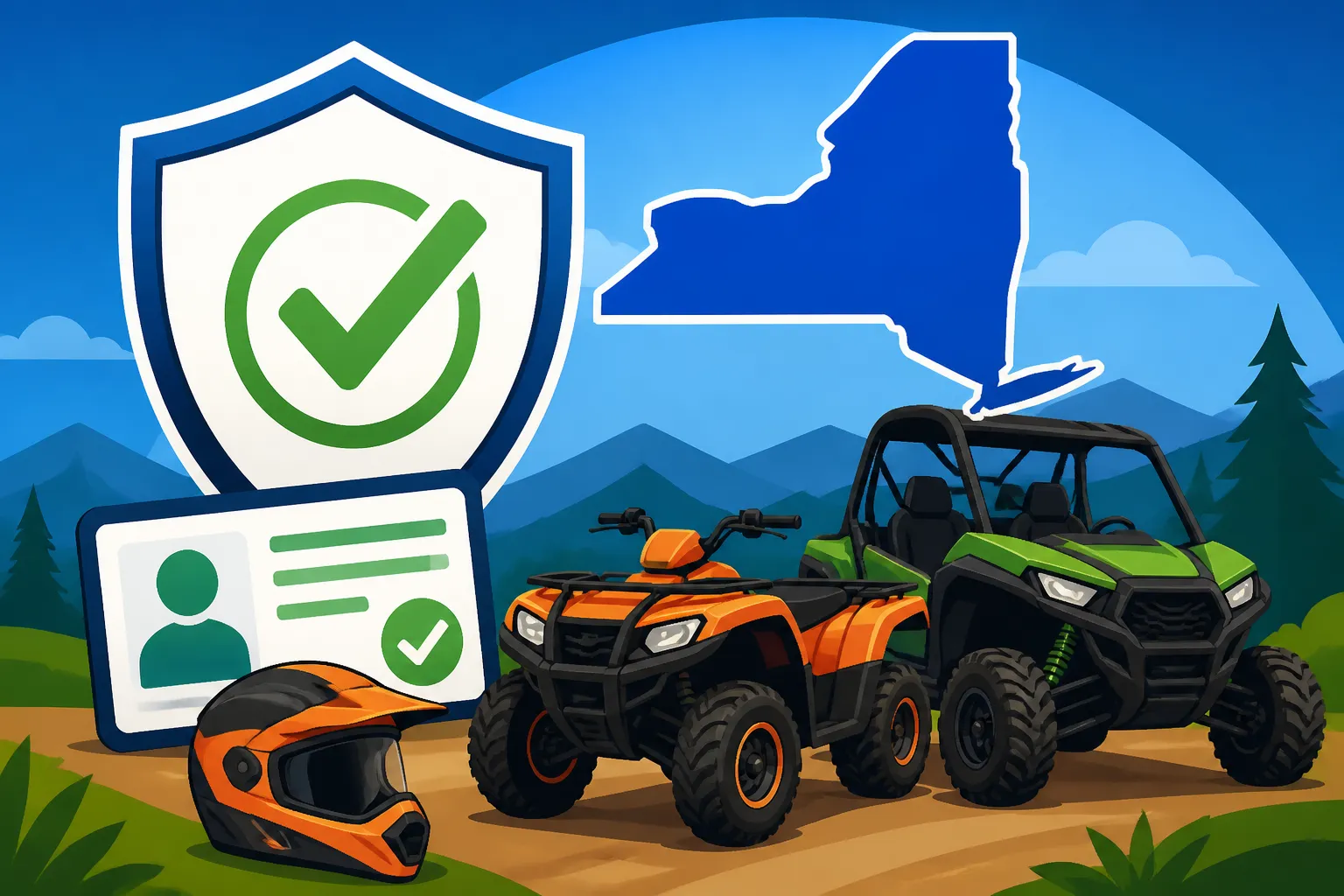
A New York ATV safety certificate is proof that a rider completed an approved ATV safety-training course. It is not a driver’s license, ATV registration, insurance policy or trail permit. It also does not make a machine legal to ride everywhere.
The certificate matters most when the operator is under 16. A young rider may need to complete the course before operating an ATV in places where the law allows them to ride. Even with a certificate, the rider may still need adult supervision, and age-related restrictions still apply. The certificate cannot authorize a child to ride where children of that age are not allowed to operate.
Think of it as one part of a wider set of requirements:
- Certificate: Shows completion of approved safety training.
- Registration: Identifies a machine for registration purposes; it is separate from the rider’s training.
- Insurance: May be required for operating the ATV, depending on the circumstances.
- Trail access: Depends on whether the landowner or trail system permits riding and whether local permit rules apply.
For a broader explanation of what the certificate is and how it fits into riding rules, see The New York ATV Safety Certificate Explained. If you are comparing the rider’s training requirements with land-access rules, New York Trail Access for Riders Under 16 covers the trail question separately.
A certificate is useful preparation, not a universal pass. A rider can have completed training and still be unable to ride a particular machine, trail or property without meeting the other applicable requirements.
Age, supervision and where the rider will operate
A rider’s age affects whether they may operate an ATV and what conditions apply. The place where they plan to ride matters too. Rules for land owned by a parent or guardian can differ from rules for public land or property belonging to someone else.
The certificate course is generally available starting at age 14. That means a younger child cannot assume they can take the course early to get permission to ride in situations where a certificate is required. For more on the age threshold, see Why the Certificate Starts at Fourteen.
| Rider’s situation | What to check |
|---|---|
| Under 10 | New York has strict limits for the youngest riders. Confirm whether the planned location and circumstances allow operation at all. |
| Ages 10–13 | Check the rules for the specific property and whether riding is permitted without a certificate. The rider cannot rely on a certificate they are not yet old enough to earn. |
| Ages 14–15 | An approved certificate may be relevant, but adult supervision and other restrictions can still apply. |
| 16 or older | The under-16 certificate rules may no longer apply, but registration, insurance, land access and general operating rules still matter. |
This table is a starting point, not permission to ride. Before taking a young rider out, confirm the rules for their exact age and intended location. In particular, do not assume that completing the course lets a 14- or 15-year-old ride alone. What New York Requires of Riders Under 16 explains the broader age rules, while What a Fourteen-Year-Old May Ride With a Safety Certificate focuses on the limits that still matter after training.
Adult supervision remains a separate requirement
A certificate does not take the place of supervision where supervision is required. New York’s rules refer to supervision by an adult, and riders and families should check the applicable definition before heading out. The adult’s presence does not automatically make every machine or location suitable for a young rider.
Keep supervision practical as well as legal. The adult should be able to monitor the young rider, communicate with them, and respond if a problem occurs. A supervising adult who is far away or unable to keep track of the rider may not provide meaningful oversight, even if they are somewhere on the same property. See General Supervision by Someone Eighteen or Over for more on this part of the rules.
The youngest riders face particularly strict limits. Do not treat a parent’s permission or a safety lesson as a substitute for checking the minimum-age rules. Why No One Under Ten May Ride in New York addresses the youngest age group and the limits that apply.
Taking an approved course and keeping proof
Before enrolling, confirm that the course is approved for the New York certificate you need. Course formats and availability can vary, so check with the official state program or an approved course provider for current enrollment details, age eligibility and how the certificate is issued. Do not assume that any online ATV video, private lesson or course from another jurisdiction will count.
A sensible process is:
- Confirm the rider’s age. Check the minimum age for the approved course and the rules for the rider’s intended type of operation.
- Choose an approved course. Verify that it leads to the New York safety certificate, rather than simply offering general ATV instruction.
- Complete the training requirements. Follow the provider’s instructions for coursework, any practical components and assessment.
- Keep the certificate information. Store the certificate or proof of completion where it can be found, and make sure the rider or accompanying adult knows how to access it.
- Check the riding location separately. Confirm that the property or trail allows ATV use and that any required permits, registration and insurance are in order.
A certificate and a trail permit serve different purposes. A county trail system, club or private property may set its own access requirements. New York does not have one statewide trail pass that automatically opens every route, so check the rules for the specific system. Do You Need a Trail Permit in New York? explains why trail access and safety training should not be confused.
Does an out-of-state certificate count?
If a young rider completed training outside New York, do not assume the card is accepted automatically. Check whether New York recognizes that course or certificate for the activity the rider plans to undertake. Recognition can depend on the type of credential and applicable state rules. Does New York Accept an Out-of-State Safety Certificate? covers that question.
This is especially important for visitors. An out-of-state registration and a safety certificate are different documents, and recognition of one does not settle the requirements for the other. For visitors’ registration questions, see New York Reciprocity for Out-of-State Registrations.
Before riding, check the whole set of requirements
A quick check before the ride can prevent a certificate from creating a false sense of permission. Confirm all of the following:
- Age: Is the rider old enough to operate in the planned location?
- Training: Does the rider need a New York-approved certificate for this situation?
- Supervision: Must an adult supervise, and who is responsible for doing so?
- Machine: Is the ATV suitable for the rider and allowed on the intended route?
- Registration and insurance: Are the machine’s documents and required coverage in order?
- Access: Has the landowner, trail system or local authority permitted ATV use?
- Other safety rules: Does the rider have the required protective equipment and understand the operating restrictions?
If the rider has completed the course but the physical card is at home, check what proof must be available and whether failing to show it is an offense. The certificate’s purpose is to document training; it should not be confused with a registration document or trail permit. Leaving Your Safety Certificate at Home on a Ride and Why Failing to Show It Is Not an Offense discuss the difference between carrying proof and meeting the underlying training requirement.
Parents and guardians should also think beyond the paperwork. A course can teach safe practices, but it cannot make an oversized or unfamiliar machine appropriate for a child. Match the ATV to the rider’s size and ability, review the route in advance, and set clear boundaries about speed, terrain and where the rider may go. Keep the first ride in a controlled setting, and do not let a certificate replace direct judgment about a young person’s readiness.
The simplest rule is to treat the certificate as one checkpoint, not the final answer. Verify the rider’s age, the supervision requirement, the machine, and the access rules for the exact place they plan to ride. When those pieces line up, the certificate can help show that the young rider has received formal safety training.
Disclaimer
This article is for general informational purposes only and does not constitute professional advice. Laws, prices and regulations vary by location and change over time. Consult a qualified professional for guidance on your specific situation.