Why the Certificate Starts at Fourteen
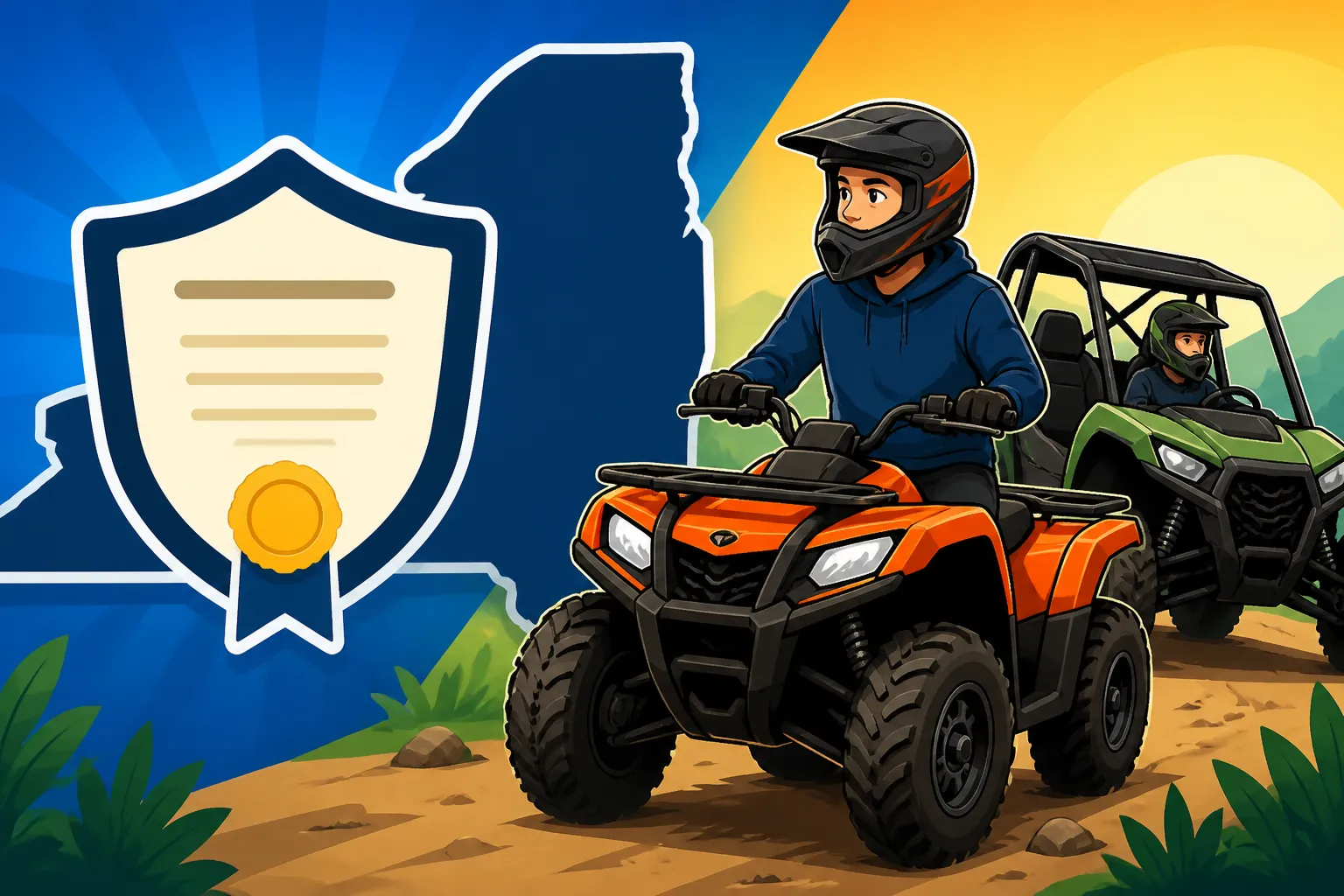
New York’s ATV safety certificate does not start at the age when a child first wants to ride. It starts at fourteen because the state treats younger riders differently: a certificate is not a substitute for the supervision required for a younger child. Here’s what the age cutoff means, what it does not mean, and how to plan a safe, legal ride for a teen.
Why the certificate age begins at fourteen
The short answer is that New York separates young riders into age groups, and fourteen is the point at which a safety certificate can become relevant to a rider’s operating privileges. It is not a general ATV learner’s permit for every child. For riders younger than fourteen, the certificate does not replace the supervision and operating restrictions that apply to their age group.
That distinction is easy to miss. A parent may hear that ATV safety training is required for young riders and assume that a child can take the course at any age, then ride independently once they pass. That is not how to think about New York’s system. The course and certificate fit into a larger set of rules that considers the rider’s age, where the machine is being used, and the type of supervision present.
A safety certificate is proof of completing approved training. It is not a driver’s license, registration, trail permit, or permission to use any land. It also does not change the machine’s physical characteristics or make an otherwise restricted ATV suitable for a child. Even when a rider has a certificate, the rules that apply to their age and riding location still matter.
For a fourteen- or fifteen-year-old, the certificate may affect what kind of supervision is acceptable in situations where the law allows the rider to operate. But it should not be read as blanket permission to ride alone, use any machine, or go anywhere an adult can ride. The practical point is to check the rule for the specific age and location before a teen starts the engine.
The cutoff also gives families a useful planning milestone. Before a child turns fourteen, focus on the rules for younger riders, close adult oversight, and appropriate private-property use. At fourteen, check whether the teen is eligible for the approved course and what the certificate changes for the kind of riding you have in mind. The overview in The New York ATV Safety Certificate Explained can help separate the credential itself from the other requirements.
| Rider’s age | What the certificate means | What it does not mean |
|---|---|---|
| Under 10 | A safety certificate is not a way around the age-related restrictions that apply to very young riders. | It does not make unrestricted ATV operation legal. |
| 10 through 13 | The certificate age floor has not been reached, so the rider remains subject to the rules for younger operators. | It does not allow the child to ride without the required adult supervision. |
| 14 or 15 | The rider may be eligible to complete approved training and receive a certificate. The certificate can matter to the supervision rules that apply to this age group. | It does not automatically authorize solo riding, every machine, every trail, or every property. |
| 16 and older | The rider is no longer in the under-16 age group, but other riding, registration, insurance, equipment, and land-access rules still apply. | It is not a general license to ride on public roads or closed land. |
This table is a planning aid, not a replacement for the current state rule. The details can depend on the rider’s age, the place of operation, and the type of machine. If you are making plans around a particular trail or property, confirm the rule that applies there instead of relying on the certificate alone.
What the certificate changes, and what it does not
It helps to treat the certificate as one piece of a legal and safety checklist. It shows that the rider completed approved safety training. It may also be relevant to the supervision level allowed for some riders aged fourteen or fifteen. But it does not erase age limits or take the place of an adult when adult supervision is required.
That last point is especially important for families who hear the phrase “general supervision.” In ordinary conversation, someone might take that to mean an adult can be somewhere in the general area and leave the teen to ride independently. Don’t assume that. The rule has a legal meaning, and the adult’s role still matters. A certificate should not be used to justify sending a teenager out of sight, beyond help, or onto unfamiliar trails.
Likewise, passing a course does not automatically make a teen ready for difficult riding. The training can teach safety principles, but judgment and machine control come with practice. A new rider may need much closer oversight than the minimum required by law, especially on uneven ground, in mud, near other riders, or in a group.
The certificate also does not answer questions about where the ATV may be ridden. A machine may be registered and the rider may hold a certificate, yet a particular trail can still be closed to ATVs, restricted to a permit holder, or limited to certain vehicles. A landowner’s permission does not automatically replace public rules, and a trail permit does not necessarily authorize riding off the marked route.
Think of the requirements as separate checks:
- Age and supervision: Is this rider old enough for this type of operation, and what adult supervision is required?
- Training: Is a safety certificate required or useful for this rider’s age and intended riding?
- Machine: Is the ATV suitable for the rider and allowed on the route?
- Registration and insurance: Does the machine meet the applicable requirements for the place where it will be used?
- Land access: Is the property or trail open to this type of riding, and is permission or a permit required?
- Equipment: Does the rider have the required protective equipment, and is the ATV in safe condition?
A safety certificate only addresses part of that list. For example, if a teen has completed a course but the family plans to ride on a county trail system, you still need to check the system’s access rules, current closures, permit requirements, and any age-related restrictions. For a broader look at the rules that apply before a teen turns sixteen, see [What New York Requires of Riders Under 16].
Why younger children cannot use the certificate as a workaround
The fourteen-year cutoff is not an arbitrary paperwork hurdle that a family can get around by finding another class or asking an instructor to make an exception. It reflects the state’s age-based approach to ATV operation. A child below the certificate age remains in the younger-rider category, with the applicable restrictions and supervision requirements.
This matters because families sometimes confuse three different questions:
- Can the child take the course?
- Can the child receive the certificate?
- Can the child operate this particular machine in this particular place?
Those questions are related, but they are not interchangeable. Being allowed to take a class would not necessarily mean a rider qualifies for a certificate at that age. And holding a certificate would not automatically establish that the rider can use every ATV or ride on every trail.
For a child under fourteen, the responsible approach is to check the rules for that child’s precise age and riding location. Do not assume that a parent’s presence on the property makes every type of operation permissible, or that an adult riding nearby meets the legal supervision standard. The rules may differ depending on whether the land belongs to the family, whether it is public or private, and whether the rider is using an organized trail.
A useful way to plan is to start with the child’s age, not the ATV’s size or the family’s experience. Then confirm where the machine will be used and what supervision is required there. The details for younger riders are covered in [New York Rules for a Rider Under 14] and [New York Supervision Rules for Young Riders]. For the specific question of why a thirteen-year-old cannot simply earn the card early, see Why Thirteen Is Too Young for the Card.
It is also worth separating a child’s ability to control a machine from the legal age rule. A child who seems confident on a small ATV does not become eligible for a certificate earlier. Conversely, reaching fourteen does not mean a rider is automatically ready for a larger, faster, or heavier machine. Age eligibility is only the starting point for deciding what riding is appropriate.
Parents should be cautious about using an older sibling’s experience as a benchmark. One teen may be physically able to control a particular machine but lack sound judgment in a busy group ride. Another may understand the controls but freeze when the ATV gets stuck or slides on a slope. A certificate can provide structured instruction, but it cannot make those individual differences disappear.
How a fourteen- or fifteen-year-old should prepare
When a teen reaches fourteen, don’t treat the birthday as a signal to hand over the keys and step away. Use it as a chance to review the rules, complete approved safety training if appropriate, and build a staged plan for riding. The certificate can be valuable because it gives a young rider formal instruction, but the learning should continue after the course.
Start by identifying the exact riding situation. A quiet private property, a marked club trail, and a public road are not interchangeable environments. A teen might be permitted to operate under one set of conditions but not another. Before riding, confirm the applicable rules for age, supervision, access, registration, insurance, and permits. If the ride crosses into a different county or trail system, check again rather than assuming that the first area’s rules follow you.
Next, match the machine to the rider. A safety class does not make a machine too large or too powerful a good choice. The rider should be able to reach the controls comfortably, understand how to stop, and manage the machine without depending on an adult to correct every move. If the ATV feels difficult to steer or stop in a controlled practice area, it is not ready for a trail ride.
A sensible progression might look like this:
- Review the rules together. Make sure both the teen and supervising adult understand where the rider may go and what supervision is required.
- Complete approved training. Confirm that the course is recognized for the certificate you need and follow the current instructions for enrollment and completion.
- Practice in a controlled area. Begin with basic starts, stops, turns, and safe dismounts on suitable ground.
- Check protective gear. A properly fitting helmet and the other required protective equipment should be ready before the ride, not borrowed at the trailhead.
- Choose an easy first route. Avoid deep mud, steep slopes, crowded conditions, and unfamiliar terrain while the teen is still learning.
- Keep the supervising adult involved. Set clear limits, stay close enough to respond, and agree on what the rider should do if separated or stuck.
- Review after the ride. Talk through difficult moments and adjust the next ride rather than simply increasing the distance or speed.
The supervising adult should also know the route and be prepared to intervene. That may mean riding a separate machine, walking a short section, or keeping the group small enough to maintain sight and communication. Whatever arrangement is used, don’t let a teenager ride beyond the adult’s ability to keep track of them and respond.
Gear shopping is a separate decision from certificate eligibility, but it is part of responsible preparation. Some families compare helmets, gloves, and eye protection through retailers such as Amazon; others prefer a local shop where the teen can try items on. An online listing on Amazon cannot confirm that a helmet fits the rider’s head, so use the manufacturer’s sizing instructions and check fit carefully. If you buy protective gear through Amazon or another seller, make sure it is suitable for ATV use and that the teen will actually wear it correctly.
A helmet that shifts, pinches, or sits incorrectly is not a good fit just because it is new. The teen should be able to fasten it securely and keep it in place during normal movement. Gloves should allow a firm grip, and clothing should protect exposed skin without catching on controls. Check gear before each outing; a damaged strap or cracked shell is a reason to stop and replace the item, not a problem to fix later.
For the age-specific questions that come up at this stage, New York Rules for a Rider Aged 14 and New York Rules for a Rider Aged 15 are useful companion topics. The rules for a fourteen-year-old and a fifteen-year-old belong to the same under-16 framework, but families should still verify the details for the rider’s exact age and the planned setting.
Common misunderstandings about the age cutoff
Several assumptions can cause trouble because they turn a limited training credential into something much broader than it is.
“If the teen has the certificate, they can ride alone”
Do not assume this. The certificate may affect the supervision rules for a rider aged fourteen or fifteen, but it is not an across-the-board solo-riding pass. Check what supervision is required in the particular setting, and make sure the adult understands their role. If you are asking whether a fifteen-year-old may ride without an adult present, check Can a Fifteen-Year-Old Ride Alone With a Certificate? rather than relying on a general description of the course.
“A certificate lets the teen ride any ATV”
It does not. The machine still needs to be appropriate for the rider and lawful for the intended route. New York has restrictions that can affect whether some machines qualify for registration or access, including rules relevant to wider side-by-sides. The certificate does not change a machine’s width, weight, or classification. Before buying or taking a machine to a trail, review the relevant equipment and registration rules.
“Training is the same as permission to use a trail”
A course does not grant access to private land or a club trail. A rider may need landowner permission, a trail permit, or membership, and the route may have its own posted conditions. Always check the current trail operator or land manager’s rules before traveling. A trail can close after rain, during mud season, or because of a landowner issue even if it was open on an earlier visit.
“If the ATV is registered, the rider can use it anywhere”
Registration is not land-use permission. It does not make an ATV street legal, open a closed trail, or authorize riding on land where the owner has not given permission. Registration, insurance, permits, and safety certificates each serve different purposes. Keep those requirements separate when making a plan.
“A certificate from another state automatically settles the New York question”
If a teen trained elsewhere, do not guess about whether that certificate is accepted for the intended New York activity. Recognition can depend on the credential and the rule being applied. Confirm with current official guidance before relying on an out-of-state card; Does New York Accept an Out-of-State Safety Certificate? addresses that issue.
“The adult only needs to be present at the start”
Supervision is an ongoing responsibility, not a quick handoff at the trailhead. A responsible adult should know where the teen is, what route they are taking, and how to respond if the rider has a problem. A certificate cannot substitute for that judgment, particularly for a new rider or on a difficult route.
A practical checklist for families
Before a teen rides, use a checklist that makes the certificate one part of the decision rather than the whole decision.
Confirm age and eligibility. Make sure the teen is old enough for the planned operation and, if relying on a certificate, eligible to obtain the appropriate credential. Don’t try to solve an under-age restriction by using another person’s card or by treating a course-completion document as a different kind of permission.
Verify the certificate details. Follow the current instructions for an approved course and keep the certificate available as required. Ask the course provider or official state guidance what proof is issued and what the rider should carry. Rules about what must be carried or shown can differ from the underlying rule about completing training.
Identify the supervisor. Decide which adult is responsible for the teen and what that adult must do. A group ride with several adults can still be poorly supervised if nobody knows who is watching the young rider.
Check the machine. Confirm that it is suitable for the rider, in safe condition, and allowed on the planned route. A teen’s first rides are a poor time to test an unfamiliar machine or to learn how a faulty brake behaves.
Check the route and access conditions. Confirm that the trail is open, that the machine is permitted, and that any required permit or membership is in place. For private property, get the required permission and stay within the area where riding has been allowed.
Check registration and insurance. These are separate from the training certificate. If the machine or rider is subject to New York registration or insurance requirements, meet those requirements before riding. Visitors should not assume that a home-state document automatically answers every New York question.
Set boundaries for the ride. Agree on where the teen may ride, when to stop, and what to do if the group becomes separated. Establish a simple rule for uncertainty: stop the machine and contact the supervising adult rather than continuing to explore.
Reassess after each ride. A certificate marks completion of training, not permanent readiness for every trail. Notice whether the teen can control the machine, follow instructions, and make safe decisions. Progress at a pace that fits the rider, not the most experienced person in the group.
The age cutoff is best understood as a boundary in New York’s youth-riding framework, not as a promise that every fourteen-year-old can ride independently. At fourteen, a teen may become eligible for a safety certificate, and that credential can matter. But the certificate works alongside supervision rules, access restrictions, equipment requirements, and the judgment of the adults responsible for the ride. Check each piece before heading out.
Disclaimer
This article is for general informational purposes only and does not constitute professional advice. Laws, prices and regulations vary by location and change over time. Consult a qualified professional for guidance on your specific situation.