Planning Fuel for a Long Northern Loop
A long northern New York ATV loop can turn into a fuel problem faster than expected: mud, hills, low-speed riding, detours, and closed gates all use up time and gasoline. Plan around your machine’s real-world range, not its brochure estimate, and treat every fuel stop as something to confirm before you leave the staging area.
Estimate your ATV’s real-world fuel range
Start with a measured ride, not a guess
An advertised range is a rough reference, not a promise. Your actual fuel use depends on the machine, how you ride, the trail surface, elevation changes, weather, load, and how often you stop and restart. A quad that sips fuel on a smooth gravel road may burn noticeably more on a slow, rutted trail where the tires are working hard.
The most useful starting point is a ride you can measure. Fill the tank, ride a familiar route under conditions similar to the loop you are planning, then refill and note how much fuel you used and how far you travelled. If you have a trip meter, record the distance. If not, track the route on a map or use a mileage log. Repeat the test if your first ride was unusually easy or short.
For example, suppose a familiar ride uses about half a tank over a certain distance. That gives you a practical baseline, but it does not mean you should plan to ride twice as far on a full tank. Your loop might include soft ground, a long climb, extra weight, or a slow stretch that changes consumption. Build in a margin rather than planning to arrive at the end with the tank nearly empty.
Adjust for trail conditions, passengers, and cargo
Northern New York routes can vary considerably within a single outing. A loop around the Tug Hill region might include faster connecting stretches, muddy sections, rocky ground, and slow trail traffic. A loaded machine pulling a small trailer, carrying extra gear, or travelling with a passenger may use fuel differently from a lightly loaded solo ride.
Weather and trail condition matter, too. After rain or a thaw, deep mud and standing water can make a route slower and more demanding. The machine may spend longer in low gears, and a route that looked manageable on a map may take much more time than expected. If you are planning for a wet weekend, do not use your best-case fuel figure as the basis for the trip.
A simple way to stay conservative is to plan with your least efficient comparable ride in mind. If you have records from both an easy day and a demanding day, use the demanding one when estimating range. Then add a separate reserve for unexpected delays or route changes. This is more reliable than assuming that every trail day will match your smoothest ride.
Set a turnaround point before the ride
Decide in advance how much fuel you want remaining when you turn back or reach a confirmed fuel stop. The right reserve depends on your machine and route, but the important principle is to make the decision before you are tired, late, or already watching the fuel gauge drop. A reserve protects you against a blocked trail, an unplanned detour, or a slower return than expected.
Share the plan with everyone in your group. If one machine has a smaller tank or a higher fuel burn, plan the loop around that machine rather than the largest tank. Agree on check-in points and what the group will do if someone’s fuel level is lower than expected. Splitting up to “make better time” can turn a manageable fuel issue into a much harder problem.
Map fuel options before choosing a route
Confirm where fuel is available
Do not assume a trail passes a fuel station just because a town or road appears nearby on a map. A service station may be several miles from the legal trail network, may not be reachable without using a road where ATV travel is prohibited, or may not be accessible during your planned hours. A place that sells fuel to road users is not automatically a permitted trail stop for an ATV.
Before you set off, identify potential fuel locations and confirm the practical details: whether they are open when you expect to arrive, whether the route to them is lawful, and whether your machine can be parked safely while you refuel. Call ahead when there is uncertainty. In rural areas, a short phone call can save you from discovering that the closest option is closed or requires a road connection you cannot legally ride.
Use the same caution when planning around trail systems in Lewis County, Oswego County, or the Tug Hill area. Trail access can depend on local arrangements, club rules, landowner permission, and seasonal conditions. A fuel stop shown near a trail does not tell you whether a particular connector is open. Check the applicable route information and local notices before loading the machine. For an overview of the broader area, see New York’s Tug Hill Riding and New York’s County Trail Systems Compared.
Separate route planning from access verification
Mapping tools can help you see distances, identify nearby roads, and compare possible loops. For example, onX Offroad can be useful for reviewing route options and keeping a planned track available while you ride. Treat any map as a planning aid, not proof that a trail is open, legal, or suitable for your machine on the day you arrive.
Before the trip, compare your planned route with information from the relevant county, trail organization, or land manager. Check for seasonal openings, closures, temporary reroutes, and permit requirements. If a route crosses private land, access depends on the applicable permission and trail agreement; do not assume that a visible track is open to public riding. A detour that looks like a convenient way to reach fuel could lead onto a closed or unauthorized route.
Make a backup plan in case your preferred trail or connector is unavailable. Mark a shorter loop that returns to the staging area, and identify a safe place where the group can stop and reassess. If you are using onX Offroad or another mapping app, save the route before you lose cell coverage, but also carry an offline map or other navigation backup. Cell service can be inconsistent in remote areas, so an app that needs a connection may not be enough by itself.
| Planning question | What to verify before departure |
|---|---|
| How far is the full loop? | Check the distance of the entire route, including connectors and the return to the staging area |
| Where can you refuel? | Confirm the location, hours, and lawful route to the stop |
| Is the trail open? | Check county, club, or land-manager notices for closures and seasonal restrictions |
| What if the route is blocked? | Choose a shorter backup loop and a clear turnaround point |
| Can you navigate without service? | Save maps offline and carry a backup navigation method |
| How much reserve will remain? | Estimate using demanding conditions, then add a margin for delays |
Carry fuel and use it safely
Choose an appropriate container and secure it properly
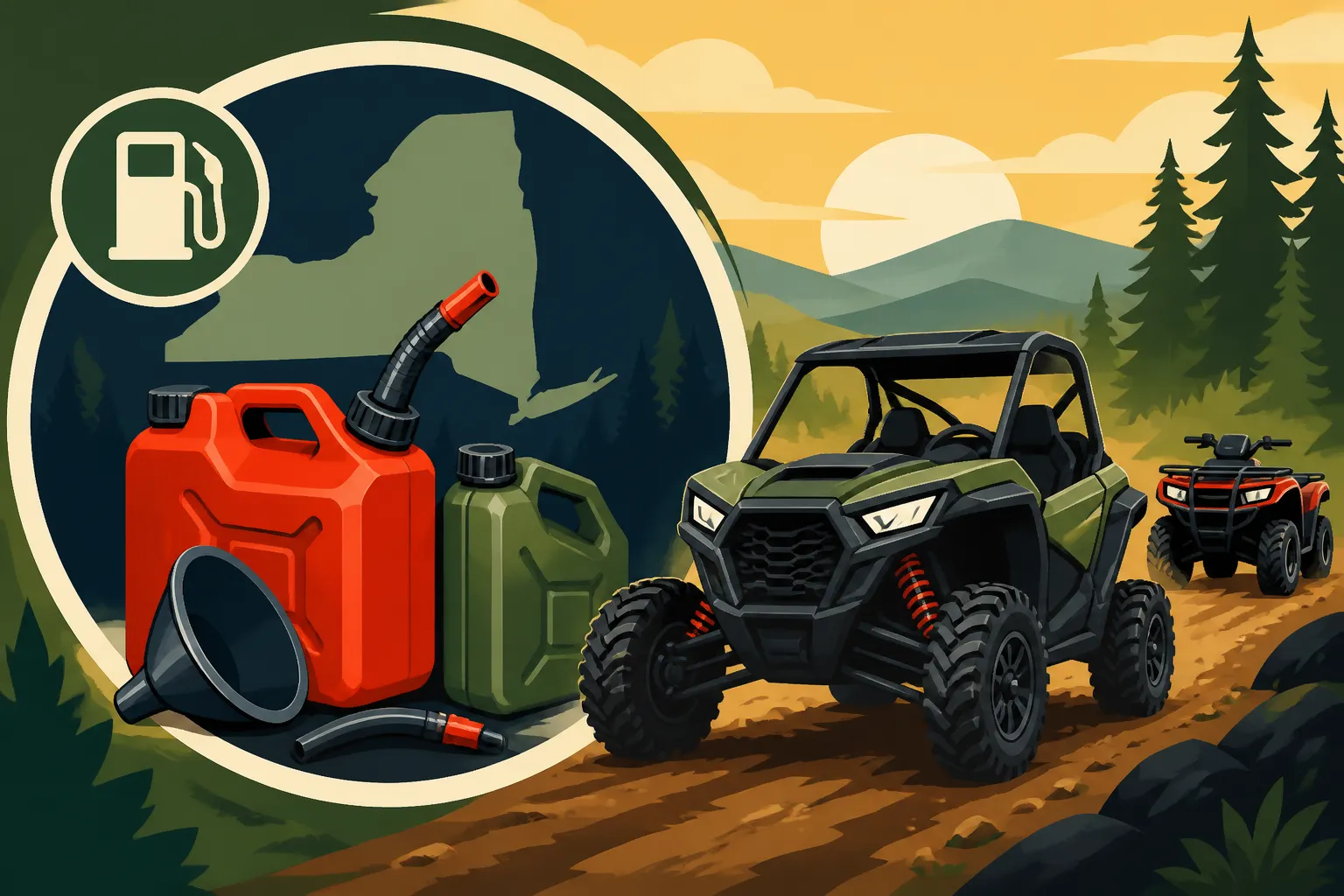
If your machine’s range is not enough for the planned loop, carrying extra fuel may be an option, but it needs careful planning. Use a fuel container designed for gasoline and suitable for the way you intend to carry it. A loose, damaged, or poorly sealed container can leak, shift, or become a hazard when the machine bounces over rough ground.
Secure the container so it cannot slide, tip, or interfere with steering, suspension, lights, exhaust components, or access to the machine’s controls. Keep fuel away from heat sources and ignition sources, and follow the machine and container manufacturers’ directions. Do not carry gasoline in an improvised bottle or an unsuitable household container. If you are unsure whether a container can be safely mounted on your ATV or UTV, check the owner’s manual or ask a qualified dealer or mechanic.
Extra fuel also adds weight. That can affect handling and, on some machines, the available space for other gear. Before the ride, check that the load is secure and that you have not blocked required equipment or made the machine difficult to control. For a group ride, it may be safer to distribute appropriately secured fuel among machines rather than overloading one ATV, as long as each rider can carry it safely and within the machine’s limits.
Refuel carefully and keep the group together
Stop on stable ground away from traffic, dry grass, and other obvious ignition hazards. Turn the machine off and give hot components time to cool before refueling. Avoid smoking or using open flames around fuel. Keep the container upright while pouring, and clean up spills before restarting. If fuel spills onto the machine or rider, deal with the spill safely before continuing.
Set a group routine for checking fuel. At a planned stop, have each rider check their gauge or estimate, and ask the rider with the shortest range how they are doing. Do not wait until one machine is close to empty to discuss the route. If anyone is using fuel faster than expected, shorten the loop early and return by a verified route.
It also helps to set a simple rule for unexpected delays: if a trail closure or mechanical issue adds distance, reassess fuel before continuing. A group that stops to check the map and fuel levels is in a better position than one that pushes on because the original plan said there should be enough. Use onX Offroad, a county map, or another navigation aid to compare your safe options, then choose the route that leaves the greatest practical fuel margin.
Build a fuel plan for a northern New York loop
Use a step-by-step planning routine
Start by choosing the trail system and confirming that your machine is eligible to use the planned routes. Width, registration, permits, and local trail rules can affect whether a route is an option at all. A large UTV may not be permitted on a route that works for a narrower ATV, so do not map the fuel plan before checking the machine requirements. Related reading includes New York Trails for a Narrow Machine and New York ATV Trail Permits Explained.
Next, estimate the route distance from the staging area and back again. Include any detour to a fuel station, the distance from the trail to the station, and the ride back to the trail or parking area. Then compare that distance with your conservative real-world range, not your best-case estimate. If the loop depends on a single uncertain fuel stop, shorten it or carry an appropriate reserve instead of treating that stop as guaranteed.
Finally, save the route and backup options, check the trail status close to departure, and tell the group where you expect to stop. Write the key details down or share them with someone who is not riding: staging area, planned route, estimated return time, and what to do if the group is delayed. For more on preparing for an outing, see New York Trail Conditions Before You Ride and Downloading a County Trail Map.
Know when the safer choice is a shorter loop
A shorter ride is often the better plan when the trail is wet, a fuel stop is unconfirmed, one machine has limited range, or the group includes riders unfamiliar with the area. It can be disappointing to turn around before reaching the route you were excited about, especially after trailering a long way. But a conservative decision at the start is far less stressful than trying to find fuel with a nearly empty tank and fading daylight.
Pay attention to the group’s pace, not just the distance on the map. A loop that looks short may take longer if the trail is rough, crowded, or unfamiliar. Leave enough daylight for the return, and avoid counting on a fast ride to make up for a late start. The route should suit the slowest machine and the least experienced rider in the group.
Before you ride, make sure everyone understands that the plan can change. If a trail is closed, conditions are worse than expected, or a machine is using fuel unusually quickly, take the shorter verified route. Planning fuel for a long northern loop is not about squeezing every possible mile out of a tank; it is about making sure the whole group can finish the ride safely and return to the trailer with fuel to spare.
Disclaimer
This article is for general informational purposes only and does not constitute professional advice. Laws, prices and regulations vary by location and change over time. Consult a qualified professional for guidance on your specific situation.