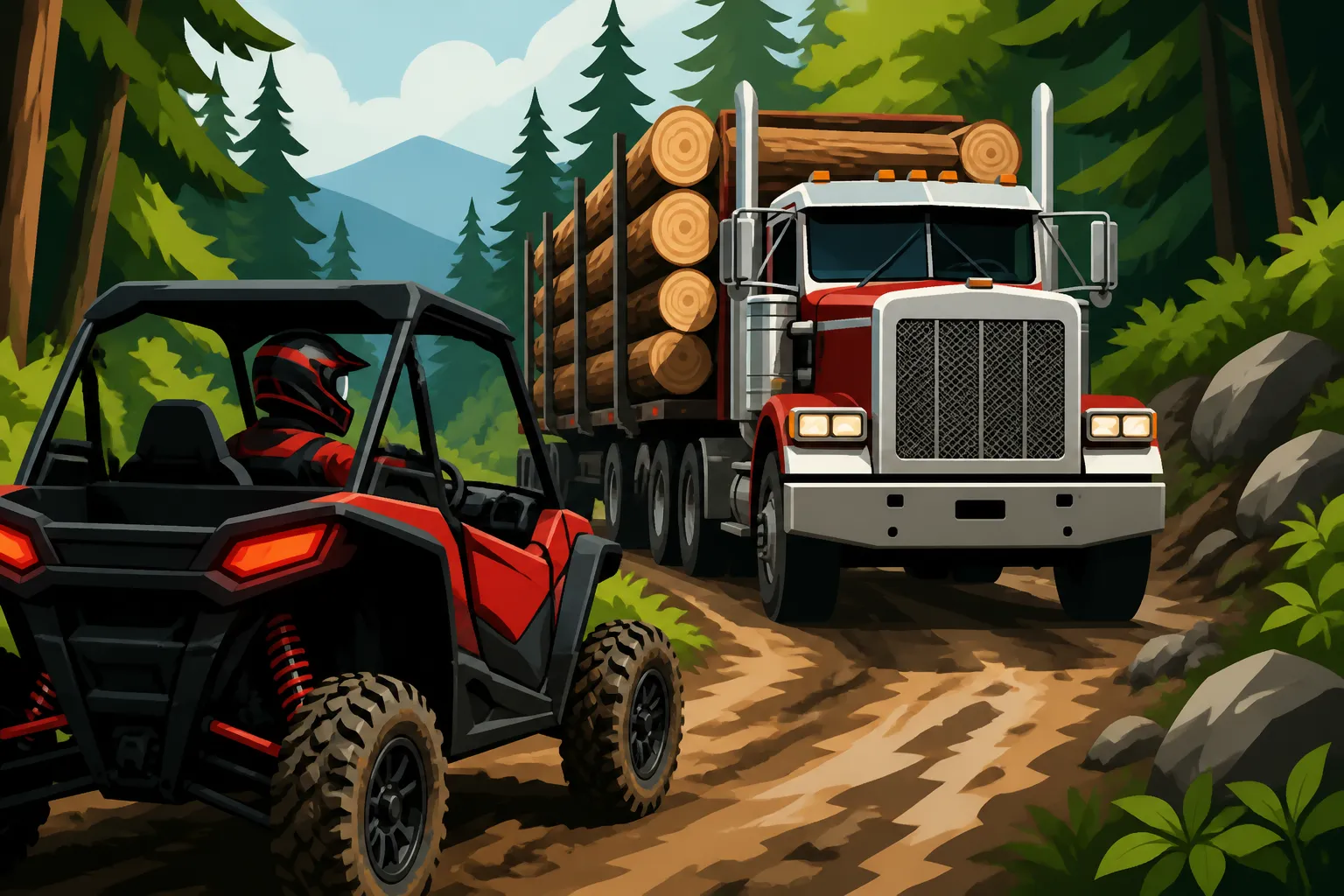
Meeting a Logging Truck on a Trail Road
A logging truck can fill a narrow trail road from ditch to ditch, and its driver may not see an ATV around a bend or through a cloud of dust. In New York, the safest response is to slow early, make yourself visible, and give the truck room without steering into an unstable shoulder. This guide explains what to do before, during, and after an encounter.
Why logging trucks need extra room on New York trail roads
A trail road may be an active work route
A road that looks like a quiet woods trail may also serve loggers, foresters, landowners, or other authorized vehicles. A loaded truck may be traveling slowly, but it needs space to turn, climb, brake, and stay on firm ground. The load can also make it wider or longer than it appears from a distance.
Logging work can change conditions quickly. A route that was passable last weekend may now have fresh tire tracks, equipment, temporary signs, or a truck entering from a landing or side road. Don’t assume that a familiar trail is free of work traffic just because you have ridden it before. Check local trail notices and closures before heading out, and follow signs at the trailhead.
A useful preparation step is checking New York Trail Closures to Check First and New York Trail Conditions Before You Ride. A county or club notice may flag an active closure or changed route, though no map can guarantee that a logging truck won’t appear after you set out. If a road is posted closed or a landowner or trail steward tells you to turn around, do so rather than trying to find a way around the barrier.
Your right to ride does not mean the road is free of work traffic
ATV access is not automatic on every woods road. In New York, an open route may depend on the road’s designation, the landowner’s permission, and local trail rules. Be especially careful not to treat a logging road as a public ATV route just because there are tire tracks on it. Review [New York Rules for Riding a Logging Road] and New York Trails That Cross Private Land when planning a route that uses private or working land.
Even on a route where ATV riding is allowed, you may encounter vehicles with a work-related reason to be there. Logging trucks are large, heavy, and slow to stop. The driver may be concentrating on traction, the load, a tight turn, or a narrow bridge—not looking for a small ATV hidden behind brush.
The practical rule is simple: assume the truck needs the road more than you do, and make room at the first safe opportunity. That does not mean diving into a ditch or backing up without looking. It means slowing early, assessing the ground and visibility, then choosing a safe place to stop or turn around.
What to do when you see a logging truck
Slow down early and make yourself predictable
As soon as you see a truck, let off the throttle and reduce speed in a controlled way. Avoid sudden braking, sharp turns, or weaving toward the edge of the road. On loose gravel, mud, or a steep grade, an abrupt move can make your ATV slide or tip.
Keep enough distance to see what the driver is doing. A truck may need to swing wide to clear a bend, avoid a soft edge, or line up for a narrow bridge. Don’t try to squeeze past it, follow closely behind, or overtake it on a blind stretch. If you can safely pull into a wide, firm turnout, stop there and wait for the truck to pass.
Make yourself visible without creating a distraction. Stay out of blind corners and avoid stopping where the truck must make a tight turn. If dust or brush reduces visibility, don’t assume the driver has seen you. Wait until the truck is fully stopped or clearly passing before making any move across its path.
Choose a safe place to yield
A good place to pull over is broad enough for your ATV and stable enough to hold it without sliding. Look for a firm turnout, a wide section of road, or a designated staging area. Avoid soft shoulders, steep banks, drainage ditches, loose fill, and spots where roots or rocks could catch a tire.
Use the table below as a quick guide. The safest choice depends on the road and what the truck is doing, so keep assessing the situation rather than following a rule mechanically.
| Situation | Safer response | Avoid |
|---|---|---|
| You see a truck approaching on a straight, visible stretch | Slow down and pull into a wide, firm turnout if one is available | Stopping just over a crest or in the truck’s turning path |
| You meet the truck at a blind bend | Stop before the bend if you can do so safely and wait for the driver to see you | Riding farther into the bend to find out whether the truck is coming |
| There is no safe place to pass | Stop in a visible, stable spot and wait for the truck to stop or direct you | Forcing your ATV onto a soft shoulder or trying to squeeze between truck and bank |
| The truck is reversing or turning | Stay well clear and wait until its movement is finished | Passing behind it, even if it appears to be moving slowly |
| Dust blocks your view | Stop and wait for visibility to improve | Riding into the dust cloud or following the truck closely |
If there is no safe passing space, do not try to manufacture one. Stop well before the narrowest point and give the truck driver time to assess the road. If the driver signals you to wait, stay put until the truck is clear. If the truck stops and the driver gives you directions, make eye contact where possible and follow those directions only when you can do so safely.
Don’t reverse or pass on guesswork
Backing up can be risky on a narrow road, especially when you cannot see the ground behind you or when another rider is close. If you need to reverse, stop first, check the route behind you, and move slowly only when you are sure the way is clear. For a group, make sure riders behind you know what you are doing before you move.
Passing is rarely worth the risk. A logging truck may have a long trailer, a wide load, or a blind spot that hides your ATV. It may also need to move across the road to turn or avoid an obstacle. Never pass while it is backing, turning, climbing a steep section, or traveling through a blind or dusty stretch. If you’re unsure whether there is enough space, wait.
The same caution applies when the truck appears parked. It may be about to move, loading may be underway, or workers may be moving between the truck and the landing. Don’t ride under raised equipment or through an active work area. Give people and machinery a wide berth, and leave if the route is not clearly open for you.
How to prepare for a ride where logging traffic is possible
Check the route and current notices
Before you leave, confirm that the route is open to ATVs and check for local notices about closures, work activity, or reroutes. County trail systems and clubs may publish information through their own channels, and signs at the trailhead can provide important updates. If you can’t establish that a road is open to you, choose a route that you know is permitted instead.
Digital maps are helpful for planning, but they should not replace signs, posted closures, or local guidance. For example, onX Offroad can help you review a planned route and identify where you may need to check access details. Treat any map as a planning aid, not proof that a particular road is open today. Compare it with current trail information and what you see on the ground.
If your route crosses several trail systems or property boundaries, plan where you can safely turn around. onX Offroad can be useful for thinking through alternate routes before you ride, but don’t make a last-minute detour onto an unmarked road just because it appears to connect to your destination. Review Following County Trail Markers and New York Trail Etiquette With Landowners before relying on a route that passes through working or private land.
Ride in a way that gives you time to react
Keep your speed appropriate for the surface, visibility, and traffic. That often means slowing near blind bends, hill crests, narrow bridges, trail junctions, and active work areas. Stay to the appropriate side of the route when visibility is good, but don’t cling to a soft edge just to make room for a vehicle that has not yet appeared.
Leave enough following distance between ATVs. If the rider in front stops suddenly to yield, the people behind need room to brake without colliding or spilling into the truck’s path. In a group, agree on a simple plan before setting out: the lead rider signals a stop, each rider pulls in only where it is safe, and the last rider makes sure the group is clear of the travel lane.
Avoid wearing headphones or playing audio loudly enough to mask engine noise. On a shared road, hearing a vehicle before you see it can give you valuable time to slow down and find a safe place to stop. Dust, vegetation, and terrain can hide a truck even when the road ahead looks empty.
Keep navigation and communication practical
Tell someone where you expect to ride and when you plan to return, especially if the route has limited cell coverage. Carry a charged phone, but don’t assume it will work throughout the ride. If the group separates or a route is blocked, stop in a safe place and regroup instead of improvising a shortcut through unfamiliar property.
A second look at your route before departure can help you avoid dead ends and narrow access roads. onX Offroad may help you organize that planning, while local trail maps, signs, and club updates provide essential context about current access. Save a backup route that stays on permitted trails, and be prepared to turn around if work activity makes the planned route unsafe.
Don’t ride into an active work zone just to ask for directions. If workers are present, stop at a safe distance, wait for a clear opportunity, and follow posted instructions. If the road is blocked or the work area is active, the sensible choice is to retreat to the last safe junction and take a permitted alternative.
After the truck passes
Wait until the road is clear before moving
Once the truck has passed, don’t immediately accelerate into its dust or follow closely behind. Wait until you can see the surface ahead and confirm there is no second truck, trailer, or vehicle following it. A convoy may be spaced out, and the next vehicle can arrive after the first one has disappeared around a bend.
Look for hazards the truck may have left behind, including loose gravel, mud, branches, ruts, or debris. A heavily loaded vehicle can change the road surface, especially after rain or during a thaw. Cross any new rut or soft patch slowly and choose a line that doesn’t risk tipping or losing traction.
If the encounter has made the road feel unsafe or raised questions about whether the route is open, turn around. Don’t let the effort of getting there pressure you into continuing. Checking Checking a County Notice Before You Load before the next ride can help you catch route changes earlier.
Treat repeated encounters as a reason to reconsider the route
One truck may be a brief encounter; regular heavy traffic may mean the road is actively serving a logging operation. If you repeatedly meet trucks, hear machinery ahead, or see signs of active hauling, it may be safer to leave the route rather than continue through the work area. Respect barriers and instructions, and do not ride around a closed gate.
If you are riding with a group, talk through what happened once everyone is stopped somewhere safe. Decide whether the group should take a known alternate route, return to the trailhead, or wait for conditions to change. Keep the discussion away from the travel lane, and don’t gather where trucks need room to turn or pass.
Good judgment matters more than finishing a planned loop. A logging truck needs space, time, and predictable movement; an ATV rider needs visibility, stable ground, and a clear way to yield. When those needs conflict, slow down, give the truck room, and be willing to change plans. That approach helps protect you, your group, the workers, and continued access to trails shared with working land users.
Disclaimer
This article is for general informational purposes only and does not constitute professional advice. Laws, prices and regulations vary by location and change over time. Consult a qualified professional for guidance on your specific situation.