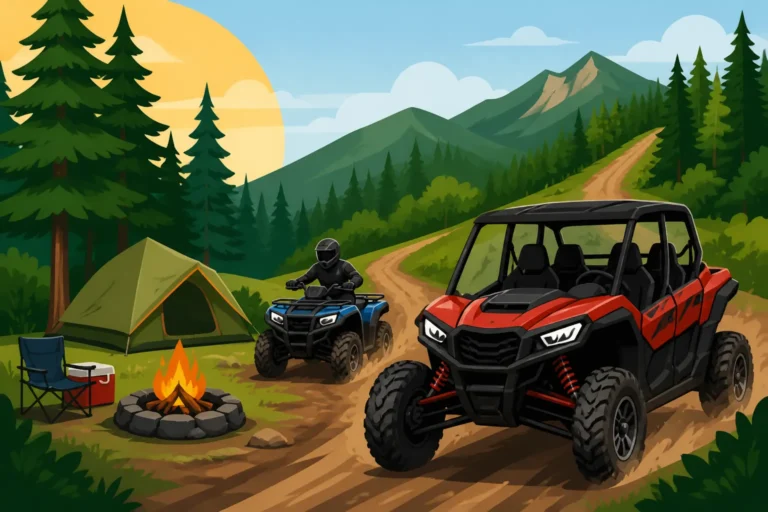
Camping Near a New York Trailhead
Planning a camping trip around New York ATV trails can get confusing fast: a campground may be close to a trail system without offering a legal riding connection, and trail access can depend on season, permits, and landowner agreements. This guide explains how to choose a campsite, confirm your route, prepare your machine and trailer, and avoid arriving at a closed gate.
Choose a camping setup that matches your ride
Campgrounds beside a trailhead are not always connected to it
“Near the trailhead” can mean several different things. A campground might sit beside a staging area, a short drive away, or merely in the same general part of the county. That difference matters if you expect to ride straight from your campsite. A nearby trail does not automatically mean you can use a campground road, town road, private lane, or shoulder to reach it.
Before reserving a site, ask the campground what riders are permitted to do between the property and the designated riding area. Ask whether machines may be ridden on the campground itself, whether there is a marked connector, and whether a trailer is needed to reach the staging lot. Get the directions to the actual trail access point, not just the campground’s mailing address.
This is especially important in rural areas around Tug Hill, where trail routes may cross private property under agreements that can change. A road that looks like a convenient link on a general map may not be open to ATV traffic. A campsite near a popular riding region is a useful base, but it does not create permission to ride every road or trail nearby. For a broader look at lodging and access planning, see [Camping Near New York ATV Trails] and [Campgrounds Beside a New York Trailhead].
Decide whether you want a full-service campground or a quieter base
A full-service campground can make a riding weekend easier if you need electric hookups, showers, a dump station, a camp store, or a place to park a truck and trailer. Those conveniences are particularly valuable when the weather turns wet or when you are traveling with children. Ask specifically about the size and layout of the site: a long trailer and tow vehicle may need more room than a standard camping setup.
A more basic campground, cabin, or private site may suit riders who want a quieter place to sleep and are comfortable handling more of their own logistics. The tradeoff is that amenities, road access, and cell service may be limited. If you are riding in a remote part of Lewis, Oswego, or Jefferson County, work out where you will fuel, buy food, and get help before you arrive.
Some riding destinations combine camping with a defined ATV park or private trail network. Tall Pines ATV Park in Allegany County is one example of a destination associated with riding and overnight stays, but rules and access arrangements vary by property. Confirm whether camping, riding, machine use, and any required passes are handled together or separately. Do not assume a reservation includes trail access or a rental machine.
| Camping setup | Often useful for | Questions to ask before booking |
|---|---|---|
| Full-service campground | Families, longer stays, and riders who want hookups or showers | Is there room for the trailer and tow vehicle? Is riding allowed on site? |
| Basic campground | Riders who prefer a simpler base and can bring supplies | What facilities are available, and how far is the nearest fuel or store? |
| Cabin or rental unit | Groups who want indoor shelter after a wet ride | Is there secure parking, and are machines allowed on the property? |
| ATV park with overnight options | Riders who want riding and lodging at one destination | What riding areas are included, and what separate rules or passes apply? |
| Private or seasonal site | Repeat visitors who know the area | Is access still authorized, and are trail connections open for the planned dates? |
Confirm the riding area before you reserve
Check the county system, not just the map pin
New York riding opportunities are not one continuous statewide network. Counties, clubs, private landowners, and other organizations may each play a role in managing access. A trail system can have specific opening periods, seasonal closures, designated staging areas, and permit requirements. Start with the county or trail operator’s information, then use maps to understand the surrounding geography.
Lewis County is known for an extensive trail network, while Oswego County has club-associated riding opportunities. That does not mean every route in either county is open to every rider on every date. Some trails may require a permit, a club membership, or compliance with local conditions. Other routes may be closed because of weather, maintenance, logging, or a change in landowner permission. Compare the options with [New York's County Trail Systems Compared] before choosing a campsite based only on distance.
A general navigation app can help with roads and directions, but it is not proof that a trail is legal or open. onX Offroad can be useful as a planning layer for reviewing route geography and keeping track of a planned ride. Treat that information as a starting point, then compare it with the current county or trail-system notice. The final decision should be based on the authority responsible for that route, not simply the line displayed on a screen.
Verify dates, permits, and closures close to departure
Trail access can change between the day you book a campsite and the day you arrive. Spring thaw can leave trails soft and vulnerable to damage; heavy rain can wash out a crossing; maintenance or a landowner request can close a section with little convenience for travelers. Some systems also have defined seasons, so a trail being visible on a map does not mean it is open during your visit.
Check the trail operator’s notices shortly before leaving and again before unloading. Look for opening and closing dates, temporary detours, permit instructions, staging-lot information, and restrictions on machine types. If the campground advertises trail proximity, ask staff whether they have heard of a closure, but confirm that information with the trail operator as well. You can also review [New York Trail Conditions Before You Ride] and [New York Trail Closures to Check First].
Keep a backup plan. If your intended system is closed, know whether another legal riding destination is realistically available from your campsite, whether you need a different permit, and whether the alternative allows your machine. Building a whole weekend around one unconfirmed route is how riders end up with a paid campsite, a loaded trailer, and nowhere appropriate to unload.
Plan the route from campsite to trail
Work out the last mile before you arrive
The drive from the campground to the staging area can be the most easily overlooked part of the trip. If the connector is not authorized for ATV use, you may need to haul the machine by trailer even when the trailhead looks close. A short distance on a map can also involve a road with no legal ATV access, a narrow entrance, a steep driveway, or a staging lot that is unsuitable for a large truck and trailer.
Ask the campground for the exact route to the staging area and whether the campground provides any legal trail connection. Then check the trail operator’s instructions for where to park, unload, and display any required permit. [Parking a Trailer at a County Trailhead] is a useful topic to review before you tow into an unfamiliar lot. If the staging area is small, arrive early enough to avoid blocking other vehicles or having to turn around in a tight space.
Use onX Offroad or another mapping tool to preview the road approach, but do not treat a suggested route as legal authorization. The app can help you notice that a campground and trailhead are separated by a river, a highway, or several miles of road. It cannot replace local rules or permission. If a route appears to cross a private road or an unmarked connector, call the trail operator rather than guessing.
Match the machine to the route and system
A campsite may be accessible to any tow vehicle, while the riding area has restrictions that affect the ATV or UTV itself. New York’s registration definition and width and weight rules can exclude some larger side-by-sides from registration as ATVs. Trail systems can also have rules about machine size, equipment, noise, or rider conduct. Confirm that your machine qualifies for the intended riding area before making the trip.
Do not use the campground’s general statement that it is “ATV friendly” as a substitute for checking the specific trail rules. Ask whether the system allows your machine’s class and dimensions, whether passengers are permitted on your model, and whether the route includes narrow sections or restrictions that matter for a wider vehicle. If you are uncertain about the New York registration rules for a side-by-side, review [Why Most Side-by-Sides Cannot Be Registered in New York] and confirm the applicable requirements before riding.
Pack the machine’s registration and required insurance proof, along with any trail permit or membership documentation. Visitors should not assume that an out-of-state registration removes New York riding obligations. [Riding New York With an Out-of-State Plate] covers the visitor question, while the trail operator can confirm the access rules for the particular system you plan to use.
Choose a site that works for trailers, machines, and people
Ask practical questions about parking and storage
A site that fits a tent or camper may not have room for a long tow vehicle, trailer, and a second family vehicle. Before booking, provide the campground with the approximate length of your full setup and ask where the trailer will be parked after unloading. Some properties have separate overflow areas; others have narrow roads, soft shoulders, low branches, or limited turning space.
Ask whether the machines can be parked at the site, whether they must be kept in a designated area, and whether there is a secure place to leave helmets, tools, and riding gear. Find out whether the campground permits fueling or maintenance on the property. Even where small repairs are allowed, washing a muddy machine or draining fluids may not be. Respecting these rules helps avoid disputes with the property owner and other campers.
If your group is arriving in more than one vehicle, coordinate who brings the trailer, who carries fuel and tools, and who has the campsite details. A tight arrival area can become stressful when several families unload at once. Sharing the campground’s directions, check-in instructions, and the trailhead plan before departure prevents the classic first-night scramble of trying to find a site while the rest of the group waits with loaded machines.
Think about noise, weather, and recovery
Riding days often start early, but other campers may be there for a quiet weekend. Keep loading, unloading, warm-ups, and late-night conversations considerate. Follow posted quiet hours, avoid unnecessary engine idling, and do not ride around the campground unless the property explicitly allows it. A campground’s proximity to trails is not permission to use its internal roads as a practice area.
Weather can change a comfortable plan quickly in northern New York. Rain may make a gravel access road slippery or soften a campsite, while cold nights can make wet riding gear difficult to dry. Bring a tarp or covered storage plan, extra gloves and socks, and bags that keep clean clothing separate from muddy equipment. If your campsite has no reliable power, plan how you will recharge phones and keep essential lights ready.
Make a simple recovery plan before riding. Tell someone where the group expects to go, carry a charged phone and an offline route reference, and agree on what to do if riders become separated. onX Offroad can help a group review its planned route and orient itself, but riders should still save key information and follow official trail markers. In a low-service area, a paper county map and a written campground address are still useful backups.
Make a practical camping and riding checklist
Gather the documents and information you will need
Keep riding paperwork together in a waterproof pouch or a protected compartment. Depending on your situation, that can include registration, insurance proof, trail permits, club documentation, and safety certificates for younger riders. Confirm the requirements for your machine and the system before leaving home rather than discovering a missing document at the staging area.
Save the campground’s address, check-in details, emergency contact information, and directions to the intended trailhead. Download or print the county’s map and current notices if available. [New York Trail Maps From a County] can help you find the sort of map to look for, and [Checking a County Notice Before You Load] is a reminder to verify conditions before towing.
For a group trip, choose one person to confirm the permit and closure information and another to check the campsite logistics. This is not about creating a complicated itinerary; it is about making sure someone knows the plan. If a route changes, the group can regroup at a named staging lot or return to camp instead of making separate assumptions.
Pack for the campsite and the trail separately
Camping gear and trail gear solve different problems, so keep them organized separately. A basic campsite kit might include weather-appropriate bedding, a headlamp, drinking water, food, a first-aid kit, and a way to keep wet clothing apart from dry gear. The trail kit should be specific to the route and machine, with protective equipment, basic tools, tire repair supplies, and any legally required safety equipment.
Do not overload a UTV or ATV with camping supplies in a way that affects handling or exceeds the machine’s capacity. Heavy items should be secured, balanced, and kept clear of hot components and moving parts. If you need to transport fuel, use suitable containers and follow the campground’s storage rules. Never assume that a campfire area or cabin is an appropriate place to store fuel.
Finally, leave room for the unplanned. A spare dry layer, extra drinking water, a charged power bank, and a few basic repair items can make a delayed return much easier. New York’s trail systems vary in remoteness and service availability, so plan for the possibility that a loop takes longer than expected. A comfortable campsite is a great base, but the safest trip is one where both the riding plan and the ride back to camp have been thought through.
Disclaimer
This article is for general informational purposes only and does not constitute professional advice. Laws, prices and regulations vary by location and change over time. Consult a qualified professional for guidance on your specific situation.