Where to Register an ATV in New York
You've just invested in the thrill of an ATV, or maybe you're bringing a beloved machine into the Empire State, eager to hit those incredible trails. But before you can feel the wind in your hair and the mud under your tires, there's that little hurdle: registration. Figuring out exactly where to register an ATV in New York can feel like navigating a maze, especially with all the different rules and paperwork. Don't sweat it – this guide will cut through the confusion and show you precisely where you need to go and what you need to do to get your quad legally registered.
Your Primary Destination: The New York DMV
When it comes to getting your ATV legally registered in New York, the first and foremost place you'll be heading is a local office of the New York State Department of Motor Vehicles (DMV). While some transactions can be done online or by mail for cars, for initial ATV registrations, an in-person visit is almost always the most straightforward and recommended approach. This is because ATVs fall into a unique category in New York, often requiring specific checks and forms that are best handled face-to-face.
Think of your local DMV as the central hub for all things vehicle-related, and ATVs are certainly no exception. Even if you bought your machine from a dealer, who might handle some initial paperwork, you'll still likely be interacting with the DMV at some point, either directly or through the dealer's filings. It's where the state processes your application, issues your unique New York ATV plate, and ensures your machine is ready for the trails.
The DMV is equipped to handle the nuances of ATV registration, including verifying your identification, reviewing your proof of ownership, and processing the necessary fees. They are the gatekeepers, ensuring all state regulations are met before you get your registration sticker. Skipping this crucial step can lead to fines and legal trouble, so making that trip to the DMV is non-negotiable for legal riding.
Why an In-Person Visit Is Often Best
In today's digital age, many of us prefer to handle errands from the comfort of our homes. However, for initial New York ATV registration, a trip to your local DMV office really is your best bet. While the idea of waiting in line might not fill you with joy, the immediate feedback and direct interaction can save you a world of headaches down the road.
ATV registration in New York has a few unique quirks, not least of which is the state's decision not to issue titles for these machines. This means your proof of ownership becomes paramount, and a DMV clerk can instantly verify that your bill of sale or Manufacturer's Certificate of Origin (MCO) meets their requirements. They can catch any missing information or incorrect forms on the spot, allowing you to rectify them immediately rather than dealing with rejection notices in the mail weeks later. Plus, if you have any questions about specific details of your ATV, like its width or weight relative to New York's specific ATV definition, a clerk can often provide clarification. This face-to-face interaction reduces the chance of errors and streamlines the process significantly, getting you on the trails faster.
Navigating the DMV – Tips and Tricks
Making your DMV visit as smooth as possible is all about preparation and timing. First, check your local DMV office's website for their operating hours and any options to schedule an appointment. Many DMVs now offer online appointment scheduling, which can dramatically cut down on your wait time. If appointments aren't available, try to go during off-peak hours, typically mid-week in the late morning or early afternoon, avoiding lunch rushes and end-of-day crowds.
Before you even leave your driveway, make sure you have every single required document neatly organized. We'll dive into the specifics of what you need to bring in the next section, but suffice it to say, having everything in order is your golden ticket to a swift transaction. If you're unsure about anything, jot down your questions and be prepared to ask the clerk when it's your turn. Their job is to guide you through the process, and being polite and prepared goes a long way. Patience is also a virtue at the DMV; things can sometimes move slowly, so bring a book or be ready to catch up on emails. A calm demeanor can make the experience far less stressful for everyone involved.
What to Bring: Getting Your Paperwork in Order
This is where the rubber meets the road. Showing up at the DMV without the correct documentation is a sure-fire way to get sent home, frustrated and empty-handed. New York's ATV registration process requires a specific set of items to prove ownership, identity, and compliance with state laws. Think of this as your essential checklist before you even think about stepping out the door. You'll need original documents or certified copies where applicable, so don't rely solely on photocopies.
The most common reason for delays at the DMV is incomplete or incorrect paperwork. Take the time to gather everything meticulously. This isn't just about speed; it's about ensuring your ATV is legally registered without any future complications. Remember, this is about proving you own the machine, that it meets the state's definition of an ATV, and that you're a responsible operator.
Proof of Ownership: Your ATV's Birth Certificate
Since New York doesn't issue titles for ATVs, your proof of ownership is arguably the most critical document you'll need. This could be a Manufacturer's Certificate of Origin (MCO or MSO) if your ATV is brand new and purchased from a dealer. This document essentially acts as the ATV's "birth certificate" from the factory. If you're buying a used machine, whether from a private seller or an out-of-state dealer, you'll need a comprehensive bill of sale. New York even has its own form, the MV-51B, designed specifically for non-titled vehicles, which is often used as a bill of sale. [New York's Form MV-51B Explained] delves deeper into this crucial document.
A good bill of sale, whether on an official form or simply a well-drafted personal one, should include the seller's full name, address, and signature; your full name and address; the ATV's make, model, year, and crucially, its Vehicle Identification Number (VIN); the purchase price; and the date of sale. Make sure the VIN on your bill of sale matches the VIN on the machine perfectly. This is also where resources like LawDepot can be invaluable. If you're preparing a private bill of sale, LawDepot offers templates that ensure all necessary legal information is included, giving you peace of mind that your proof of ownership will be accepted by the DMV. Having a clear chain of ownership is vital, so if the seller never registered the quad, you might need their original bill of sale from when they bought it. For more details on what counts, check out [New York ATV Proof of Ownership Requirements].
Your ID and Proof of Residency
Just like with any other vehicle transaction, the DMV needs to verify who you are and where you live. You'll need to present a valid form of identification, typically your New York State driver's license or a non-driver ID card. Make sure this ID is current and not expired. If your current address doesn't match what's on your driver's license, you'll need to bring additional proof of residency.
This can include recent utility bills (electric, gas, water), a bank statement, or other official mail that clearly shows your name and your current New York address. The DMV uses this to ensure that you are a legitimate New York resident and that your registration documents are sent to the correct location. It’s all part of the process to confirm you’re eligible to register a vehicle in the state. Remember, having these ready will prevent any last-minute scrambling at the counter.
Insurance: Don't Leave Home Without It
New York State mandates that all ATVs operated off your own property must be insured. This isn't just a suggestion; it's a legal requirement. Therefore, before you can register your ATV, you must have proof of liability insurance coverage. This means bringing a valid New York ATV insurance identification card or a copy of your policy that clearly shows the required minimum liability coverage.
The insurance policy needs to be issued by an insurer authorized to do business in New York. The DMV clerk will check this detail meticulously. Without proper insurance, your registration application will be denied, plain and simple. So, before you even think about setting foot in the DMV, call your insurance provider and get your ATV policy set up. If you're curious about what minimums New York requires, take a look at [New York's Mandatory ATV Insurance]. This step is crucial for both legal compliance and your own protection on the trails, and it's a non-negotiable part of the registration process.
The All-Important VIN Tracing
This might sound a little old-school, but for ATV registration in New York, the DMV often requires a pencil tracing or a very clear photograph of your ATV's Vehicle Identification Number (VIN). This physical verification step is a safeguard against fraud and ensures that the specific machine you are attempting to register is indeed the one described in your ownership documents. [Why New York Wants a Pencil Tracing of the VIN] explains the rationale behind this.
To get a pencil tracing, you'll need a piece of paper and a pencil. Locate the VIN on your ATV's frame (it's usually stamped into the metal, often on the front frame tube, near the steering head, or sometimes on a side frame rail). Place the paper over the VIN and rub the side of the pencil lead across the paper until the numbers and letters of the VIN clearly appear. Alternatively, a sharp, well-lit photograph that shows the VIN clearly and is legible will often suffice, but it's always best to confirm with your specific DMV office beforehand whether a tracing or photo is preferred or if both are accepted. This tiny detail can cause a big holdup if you're not prepared, so get it done before you go.
Understanding the Registration Process Beyond the Counter
Once you've presented all your documents and the DMV clerk has verified everything, the process moves forward. It's not just about handing over paper; it's about what the DMV does next and what you'll receive in return. This finalizes your legal standing to operate your ATV in New York.
The process is designed to be comprehensive, ensuring that every registered ATV meets the state's basic requirements for operation. From the moment you pay your fees to the instant you receive your plate, each step contributes to your machine's legal status. Understanding these steps can help manage expectations and ensure you know exactly what to look for when your registration is complete.
What Happens After You Submit Your Paperwork
After the DMV clerk has reviewed all your documents, verified your identity, and processed your payment for the registration fees and the one-time plate fee (you only pay the plate fee once!), you'll typically walk away with a temporary registration. This temporary document allows you to legally operate your ATV while you wait for your permanent registration card and metal plate to arrive in the mail. The temporary registration usually includes an expiration date, so make sure to keep it somewhere safe on your person when riding until the permanent documents arrive.
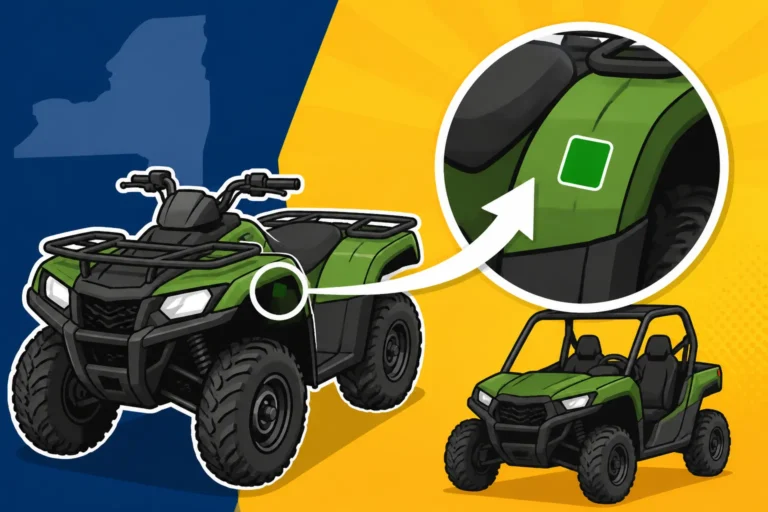
Shortly after your visit, you'll receive your permanent New York ATV registration card, your metal ATV plate, and a small validation decal. The plate needs to be securely mounted on the rear of your ATV, in a clearly visible location. [New York ATV Plates and Where They Mount] gives you all the practical advice on proper placement. The validation decal, which signifies the current registration period, needs to be affixed to a designated spot on the plate itself. [Where to Stick a New York ATV Validation Decal] shows you where it typically goes. Keep your registration card with you whenever you're riding, as it's proof that your machine is legally registered in the state.
When Your Dealer Handles the Heavy Lifting
For many people, buying a new ATV from a dealership simplifies the registration process considerably. Authorized New York ATV dealers can often handle a significant portion, if not all, of the initial registration paperwork for you. They'll collect all the necessary information and documents from you at the time of purchase – your ID, insurance proof, and the MCO – and then submit them directly to the DMV on your behalf. This is a huge convenience, as it means you might only need to pick up your plate and registration card from the dealer, or have it mailed to you directly.
Dealers typically use a different form, such as Form RV-2, to register vehicles before delivery, streamlining the process for new sales. [What New York ATV Dealers File on Form RV-2] explains this specific form and its purpose. It's important to confirm with your dealer exactly what they will handle and what, if anything, you'll still need to do yourself. While dealers make it easier, you're still ultimately responsible for ensuring your ATV is correctly registered. Always double-check that you receive proper documentation and that the registration is indeed complete before you take your new quad out on the trails. [Dealers Registering Before Delivery in New York] covers more on this convenient service.
Common Pitfalls and How to Avoid Them
The journey to legal ATV ownership in New York can sometimes feel like a trek through unexpected terrain. There are a few common issues that can trip up even the most prepared rider. Being aware of these potential pitfalls upfront can save you time, stress, and multiple trips to the DMV. The goal is to make the process as smooth as possible, allowing you to focus on the fun part: riding.
From understanding New York's unique approach to ATV titling to navigating registrations for machines from other states, there are nuances to consider. Preparing for these specific scenarios will ensure your registration journey is a straightforward path rather than a detour.
The Case of the Missing Title
One of the biggest sources of confusion for new ATV owners in New York, especially those coming from other states, is the absence of a title document. Unlike cars, trucks, and many other vehicles, New York State does not issue titles for ATVs. This can be a significant point of anxiety for buyers and sellers alike, as titles are typically the definitive proof of ownership for most vehicles. However, for ATVs in New York, your primary proof of ownership rests on a robust bill of sale (like the MV-51B) and the Manufacturer's Certificate of Origin (MCO) if it's a new machine.
This lack of a title means you must be extra diligent about maintaining detailed records of your purchase and sale. When buying a used ATV, always insist on a clear, signed bill of sale that includes all the necessary details and the VIN. If possible, gather a history of previous bills of sale if the machine has changed hands multiple times. LawDepot can assist in generating these critical documents accurately, providing you with a solid legal foundation for your ATV ownership. For a deeper dive into this unique aspect of New York law, check out [Why New York Issues No ATV Title]. Understanding this policy is key to navigating the registration process successfully.
Out-of-State Machines and Visitors
If you're bringing an ATV into New York from another state, or if you're a visitor planning to ride New York's trails, the registration rules can feel a bit murky. New York generally requires any ATV operated within its borders to be registered in New York, even if it's already registered in another state. There's often no direct reciprocity for out-of-state ATV registrations, so you can't just slap on your Pennsylvania plate and expect to ride legally here for an extended period. [Registering an Out-of-State Machine in New York] provides a full breakdown of this process.
Visitors might have some limited exceptions for short-term recreational use, but for residents moving into the state or those planning regular riding, a New York registration is mandatory. The process for registering an out-of-state machine is largely the same as registering one bought within New York, requiring the same proofs of ownership, ID, and insurance. Be prepared to present your previous state's registration documents as additional proof of your ownership history. It’s always best to err on the side of caution and get that New York registration if you plan on being here for any length of time. If you're just visiting, understanding [Registering a Visitor's Machine in New York] is essential.
Special Circumstances: Farm Quads and More
New York law does provide for certain exemptions from ATV registration, but these are very specific and often misunderstood. The most common exemption relates to ATVs used exclusively for agricultural purposes on private land. If your quad is strictly used as a workhorse on a farm and never touches public lands, roads, or designated trails, it might be exempt from registration. However, the moment that "farm quad" leaves private agricultural property, even to cross a road to another field, it generally needs to be registered. [The Agricultural Exemption in New York] elaborates on these rules.
Similarly, an ATV used solely for snow removal on private property, like your own driveway or a neighbor's with permission, might also be exempt. But again, any use beyond that specific, private context typically triggers the registration requirement. It's crucial not to assume your machine is exempt without thoroughly understanding the specific conditions. If there's any doubt, or if you ever foresee your ATV being used outside these narrow exemptions, registering it is the safest and most legally sound course of action. For farm-specific registration questions, see [Registering a Farm Quad in New York].
Here’s a quick overview of what you’ll generally need to bring to the DMV:
| Document Type | Description |
|---|---|
| Proof of Ownership | This is usually a Manufacturer's Certificate of Origin (MCO or MSO) if new, or a bill of sale (Form MV-51B for non-titled vehicles is a common one) if used. If you bought it from a private seller, a detailed bill of sale with seller and buyer information, VIN, purchase price, and date is essential. Remember, New York doesn't title ATVs, so this document is your primary proof of ownership. |
| Proof of Identity | Your valid New York State driver's license or non-driver ID card. |
| Proof of Residency | Utility bill, bank statement, or other official mail showing your name and current New York address, especially if your ID doesn't reflect your current address. |
| Proof of Insurance | A valid New York ATV insurance identification card or policy showing the required liability coverage. This must be from an insurer authorized to do business in New York. |
| Payment for Fees | Be ready to pay the applicable registration fees and the one-time plate fee. Check the DMV website for current amounts, as these can change. |
| VIN Tracing/Photo | The DMV often requires a pencil tracing or a clear photograph of your ATV's Vehicle Identification Number (VIN). This helps prevent fraud and ensures the correct machine is being registered. Make sure you know where your VIN is located on the frame. |
| Form MV-82 (Application) | While New York has a specific form for registering non-titled vehicles (MV-51B) which we'll discuss, the standard vehicle registration/title application (Form MV-82) is often used in conjunction with it, particularly for establishing your personal details and vehicle information in the system. Your local DMV will guide you on which combination of forms they prefer for ATVs. |
Disclaimer
This article is for general informational purposes only and does not constitute professional advice. Laws, prices and regulations vary by location and change over time. Consult a qualified professional for guidance on your specific situation.