New York ATV Plate Fee
It can feel a bit overwhelming when you're looking at buying an ATV in New York, and all these different fees start piling up. Beyond the sticker price of the machine itself, you've got sales tax, registration, and then that little plate fee that sometimes gets overlooked. It's easy to wonder why you're paying for a plate and registration, and if it's an annual thing or just a one-and-done cost. This guide is here to demystify the New York ATV plate fee, explaining exactly what it is, when you pay it, and how it fits into your overall ownership costs.
Understanding the New York ATV Plate Fee
The New York ATV plate fee is one of those small but essential costs you'll encounter when you bring a new (or new-to-you) machine home. It's often bundled with the initial registration process, but it's important to understand it as a distinct charge. Think of it as the cost of the physical license plate itself, which serves as your ATV's unique identifier.
A One-Time Cost for Your ATV Identity
One of the biggest reliefs for many new ATV owners in New York is learning that the plate fee is typically a one-time charge. Unlike your annual registration, which you'll renew every year, the fee for the physical plate itself is something you generally pay only once when you first register your machine. This means you won't be budgeting for a new plate every time August 31st rolls around for your registration renewal. [New York's August 31 Expiration]
This single payment covers the cost of manufacturing and issuing that durable little piece of metal (or sometimes plastic, depending on the state's current materials) that gets bolted to the back of your quad. It’s designed to last for the lifetime of your ownership, provided it doesn't get lost or damaged on the trails. It's the unique identifier that links your specific ATV to your registration records with the New York Department of Motor Vehicles (DMV).
Why New York Charges a Separate Plate Fee
You might be thinking, "Why a separate fee? Isn't it just part of the registration?" And that's a fair question. The reason New York separates the plate fee from the registration fee boils down to the nature of what each charge covers. The registration fee, which is renewed annually, covers the administrative costs of maintaining your ATV's active status in the system, processing paperwork, and supporting trail programs. [Where New York ATV Fees Go]
The plate fee, however, is specifically for the physical item—the plate itself. It covers the material costs, the stamping or printing process, and the logistics of getting that plate issued to you. While the registration signifies your legal right to operate the ATV on designated lands, the plate is the tangible proof of that registration that law enforcement can visually verify on the trail. It's a common practice across many vehicle types, from cars to snowmobiles, to have a distinct charge for the physical identification marker.
What the Fee Covers
So, what exactly does this modest fee pay for? Primarily, it covers the cost of producing that small, rectangular plate you'll affix to your ATV. This includes the material it's made from (often aluminum), the reflective coating that helps with visibility, the embossed numbers and letters that make up your unique identifier, and the state's branding (like "New York" or "Empire State"). It's a small but robust item designed to withstand the rigors of off-road riding, from mud splashes to brush scrapes.
Beyond the physical plate, the fee also contributes to the administrative overhead involved in its issuance. This includes the systems used to assign unique plate numbers, track inventory, and ensure that the correct plate is associated with the correct vehicle and owner. While it's not a large sum, it's a necessary component of the overall registration infrastructure in New York. [New York ATV Plates and Where They Mount]
When and How You Pay the Plate Fee
Understanding the timing and method of payment for your New York ATV plate fee is crucial for a smooth registration process. It's not a standalone bill that arrives in your mailbox later; it's integrated into the initial steps of becoming a legal ATV owner.
The Initial Registration Moment
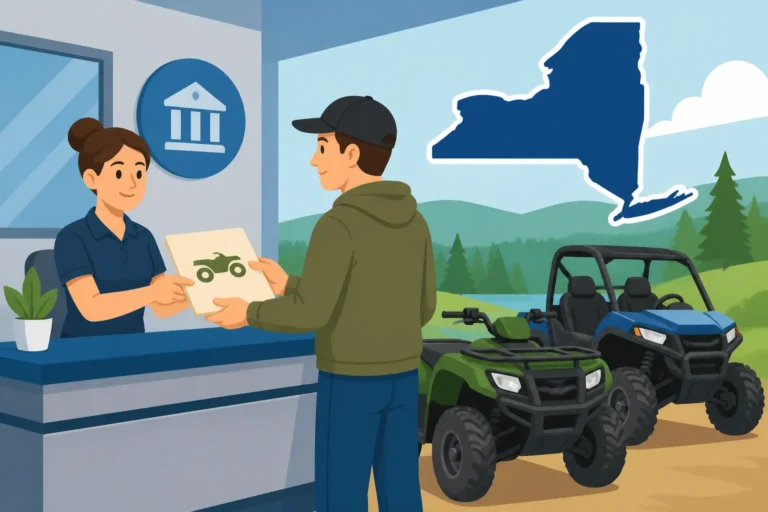
The New York ATV plate fee is assessed and paid at the very first point of registration for your machine. This happens when you visit a New York Department of Motor Vehicles office to complete the initial paperwork to get your ATV registered. Whether you're buying a brand-new machine from a dealer or a used one from a private seller, this is the moment when you'll pay for the plate. [Registering an ATV in New York]
It's typically listed as a separate line item on your receipt, distinct from the registration fee itself, but you'll hand over one lump sum for all applicable charges. This upfront payment simplifies the process, ensuring that once your registration is approved, your plate can be issued without further delay or separate transactions. Be prepared to pay this, along with your registration fee and any applicable sales tax, when you first get your machine set up.
No Annual Repeat – Just the Once
This is where the New York ATV plate fee differs significantly from your annual registration fee. Once you've paid the plate fee and received your physical plate, you generally do not pay it again in subsequent years. Your yearly renewals will only involve the registration fee itself, along with any processing charges. The plate is yours to keep and use as long as it remains legible and attached to your registered ATV.
This "one-and-done" aspect of the plate fee helps keep your long-term ownership costs predictable. You won't have to factor in a new plate purchase into your annual budget. It's a small upfront investment that secures your machine's physical identification for years to come. [What a New York Renewal Costs]
Payment Methods at the DMV
When you head to the DMV to register your ATV and pay the plate fee, you'll find that most offices offer a variety of payment methods to make the process convenient. Typically, you can pay with cash, a personal check, or a money order. Many, if not all, New York DMV locations also accept major credit and debit cards, though it's always a good idea to confirm with your specific office beforehand, just in case there are any local variations or temporary system issues.
Be sure to have your payment method ready along with all your required documentation, such as proof of ownership (like a bill of sale or Manufacturer's Statement of Origin), proof of insurance, and your identification. Having everything in order will help ensure a smooth transaction and get you on the trails faster. [New York ATV Registration Paperwork]
The Difference Between Plate Fee and Registration Costs
It's common for new ATV owners to conflate the plate fee and the registration cost, or to assume they're the same thing. However, understanding the distinction is important for budgeting and knowing what to expect each year. They serve different but complementary purposes in New York's ATV regulations.
Registration: The Yearly Trail Pass
Think of your ATV registration in New York as your annual permission slip to operate your machine on designated trails and lands where ATVs are permitted. It's a recurring cost that you pay every year to keep your right to ride active. The funds collected from registration fees go towards a variety of initiatives, including maintaining trails, funding safety programs, and administrative oversight. [New York's Annual ATV Registration]
When you pay your annual registration fee, you're not getting a new physical plate. Instead, you'll typically receive a small validation decal or sticker that you'll affix to your existing plate. This decal has the current year on it, visually indicating that your registration is up to date and valid for the current season. If you forget to renew, or let your registration lapse, you could face penalties for riding an unregistered machine. [Riding on an Expired Registration]
Plate Fee: Your Machine's Permanent ID
In contrast, the plate fee is a one-time charge specifically for the physical license plate itself. This plate is your ATV's unique, permanent identification number, much like a car's license plate. It doesn't change from year to year (unless you need a replacement), and you don't pay for it annually. It's the physical identifier that corresponds to your registration.
The plate itself doesn't expire. What expires is the registration that the plate represents. The plate is the constant, and the validation decal or sticker from your annual registration is the variable that confirms its current legal status. This clear distinction helps explain why you see two separate line items on your initial registration bill. [The One-Time Plate Fee in New York]
Why Both Fees Exist for Your ATV
New York, like many other states, has both a plate fee and an annual registration fee for ATVs for logical reasons. The plate fee ensures that every registered ATV has a durable, standardized physical identifier that can be easily seen and recorded by law enforcement, trail officials, and other riders. This physical plate is crucial for identification in case of an accident, theft, or regulatory check.
The annual registration fee, on the other hand, ensures that the state has an up-to-date record of active ATVs and their owners. This allows for effective administration of ATV laws, collection of funds for trail maintenance and safety initiatives, and tracking of ownership transfers. By separating these two fees, New York can cover the distinct costs associated with both the physical identification marker and the ongoing administrative and programmatic support for ATV riding. Without both, the system would be less efficient and harder to enforce.
What Happens If You Need a Replacement Plate?
Life on the trails can be rough, and sometimes, even the most carefully mounted ATV plate can meet an unfortunate end. Whether it's a deep mud hole, a stray tree branch, or even something more malicious, you might find yourself needing a new plate. Don't worry, New York has a process for that, and it doesn't involve paying the full initial plate fee again.
Lost, Stolen, or Damaged Plates
It's a common scenario: you're out on the trails, enjoying a fantastic ride, only to get back to your truck and realize your ATV plate is gone. Maybe it snapped off in a particularly gnarly section, or perhaps it was damaged beyond recognition in a minor mishap. In rarer, more concerning cases, a plate might even be stolen. Whatever the reason, riding without a clearly visible and legible plate can lead to fines and other issues, so addressing a missing or damaged plate quickly is important. [Replacing a Lost New York ATV Plate]
If your plate is lost or stolen, it's a good practice to file a police report, especially for stolen plates, as this can help protect you if the plate is misused. Regardless, the next step is contacting the New York DMV to get a replacement. Don't just try to create your own makeshift plate; it won't be considered valid.
The Cost of a New Plate
When you need a replacement ATV plate in New York, you typically won't pay the same initial "one-time" plate fee you did when you first registered. Instead, there's usually a smaller, specific fee for a replacement plate. This fee covers the administrative cost and the production of the new plate, but it's not the same as the full initial charge which also covered the initial setup of your registration.
The exact amount for a replacement plate can vary, so it's best to check the current fee schedule on the New York DMV website or call your local office. It's a nominal charge, designed to cover the cost of the replacement without being burdensome. You'll still need to ensure your registration is current when you request a new plate. [New York ATV Plate Replacement Cost]
How to Order a Replacement
Ordering a replacement ATV plate in New York is generally a straightforward process. You'll usually need to visit a New York DMV office in person to complete the necessary paperwork. You'll likely fill out a form (such as the MV-15, Application for Replacement Plates, Stickers, or Tags, though always confirm the current form with the DMV) and pay the replacement fee.
It's wise to bring your current ATV registration document, your driver's license, and any police report if the plate was stolen, to streamline the process. They'll verify your ownership and registration status before issuing a new plate. Sometimes, they can issue a new plate on the spot, or it may be mailed to you, depending on the office and current inventory. Either way, getting this sorted quickly will ensure you can continue to enjoy your ATV legally and without worry. [Ordering a Replacement New York Plate]
Common Questions About the New York ATV Plate Fee
Navigating the nuances of ATV registration and fees can sometimes feel like trying to find your way through a new trail system without a map. There are always a few common questions that pop up, especially regarding specific charges like the plate fee. Let's tackle some of the most frequent ones to clear up any lingering confusion.
Is the Plate Fee Prorated?
This is a really common question, especially for those who register their ATV partway through the year. The simple answer is no, the New York ATV plate fee is not prorated. Because it's a one-time charge for a physical item—the plate itself—there's no mechanism to reduce its cost based on how much of the year is left. You pay the full, standard plate fee regardless of whether you register your ATV in September or April.
The concept of proration usually applies to recurring annual fees, like vehicle registration or insurance premiums, where the cost is calculated for a specific period of time. Since the plate is a permanent piece of identification (until lost or damaged), its cost is fixed. So, whether you're registering in June and it's expiring in August, or you're getting it done right after renewal season, the plate fee remains the same. [Why the Fee Is Not Prorated]
Does the Plate Fee Apply to All Machines?
Generally speaking, if an ATV needs to be registered in New York, it will also incur the plate fee. This applies to most ATVs used for recreation on public lands or trails. However, there are specific exemptions for registration that could indirectly mean no plate fee is assessed. For example, if a machine is solely used for agricultural purposes on private land and never leaves that land, it might be exempt from registration. [The Agricultural Exemption in New York]
Similarly, ATVs used exclusively for snow removal on private property might not require registration. If a machine falls into one of these exempt categories and does not need to be registered with the DMV, then by extension, you wouldn't be paying a plate fee for it, because no plate would be issued. It's crucial to understand that these exemptions are very specific and narrow, and most recreational riders will indeed need to register their ATVs and pay the associated plate fee. [Machines New York Exempts From Registration]
What If I Buy a Used ATV?
Buying a used ATV in New York adds another layer to the plate fee question. When you purchase a used machine that was already registered in New York by a previous owner, that ATV will likely already have a physical New York ATV plate. In this scenario, you typically will not pay a new plate fee when you transfer the registration into your name. The existing plate stays with the machine, and you simply update the registration to reflect the new ownership.
However, if you buy a used ATV that was never registered in New York (perhaps it came from a state without an ATV registration program, or it was always used on private land by the previous owner), then you will pay the initial plate fee as part of your first-time registration in New York. The same applies if the machine was registered but the previous owner removed or lost the plate, and you need a new one issued. Always verify the machine's registration history and the presence of a valid plate when buying used. [Buying a Used ATV in New York]
Here's a quick breakdown to help keep the initial and ongoing costs clear:
| Cost Item | What it Covers | When You Pay It | Is It Annual? |
|---|---|---|---|
| ATV Plate Fee | The physical license plate for your ATV | Once, at initial registration | No |
| ATV Registration Fee | Annual permission to operate, administrative costs | Annually, by August 31st | Yes |
| Replacement Plate Fee | New physical plate if original is lost/damaged | As needed, if a replacement is required | No |
| Sales Tax | Tax on the purchase price of the ATV | Once, at the time of purchase/initial registration | No |
Remember, understanding these distinctions will help you budget effectively and ensure you're always in compliance with New York's ATV regulations.
Disclaimer
This article is for general informational purposes only and does not constitute professional advice. Laws, prices and regulations vary by location and change over time. Consult a qualified professional for guidance on your specific situation.