New York’s 70-Inch Width Limit
It's incredibly frustrating when you invest in a new all-terrain vehicle, only to discover it doesn't meet the state's very specific dimensions for legal registration and trail access. Many riders in New York buy a machine, especially a wider side-by-side, without realizing there's a critical 70-inch width limit that can dictate where and how you can ride. This guide will meticulously break down New York's 70-inch ATV width limit, explaining what it means for your machine, how it impacts registration, and what you need to know as a rider or potential buyer to avoid costly mistakes.
Understanding New York's ATV Width Limit
New York State law has a very particular definition of what constitutes an All-Terrain Vehicle (ATV) for registration purposes, and a key component of that definition is its physical dimensions. This isn't just a suggestion; it's a hard rule that impacts everything from how you prove ownership to where you can legally ride. Getting this wrong can mean owning a machine you can barely use, so it's vital to grasp the nuances of this limit.
What the 70-Inch Rule Means
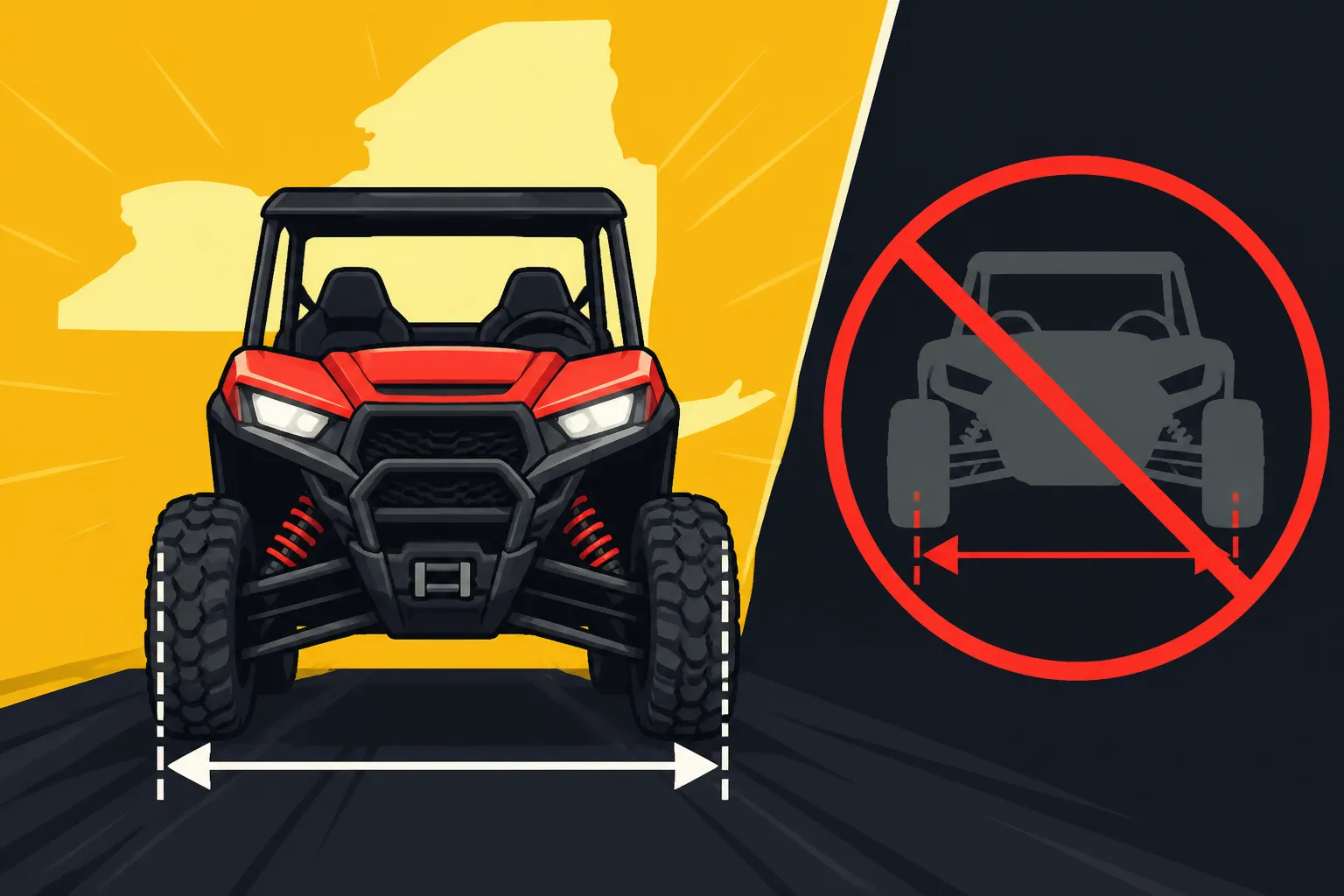
At its core, New York Vehicle and Traffic Law (VTL) Article 48-C defines an ATV, in part, as a "self-propelled vehicle which is manufactured for use off the road, having a gross weight of less than one thousand pounds, equipped with four low pressure tires and a seat designed to be straddled by the operator and having a width of seventy inches or less." That last part is the kicker. Your machine, from its widest point (which is almost always across the outside edges of the tires), cannot exceed seventy inches. If it does, by even an inch, it simply doesn't fit the state's legal definition of an ATV for registration purposes. This means it cannot be registered as an ATV in New York, which in turn means it cannot be ridden on any designated ATV trails or public lands that require state registration. It's a pretty absolute barrier that catches many new owners by surprise.
Think about it this way: the state isn't just being arbitrary. This limit is often tied to the historical design of ATV trails, many of which were originally cut for narrower machines or even snowmobiles. A wider machine can cause excessive wear, damage trail infrastructure, or simply not fit through gates, bridges, or tight turns. It's a critical dimension that ensures safety and preserves the integrity of the trail systems we all enjoy.
Why This Specific Number?
The 70-inch limit isn't pulled out of thin air; it stems from the traditional design and use of ATVs as they evolved over decades. When ATV laws were initially drafted and defined, the vast majority of machines on the market fit within these dimensions. Early ATVs, often called "quads," were generally designed to be nimble, single-rider vehicles with a relatively narrow footprint, allowing them to navigate wooded trails, tight turns, and challenging terrain without excessive difficulty or impact. The width and [New York's 1,000-Pound Weight Limit] were key characteristics of these machines.
This specific number helps differentiate ATVs from larger, heavier, and wider utility task vehicles (UTVs) or side-by-sides (SxS) that have become incredibly popular in recent years. These newer machines often offer seating for multiple passengers, larger cargo capacities, and wider stances for stability, but they simply don't align with the older, narrower ATV definition. The 70-inch rule acts as a gatekeeper, preventing vehicles that exceed these historical parameters from being classified and registered in the same category as traditional ATVs. It's a legislative attempt to maintain a clear distinction, even as vehicle technology and design evolve.
How to Measure Your ATV's Width
Measuring your ATV's width accurately is absolutely crucial, especially if you're looking at a machine that seems to be on the border. You can't just eyeball it or go by what a casual salesperson tells you. The New York DMV, and any officer checking your machine roadside, will be looking for the absolute widest point of your machine.
Here's how to do it correctly:
- Park on Level Ground: Ensure your ATV is on a flat, level surface. This prevents any skewing of your measurement.
- Straighten the Wheels: Make sure your front wheels are pointed straight ahead, not turned.
- Measure Outside to Outside: Take a sturdy tape measure and stretch it across the widest part of your vehicle. For most ATVs and UTVs, this will be the outermost edge of the tires, specifically the bulges on the sidewalls of the front or rear tires, whichever is wider. Do not measure from the edge of the rim, or from the fender flares, unless they are the widest point. It's the maximum dimension.
- Consider Accessories: Any aftermarket accessories like wider offset wheels, tire spacers, or even certain fender extensions could push your machine over the limit. Measure with all accessories that will be on the machine when you intend to ride it.
Many riders mistakenly measure from tire tread to tire tread, or even from the outside of the A-arms, but this often gives an inaccurate, narrower reading. The true measurement includes the full width of the tire's bulge. If you're unsure, have a second person double-check your measurement. It's much better to be certain before you even consider purchasing a machine that might fall foul of the rule.
The Impact on Side-by-Sides and Wider ATVs
The rise in popularity of side-by-sides has brought this 70-inch width limit into sharper focus, as many of these machines simply do not fit New York's definition of an ATV. This creates a significant challenge for owners and potential buyers who want to legally ride their wider machines on public lands and designated trails.
Why Most Side-by-Sides Cannot Be Registered in New York
The primary reason [Why Most Side-by-Sides Cannot Be Registered in New York] as ATVs is quite simple: their width. Manufacturers design side-by-sides for stability, comfort, and utility, which often means a wider stance. Many popular models of UTVs/SxS machines, even entry-level ones, exceed the 70-inch limit right off the showroom floor. Common widths for side-by-sides can range from 60 inches all the way up to 72 or even 80 inches for high-performance or utility models.
The DMV isn't going to make an exception just because your vehicle looks like an ATV but is a few inches wider. If it doesn't fit the statutory definition, it cannot be registered as an ATV. This can lead to significant disappointment for buyers who envision riding their new side-by-side on their favorite trails, only to find out it's legally impossible. This issue is compounded by the fact that New York doesn't have a separate registration category for UTVs, unlike many other states. Without a specific legal framework, these wider machines are essentially in a registration limbo, unable to be registered as either an ATV or a road-legal vehicle (as they lack many street-legal components). This is a stark reality that every prospective side-by-side owner in New York must face. For a deeper dive, consider [Why a Modern Side-by-Side Fails the Test].
Consequences of Owning an Over-Width Machine
The consequences of owning an over-width machine that cannot be registered as an ATV in New York are quite severe and can greatly limit your ability to enjoy your purchase. First and foremost, you cannot legally operate it on any public lands, designated ATV trails, or public thoroughfares (even to cross them) that require an ATV registration. This means no riding on Lewis County's extensive trail system, no exploring the Tug Hill Plateau, and no access to any of the club trails that rely on state registration. Your riding opportunities are effectively confined to private property where you have explicit permission.
Furthermore, riding an unregistered machine where registration is required can lead to significant fines and penalties. If you're stopped by a law enforcement officer while operating an over-width, unregistered machine on a public trail or road, you could face hefty tickets. Beyond the immediate legal trouble, there's the issue of liability. Operating an unregistered vehicle could complicate insurance claims in the event of an accident, potentially leaving you exposed to significant financial burdens. [What a New York Officer Checks Roadside] often includes looking for a valid registration sticker and ensuring the machine meets the definition. It's a risk simply not worth taking.
Common Misconceptions About Width and Registration
There are several persistent myths and misconceptions circulating among riders regarding the 70-inch width limit and ATV registration in New York. Let's clear some of them up:
- "My dealer said it would be fine." While most reputable dealers are knowledgeable, some might inadvertently misinform or simply not be aware of the exact intricacies of New York's VTL. Always verify the specifications yourself and understand the law. Don't rely solely on verbal assurances.
- "I can just register it as something else." New York does not have a "UTV" registration class. If it doesn't fit the ATV definition, it doesn't fit into another common vehicle class for off-road use either. You can't register it as a car, truck, or even a motorcycle. This lack of an alternative category is precisely why wider UTVs face such hurdles.
- "I only ride on private land, so it doesn't matter." While you don't need state registration to ride on your own private property, if you ever plan to transport your machine to a friend's property, a club trail, or any designated riding area that requires registration, you'll be out of luck. Also, many private club trails still require state registration as part of their liability agreements and compliance.
- "Everyone else is doing it." Just because you see other wider machines on trails doesn't mean they are legally registered or that those riders aren't risking significant fines. Following bad examples won't protect you from the law.
Understanding these points is critical. The 70-inch rule is not flexible, and it's a defining factor in legal ATV operation in New York.
Registration and the 70-Inch Limit
The registration process in New York is where the rubber meets the road (or, more accurately, where the tire meets the tape measure) for the 70-inch width limit. It’s during this crucial step that the state determines whether your machine legally qualifies as an ATV. This isn't a formality; it's a fundamental part of the process.
The Registration Process and Width Verification
When you go to register an ATV in New York, whether it's new or used, the DMV has a process to ensure compliance with the state's definition. This typically involves submitting specific paperwork, including proof of ownership (like a bill of sale or manufacturer's certificate of origin) and a completed registration application form. While they don't always physically measure every machine, they rely on the information provided, and there are ways they can verify.
For a new machine, the manufacturer's certificate of origin (MCO or MSO) will list the vehicle's specifications, including its width. The dealer is also required to attest that the machine meets the ATV definition. For a used machine, especially one that might be questionable in terms of width, the DMV clerk might ask questions or even request a physical verification. Ultimately, you, the applicant, are affirming that your machine meets all the legal requirements. Providing false information, even unknowingly, can lead to issues down the line. It's your responsibility to ensure your machine adheres to the rules before you even begin to fill out the [New York ATV Registration Paperwork].
What Happens if Your Machine Exceeds 70 Inches
If your machine exceeds the 70-inch width limit, you simply cannot register it as an ATV in New York. The DMV will reject your application, plain and simple. There are no waivers, no special permits for slightly wider machines, and no alternative "wide ATV" or "UTV" registration class. This is a hard stop.
This rejection means you'll own a vehicle that cannot be legally operated on any public ATV trails or roads in New York. Your options become extremely limited:
- Private Land Only: You can only ride your machine on private property where you have the owner's explicit permission. This is a very restrictive scenario for many riders who dream of exploring New York's vast trail networks.
- Sell Out-of-State: Your best option might be to sell the machine to someone in a state with more permissive ATV or UTV registration laws. This can be a hassle and might mean taking a loss, but it could be the only way to avoid owning a very expensive paperweight.
- Wait for Legislative Change: You could hold onto it and hope that New York's laws change to include a UTV registration category. However, as we'll discuss, legislative processes are slow, and there's no guarantee of success.
The takeaway here is stark: measure twice, buy once. Ensure your potential purchase fits the 70-inch rule before signing any papers.
Exceptions and Exemptions
While the 70-inch rule is strict for standard ATV registration, New York does recognize a few specific exemptions for certain types of operations. These are not broad exemptions allowing wider recreational use, but rather narrow allowances for machines used in very particular contexts.
- Agricultural Exemption: Machines used exclusively for agricultural purposes on farms are often exempt from standard ATV registration requirements. This means a wider UTV used solely for hauling feed, checking fences, or plowing fields on a working farm may not need to be registered as an ATV. However, if that same machine is ever taken off the farm for recreational riding, it would immediately fall under the regular registration rules and the width limit would apply. It’s not a free pass for recreational use. [The Agricultural Exemption in New York] clarifies this.
- Snow Removal on Private Property: Similarly, a wider UTV used strictly for [Snow Removal on Private Property] might not need to be registered. Again, this is tied to specific, limited-scope work on private land, not recreational trail riding.
- Government/Municipal Use: Vehicles owned and operated by governmental agencies for official purposes (e.g., parks departments, emergency services) may have different rules or be exempt from certain aspects of standard ATV registration, including the width limit, for their specific operational needs.
It's crucial to understand that these are specific-use exemptions and do not open the door for recreational riding of over-width machines. For the vast majority of New York ATV enthusiasts, the 70-inch width limit remains a hard and fast rule.
Practical Advice for Riders and Buyers
Navigating New York's ATV width limit can be tricky, especially for newcomers or those looking to upgrade their machines. Making an informed decision before you commit to a purchase is paramount to avoid disappointment and financial loss.
Buying a Machine You Can Only Ride at Home
One of the most disheartening scenarios is purchasing a beautiful, powerful side-by-side or wider ATV only to realize you can only ride it in your backyard or on a very limited piece of private land. This is the reality for many who overlook the 70-inch rule. Imagine the excitement of buying a new machine, only to find you can't get a plate for it at the DMV, meaning no access to the incredible trails in Lewis County or Oswego. You've essentially bought a very expensive toy with severely restricted play areas.
Before you even start shopping, consider your primary intended use. If hitting New York's extensive trail systems, joining club rides, or exploring state-designated areas is on your agenda, then the 70-inch width limit must be your first filter. Don't fall in love with a machine until you've confirmed its dimensions against the legal requirement. A simple measurement in the showroom (or by checking the manufacturer's specs very carefully) can save you a world of heartache. For more on this, consider [Buying a Machine You Can Only Ride at Home].
Reselling a Machine You Cannot Register
If you find yourself in the unenviable position of owning an over-width machine that you can't register in New York, reselling it can be a challenge. You can't honestly market it to another New York resident as a "trail-ready ATV" unless they too only plan to ride on private land. This immediately shrinks your potential buyer pool and often forces you to sell at a discount.
Here are a few tips if you're in this situation:
- Be Transparent: Always be upfront with potential buyers about the machine's width and its registration status in New York. Honesty is crucial to avoid future legal issues or disputes. You might even want to use a service like LawDepot to draft a clear bill of sale that outlines these specifics.
- Target Out-of-State Buyers: Your best bet might be to market the machine to buyers in neighboring states like Pennsylvania or Vermont, which have different (often more permissive) UTV registration laws. This might involve shipping or meeting a buyer across state lines.
- Emphasize Private Land Use: If selling within New York, focus on buyers who explicitly state their intention to use the machine solely on private property for work or recreation, making it clear it cannot be registered for trail use.
It's a tough spot to be in, and it underscores the importance of doing your homework before the initial purchase. The specific post [Reselling a Machine You Cannot Register] has more insights.
What a Dealer Should Tell You About Width
A reputable ATV dealer in New York should be well-versed in the state's registration laws, including the 70-inch width limit. When you're looking at machines, especially side-by-sides, they should proactively inform you if a particular model cannot be registered as an ATV in New York due to its dimensions. They should clearly explain the implications, such as being restricted to private land use.
Unfortunately, not all dealers are equally diligent, or a salesperson might simply be less informed. It's not uncommon for buyers to report that they were not fully informed about the width restrictions until after the purchase. This puts the onus back on you, the buyer, to ask the right questions and verify the information.
Here's what you should ask:
- "What is the exact overall width of this machine, measured from the widest point of the tires?"
- "Can this specific model be registered as an ATV in New York State?"
- "If it exceeds 70 inches, what are my legal options for riding it in New York?"
If a dealer seems vague or dismissive, that should be a red flag. A knowledgeable dealer will be able to show you the manufacturer's specifications and confirm compliance. For further guidance on what to expect, refer to [What a Dealer Should Tell You About Width]. Remember, the final responsibility lies with you to understand the regulations before you buy.
Looking Ahead: Potential Changes and Bills
The static nature of New York's ATV laws, particularly the 70-inch width limit, often feels outdated in the face of evolving vehicle technology. Many riders and industry advocates are pushing for changes that would better accommodate modern side-by-sides and other wider off-road vehicles.
A New York Bill to Widen the ATV Definition
There have been ongoing legislative efforts in New York to update the definition of an ATV or to create a new category for Utility Task Vehicles (UTVs). These proposed bills typically aim to increase the maximum allowable width and/or weight for off-highway vehicles, bringing New York more in line with other states that have broader definitions or specific UTV registration classes. A common proposal seen in various legislative sessions is to increase the width limit to 80 inches and the weight limit to 2,000 pounds, which would open the door for many popular side-by-side models to be legally registered and ridden on designated trails.
The impetus behind these bills is clear: to expand recreational opportunities for a growing segment of off-road enthusiasts and to boost local economies in rural areas that could benefit from increased tourism. However, such legislation often faces hurdles, including concerns from environmental groups about trail impact, safety concerns related to larger vehicles, and the complexities of amending existing vehicle and traffic laws. These discussions are dynamic, and staying informed about proposed changes is key for anyone interested in wider machines. For more details, explore [A New York Bill to Widen the ATV Definition].
Why New York's UTV Bills Are Not Law Yet
Despite the clear demand from the riding community and persistent legislative efforts, [Why New York's UTV Bills Are Not Law Yet] is a complex issue. The legislative process in New York can be slow and challenging, especially for bills that involve significant changes to vehicle classifications and potential environmental impacts.
Several factors contribute to the delay:
- Opposition from Environmental Groups: Concerns about potential increased trail degradation, erosion, and noise in sensitive areas are frequently raised by environmental organizations, who often lobby against expanding ATV/UTV access.
- Safety Concerns: Some legislators and safety advocates express concerns about allowing larger, heavier, and potentially faster vehicles on trails that were designed for traditional ATVs, citing risks to riders and other trail users.
- Interagency Coordination: Amending vehicle laws requires input and agreement from various state agencies, including the Department of Environmental Conservation (DEC), Office of Parks, Recreation and Historic Preservation (OPRHP), and the Department of Motor Vehicles (DMV). Coordinating these diverse interests is a monumental task.
- Prioritization: In a busy legislative session, bills related to off-road vehicles may not be seen as top priority compared to other pressing issues, leading to them languishing in committees or failing to make it to a floor vote.
- Lack of Consensus: Even within the off-road community, there can be differing opinions on the specifics of proposed legislation, making it harder to present a unified front to lawmakers.
As a result, while bills are introduced and debated, they often fail to gain enough traction to pass both houses of the legislature and be signed into law by the governor. This means the existing 70-inch rule continues to govern.
The Future of Wider Machines in New York
What does all this mean for the future of wider machines, like side-by-sides, in New York? The situation remains in flux, but there's a strong and persistent push for change. It's likely that efforts to update New York's VTL will continue, reflecting the growing popularity of UTVs across the country.
However, riders should not hold their breath for immediate changes. Legislative processes move slowly, and even if a bill passes, implementation can take time. For now, the 70-inch width limit (and the 1,000-pound weight limit) for ATVs is the law of the land.
This means that current and prospective owners of wider machines must continue to either ride exclusively on private land or consider vehicles that comply with the current New York ATV definition. Those who are passionate about seeing change should consider getting involved with local ATV clubs and advocacy groups, as these organizations play a vital role in lobbying legislators and educating the public. Their collective voice is often the most effective way to push for meaningful legislative reform. Until then, strict adherence to existing laws is the only way to avoid issues.
| Feature | Traditional ATV (Quad) | Side-by-Side (UTV/SxS) |
|---|---|---|
| Typical Width | 45-50 inches (many under 70") | 50-80+ inches (many over 70") |
| Seating | Straddle seat, 1-2 riders (tandem) | Bench/bucket seats, 2-6 riders |
| Steering | Handlebars | Steering wheel |
| Weight | Often under 1,000 lbs | Often over 1,000 lbs |
| Primary Use | Recreation, sport, light utility | Recreation, utility, hunting, work |
| NY ATV Reg. | Generally qualifies (if under 70"/1000lb) | Generally does not qualify |
| Trail Access | Legal on designated NY trails | Restricted to private land in NY |
Disclaimer
This article is for general informational purposes only and does not constitute professional advice. Laws, prices and regulations vary by location and change over time. Consult a qualified professional for guidance on your specific situation.